
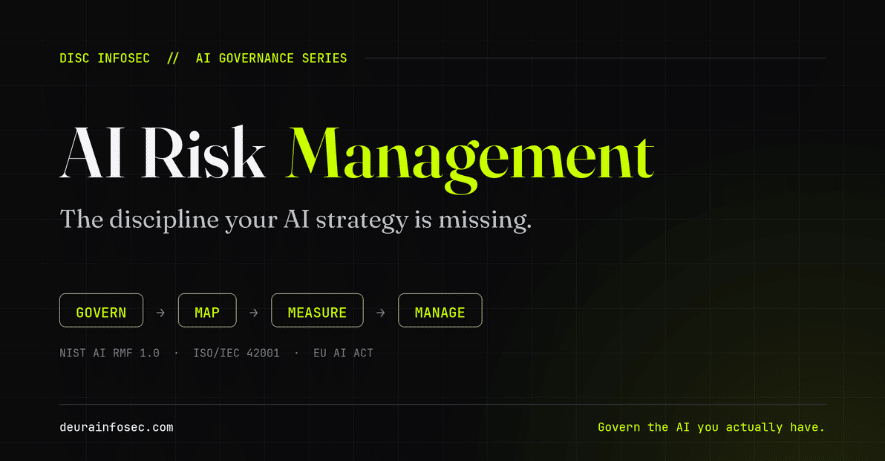
AI Risk Management: The Discipline Your AI Strategy is Missing
Most organizations discovered last year just how much AI they were already running. A customer support chatbot here. Copilot in the IDE. Einstein scoring leads in the CRM. A fraud model someone built in 2021 that nobody owns anymore. When I run AI inventories for clients, the number of AI systems they think they have and the number they actually have are never the same — and the gap is where the risk lives.
That gap is exactly what AI risk management exists to close.
What Is AI Risk Management?
AI risk management is the discipline of identifying, evaluating, and treating the risks that AI systems introduce across their entire lifecycle — not just the security risks, but the fairness, robustness, transparency, privacy, and accountability risks that traditional security programs were never designed to catch.
Here’s the distinction that matters: prompt injection and jailbreaks are the security slice of AI risk. They get the headlines. But the risks that actually put organizations in front of regulators look different. A hiring model that screens out candidates from a protected class. A credit model that’s 95% accurate overall but 60% accurate on the demographic it impacts most. A production LLM that hallucinates a policy your company never had — to a customer, in writing. A model that drifted quietly for eighteen months because nobody was watching, and no one could explain its decisions when a regulator asked.
None of those are breaches. All of them are business-ending risks in the wrong context.
The most widely adopted framework for managing this is the NIST AI Risk Management Framework (AI RMF 1.0). It’s voluntary, but it has become the lingua franca of AI risk — cited in contracts, RFPs, executive orders, and increasingly in customer security questionnaires. If you speak NIST CSF, the shape will feel familiar. The AI RMF organizes the work into four functions:
GOVERN is the persistent layer: written AI principles, a named AI risk owner, approval gates for high-impact deployments, and — critically — someone with the authority to stop a deployment. If nobody in your organization can say “no” to an AI system, you don’t have governance. You have hope.
MAP establishes context per system: what does this AI actually do, who does it affect, what does “broken” look like, and — the question I find most clarifying in practice — is the decision reversible? A spam filter making a wrong call is an annoyance. A mortgage denial is not.
MEASURE is where the engineering happens: accuracy evaluated on data slices rather than aggregates, fairness metrics (demographic parity, equalized odds, calibration — which conflict, and choosing among them is a governance decision, not a technical one), robustness against adversarial inputs and distribution shift, and explainability. A model you cannot explain is a model you cannot defend in a regulatory inquiry.
MANAGE treats what MEASURE surfaces: retrieval-augmented generation for hallucination, monitoring and scheduled retraining for drift, human-in-the-loop for high-stakes decisions, vendor risk reviews for third-party models — and a decommissioning plan for every model, because an unowned production model is the AI equivalent of an unmaintained dependency.
Layer the regulatory landscape on top — the EU AI Act with its risk tiers and phased enforcement, the Colorado AI Act, NYC’s bias audit law for automated hiring tools, FTC and EEOC enforcement authority — and the picture is clear: AI risk management is no longer optional for any organization deploying AI in consequential decisions.
My Perspective: What a Proper AI Risk Management Program Actually Buys You
I led the ISO 42001 AI Management System implementation at ShareVault, a virtual data room platform serving M&A and financial services clients — an environment where the data is deal-sensitive and the tolerance for AI failure is effectively zero. Taking that program through a successful Stage 2 audit taught me what separates AI risk management as a paper exercise from AI risk management as a working system. Here’s what a proper program delivers:
It converts unknown risk into managed risk. The inventory step alone is worth the engagement. You cannot govern what you haven’t cataloged, and shadow AI — the tools employees adopted without review — is present in every organization I’ve assessed. Visibility precedes control, always.
It prevents the expensive failures, not just the embarrassing ones. Biased outcomes in hiring or credit carry regulatory penalties, litigation exposure, and remediation costs that dwarf the price of evaluating the model before deployment. Fairness testing during MEASURE costs days. A disparate-impact claim costs years.
It turns compliance from a scramble into a byproduct. Organizations with a working AI RMF-aligned program aren’t rebuilding from scratch when the EU AI Act’s high-risk requirements apply to them, or when a state law lands, or when an enterprise customer’s due-diligence questionnaire asks how they govern AI. The documentation, the impact assessments, the human oversight mechanisms — they already exist. Frameworks like NIST AI RMF and ISO 42001 map cleanly onto each other and onto the regulations. Build once, answer everywhere.
It becomes a sales asset. This is the part most organizations underestimate. In B2B — especially financial services — your customers’ risk teams are now asking about your AI. Being able to hand over an AI system inventory, model documentation, and evidence of independent audit doesn’t just pass procurement. It shortens sales cycles. At ShareVault, ISO 42001 certification became a differentiator precisely because the market is full of AI claims and short on AI evidence.
It lets you move faster, not slower. The counterintuitive one. Teams without governance hesitate on every AI deployment because nobody knows what’s acceptable. Teams with clear approval gates — rigorous review for high-impact systems, lightweight paths for low-impact ones — ship with confidence. Good governance is a throttle, not a brake. Overengineering the process kills it; right-sizing it accelerates everything.
The organizations getting AI risk management right in 2026 aren’t the ones with the thickest policy binders. They’re the ones who treated it as an operating discipline: inventory what you have, understand what it affects, measure what matters, treat what you find, and build the governance layer that keeps it working after the consultants leave.
Leadership must treat regulatory security, privacy & AI compliance as a strategic risk management priority. Noncompliance can lead to financial penalties, litigation exposure, reputational damage, and loss of customer trust. Top management should ensure that security, privacy & AI compliance risks are incorporated into enterprise risk assessments, evaluated using risk-based decision-making frameworks, reported regularly to executive leadership and governing bodies, and addressed through mitigation strategies aligned with organizational risk tolerance.
The ones getting it wrong will find out the way organizations always find out — in production, in public, or in front of a regulator.
HD is Principal Consultant at DISC InfoSec, a boutique cybersecurity and AI governance consultancy. He holds CISSP, CISM, AICP, ISO 27001 Lead Implementer, and ISO 42001 credentials, and led the ISO 42001 AIMS implementation and internal audit at ShareVault through a successful Stage 2 certification audit.
If your organization is deploying AI and can’t yet answer “how do you govern it?” — let’s talk. Book a consultation: info@deurainfosec.com
AI Vulnerability Scorecard: Discover Your AI Attack Surface Before Attackers Do
Your Shadow AI Problem Has a Name-And Now It Has a Score
Most AI Security Tools Won’t Pass an Audit. Here’s a 15-Minute Way to Find Out.
InfoSec services | InfoSec books | Follow our blog | DISC llc is listed on The vCISO Directory | ISO 27k Chat bot | Comprehensive vCISO Services | ISMS Services | AIMS Services | Security Risk Assessment Services | Mergers and Acquisition Security
- You can’t put a human in the loop of a system that kills its agents every 3 minutes
- Human Oversight vs Human Control: Where the Human Sits in AI Execution
- A signed two-page policy beats a fifty-page draft. Every time…
- We have guardrails for that is not a control – Here’s the difference
- Point-in-time remediation is dead against a persistent adversary
DISC InfoSec blog | DISC InfoSec Site





