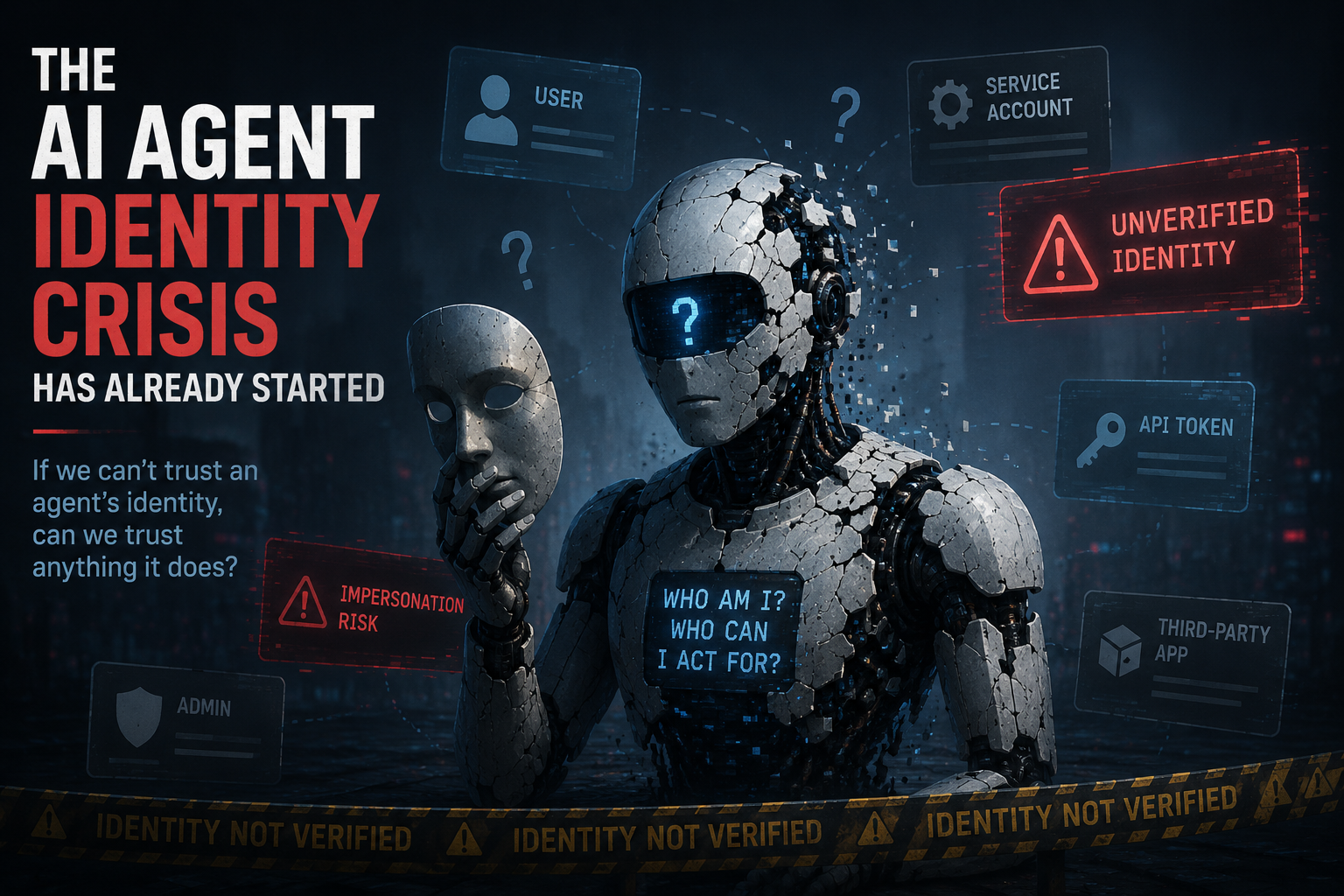
The AI Agent Identity Crisis Has Already Started
The enterprise AI security problem is no longer theoretical — it is already unfolding inside organizations at a much faster pace than governance teams can control. A recent discussion featuring Slavik Markovich and Rishi Bhargava from Descope highlighted a real-world example that perfectly captures the emerging risks of agentic AI adoption. In the scenario, a salesperson attended an AI workshop, built an autonomous AI agent with access to Gmail and calendar systems, and attempted to secure it using nothing more than a secret URL. There was no authentication, no authorization framework, and no oversight from security or governance teams.
What makes this situation alarming is not the technical simplicity of the mistake — it is how common these behaviors are becoming across enterprises. Employees are increasingly deploying AI agents, copilots, and automation workflows outside traditional governance processes, creating a new wave of shadow AI risks that most organizations are not prepared to manage. In many cases, these systems gain access to sensitive business applications, internal APIs, customer data, and operational workflows without proper security validation or executive visibility.
The larger problem is that most enterprise APIs were never designed for autonomous AI exposure. Traditional APIs assumed predictable software behavior and human-controlled interactions. AI agents fundamentally change that model. They can autonomously make decisions, chain actions together, interact with multiple systems, and execute tasks with varying degrees of unpredictability. This creates a massive governance and identity management challenge that existing security architectures were not built to handle.
One of the most important insights from the discussion is that AI agents require identity governance just like human users — but with far greater complexity. Unlike deterministic applications, AI agents are probabilistic actors. They may behave differently under changing prompts, context windows, external data inputs, or evolving objectives. Even when operating within assigned permissions, their actions may produce unintended consequences that traditional access control systems cannot easily predict or constrain.
This introduces a dangerous gap between innovation and governance. Organizations are racing to deploy AI-enabled productivity tools while security, risk, and compliance programs struggle to establish visibility and control. Many executives still view AI governance as a policy exercise, while the operational reality is that employees are already connecting AI agents directly into enterprise environments with privileged access to sensitive systems and data.
The implications extend far beyond cybersecurity. Poorly governed AI agents can create compliance violations, privacy exposure, intellectual property leakage, inaccurate automated decisions, and reputational damage. In regulated industries, these risks may also trigger legal and regulatory consequences if organizations cannot demonstrate accountability, auditability, and control over autonomous AI actions.
This is why AI governance must evolve beyond traditional security thinking. Organizations need identity-centric AI governance models that include agent authentication, fine-grained authorization, runtime monitoring, behavioral analytics, policy enforcement, human oversight, and continuous auditing of AI actions. AI agents should be treated as privileged digital identities — not as lightweight automation scripts operating outside governance boundaries.
Another major challenge is visibility. Many organizations currently lack the ability to discover where AI agents are deployed, what systems they access, what APIs they interact with, and what decisions they are making autonomously. Without continuous AI discovery and monitoring, security teams may not even realize these risks exist until a data exposure or operational incident occurs.
The rise of agentic AI is forcing enterprises to rethink identity and access management itself. Traditional IAM systems were designed for humans and static machine accounts. AI agents introduce a new category of dynamic, autonomous identities that require adaptive trust models, contextual access controls, and continuous governance throughout the AI lifecycle.
My perspective: The industry is underestimating how quickly AI agents are becoming operational actors inside enterprises. The conversation should no longer focus solely on “AI productivity” but on AI accountability, identity, and control. Organizations that fail to establish AI governance guardrails now may face significant security, compliance, and operational consequences later. The future of AI security will not be defined only by protecting models — it will be defined by governing autonomous AI identities operating across enterprise ecosystems.
#AI #AIGovernance #AISecurity #AgenticAI #CyberSecurity #IdentityManagement #APIsecurity #GenAI #ResponsibleAI #ZeroTrust #IAM #RiskManagement #AICompliance #ShadowAI #DISCInfoSec
A recent discussion featuring Slavik Markovich and Rishi Bhargava from Descope
The AI Governance Quick-Start: Defensible in 10 Days, Not 4 Quarters
DISC InfoSec is an active ISO 42001 implementer and PECB Authorized Training Partner specializing in AI governance for B2B SaaS and financial services organizations.
AI Vulnerability Scorecard: Discover Your AI Attack Surface Before Attackers Do
Your Shadow AI Problem Has a Name-And Now It Has a Score
Most AI Security Tools Won’t Pass an Audit. Here’s a 15-Minute Way to Find Out.

InfoSec services | InfoSec books | Follow our blog | DISC llc is listed on The vCISO Directory | ISO 27k Chat bot | Comprehensive vCISO Services | ISMS Services | AIMS Services | Security Risk Assessment Services | Mergers and Acquisition Security
- The cheapest security control you’ll ever implement is the component you decided not to build
- AI Handoffs: How Uncertainty Propagates—and How to Fix It
- The Security Risks Hiding in AI Agent Memory
- AI Log Retention: Why Every AI Log Doesn’t Deserve the Same Shelf Life
- The AI Agent Harness Is the New Security Boundary