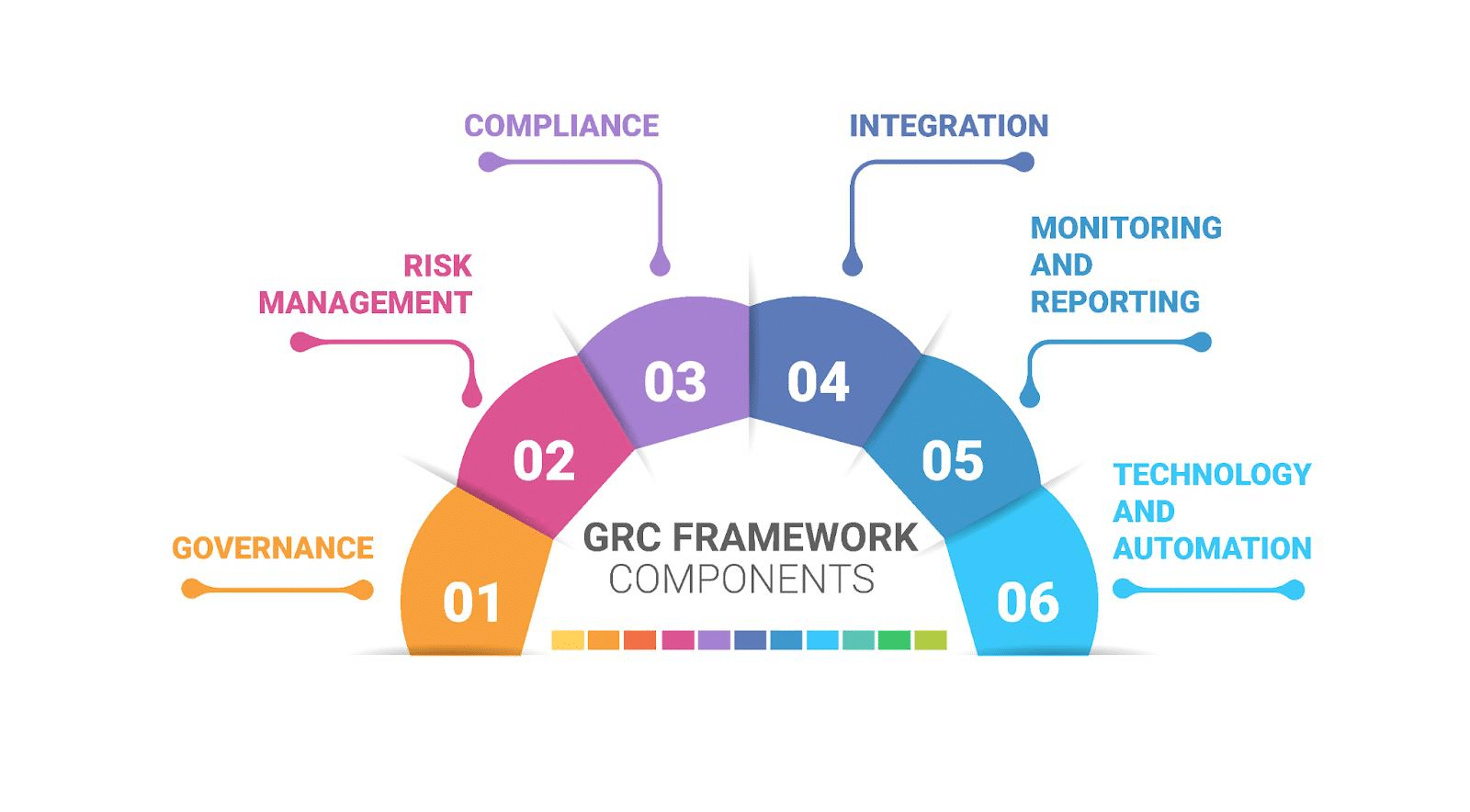
The Six Layers of a Mature GRC Operating Model
In today’s rapidly evolving business environment, Governance, Risk, and Compliance (GRC) can no longer operate as disconnected activities managed by separate teams and spreadsheets. Organizations facing cyber threats, AI risks, regulatory pressure, and operational complexity need a unified GRC operating model that connects governance, risk management, compliance, assurance, and technology into one coordinated discipline.
True GRC maturity comes from building a system where leadership oversight, accountability, controls, reporting, and automation work together to support better business decisions. Organizations that achieve this level of maturity move beyond “check-the-box compliance” and create resilient, measurable, and scalable governance programs.

1. Strategic Governance
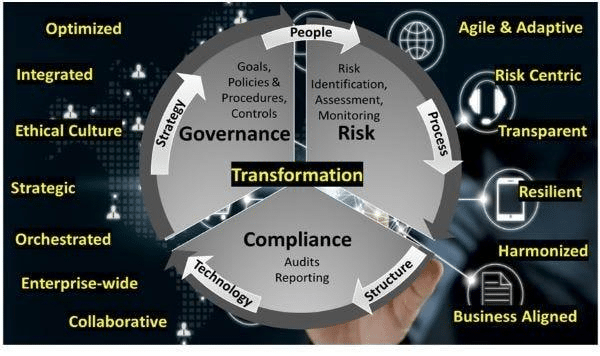
Every mature GRC program begins with strategic governance. This layer establishes executive accountability, corporate governance structures, board oversight, policies, and long-term planning.
Without strong governance, organizations struggle with fragmented ownership, inconsistent decision-making, and weak accountability. Leadership must define risk appetite, governance objectives, and operational priorities that align with business strategy.
Key elements include:
- Corporate governance
- Board oversight and accountability
- Policies and procedures
- Strategic planning
This layer ensures GRC is treated as a business enabler — not just a compliance requirement.
2. Risk Management
Risk management transforms governance goals into actionable operational processes. Mature organizations continuously identify, assess, mitigate, and monitor risks across cybersecurity, AI, third-party vendors, operations, and regulatory exposure.
An effective risk management layer includes:
- Risk identification
- Risk assessment and analysis
- Risk treatment and mitigation
- Risk monitoring and reporting
Organizations that operationalize risk management gain visibility into emerging threats before they become incidents. This is especially critical in modern environments where AI governance, cyber risk, and supply chain risks evolve rapidly.
3. Compliance Management
Compliance management ensures the organization can meet legal, regulatory, contractual, and internal obligations while maintaining operational integrity.
Many organizations make the mistake of treating compliance as isolated audits or annual exercises. Mature GRC programs integrate compliance directly into daily business operations.
Core capabilities include:
- Regulatory and legal compliance
- Internal controls
- Audit and assurance
- Incident and non-compliance management
When integrated correctly, compliance becomes proactive instead of reactive.
4. Performance, Controls & Assurance
This layer focuses on validating whether controls are actually working. Policies alone do not reduce risk — effective controls, continuous monitoring, and remediation do.
Mature organizations establish measurable Key Performance Indicators (KPIs) and Key Risk Indicators (KRIs) to evaluate operational effectiveness.
Critical components include:
- GRC KPIs and KRIs
- Control effectiveness testing
- Issue tracking and remediation
- Continuous monitoring
This is where organizations build accountability and create confidence with executives, auditors, customers, and regulators.
5. GRC Foundations
The foundation layer creates consistency across the enterprise. Without centralized frameworks, reporting, documentation, and awareness programs, GRC efforts become fragmented and difficult to scale.
This layer includes:
- GRC strategy and framework
- Policy repositories
- GRC reporting and dashboards
- Training and awareness
A mature foundation helps organizations standardize governance processes across departments, business units, and global operations.
6. Technology & Data Enablement
Modern GRC cannot scale without technology and automation. Manual spreadsheets and disconnected tools create visibility gaps, inconsistent reporting, and operational inefficiencies.
Technology enables organizations to automate workflows, centralize reporting, integrate data sources, and improve decision-making.
This layer includes:
- GRC platforms and tools
- Risk and control automation
- Data integration
- Reporting dashboards
Organizations adopting AI, cloud platforms, and digital transformation initiatives especially need technology-enabled GRC to maintain visibility and control.
Why This Layered Model Matters
The most mature organizations understand that governance, risk, compliance, assurance, and technology are interconnected. Weakness in one layer impacts the effectiveness of the entire program.
A layered GRC operating model helps organizations:
- Improve executive visibility
- Strengthen accountability
- Reduce operational and cyber risk
- Enhance audit readiness
- Support AI governance initiatives
- Accelerate remediation
- Enable better business decisions
Most importantly, it transforms GRC from a reactive compliance function into a strategic business capability.
How DISC InfoSec Helps
At DISC InfoSec, we help organizations design and operationalize modern GRC programs that align cybersecurity, compliance, AI governance, and risk management into one integrated operating model.
Our services support organizations with:
- GRC program development
- AI governance and risk management
- Security and compliance assessments
- Virtual CISO (vCISO) leadership
- Policy and control frameworks
- Continuous compliance and reporting
- Risk-based security strategy
As regulatory expectations and AI risks continue to evolve, organizations need practical, scalable, and business-aligned GRC programs that go beyond documentation.
#GRC #Governance #RiskManagement #Compliance #CyberSecurity #AIGovernance #EnterpriseRiskManagement #InfoSec #InternalAudit #ThirdPartyRisk #OperationalRisk #DISCInfoSec #RiskManagementFramework #ContinuousCompliance #DigitalTransformation
The AI Governance Quick-Start: Defensible in 10 Days, Not 4 Quarters
DISC InfoSec is an active ISO 42001 implementer and PECB Authorized Training Partner specializing in AI governance for B2B SaaS and financial services organizations.
AI Vulnerability Scorecard: Discover Your AI Attack Surface Before Attackers Do
Your Shadow AI Problem Has a Name-And Now It Has a Score
Most AI Security Tools Won’t Pass an Audit. Here’s a 15-Minute Way to Find Out.
InfoSec services | InfoSec books | Follow our blog | DISC llc is listed on The vCISO Directory | ISO 27k Chat bot | Comprehensive vCISO Services | ISMS Services | AIMS Services | Security Risk Assessment Services | Mergers and Acquisition Security
- US Banks Are Blocking Third-Party AI Agents from Customer Accounts
- Traditional vs. Agent Frameworks: Same Dimensions, Different Liabilities
- The Controls Are Still Being Written: Governing AI When the Technology Outruns the Audit
- If Your Frontier Model Vanished for 3 Weeks, Would Your Business Stop?
- The Evidence Lifecycle: Which Organizational Events to Log for Liability — and How Long to Keep Them