Where Organizations Should Start With Their AI Agent Security
Nov 18, 2026 · @disc
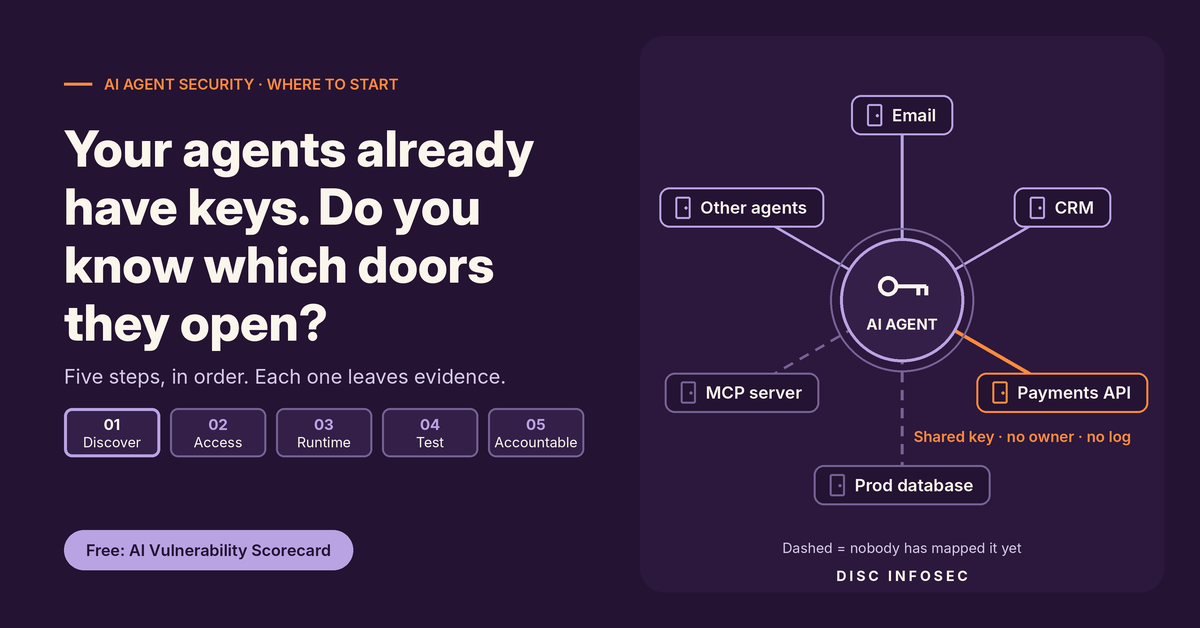
Your agents already have keys. Do you know which doors they open?
A chatbot answers. An agent acts.
It reads your inbox, queries your CRM, opens a ticket, pushes a config change, and calls another agent to finish the job. Often with a service account nobody remembers creating.
That shift changes the security question. It is no longer “what did the model say?” It is “what did the agent do, with whose authority, and could we have stopped it?”
Most organizations I talk to are not short on frameworks. They are short on a starting point. So here is the one I use with clients: five steps, in order, each one producing evidence you can show an auditor or a board.
- Discover where AI is being used
- Understand what it can access
- Get runtime visibility and control
- Test AI before you deploy it
- Make agents accountable
Skip step one and every step after it is guesswork. You cannot secure an agent you don’t know exists.
The five-step baseline for AI agent security
In my last post I argued that an agent is only as secure as its harness: the tools, identity, memory, and orchestration wrapped around the model. This post answers the follow-up question I got most: fine, but where do we start?
Start here. Each step below names the risk, the threats (mapped to the OWASP Top 10 for Agentic Applications), the control, and the evidence. Evidence is the part most programs skip. If the artifact doesn’t exist, the control doesn’t either.
01 — Discover where AI is being used
You can’t secure an agent you don’t know exists. And in most organizations, agents arrive sideways: a SaaS vendor flips on an “AI assistant” by default, a developer wires a coding agent to the repo, a sales rep connects a meeting recorder to the CRM.
None of them went through intake. All of them have credentials.
- Risk: Shadow agents operating outside any risk assessment, with no owner and no review date.
- Threats: ASI04 Agentic Supply Chain Vulnerabilities (unvetted MCP servers, plugins, skills); ASI03 Identity & Privilege Abuse (orphaned service accounts and API keys).
- Control: A living agent inventory fed by more than a survey. Pull from SSO and OAuth grant logs, API gateway traffic, cloud billing, browser extension inventories, and vendor release notes. Make AI intake a gate in procurement and change management.
- Evidence: An agent register with owner, business purpose, model and version, risk tier, and next review date for every entry. Plus the discovery queries you ran and when.
02 — Understand what it can access
Once you know an agent exists, the next question is blast radius. What can it read? What can it write? What can it call? Whose identity does it act under?
The most common finding in my assessments is not a clever attack. It is an agent running on a shared, long-lived API key with far more access than its job requires.
- Risk: Excessive agency. An agent with production write access, a payments API, and an email tool is one prompt injection away from a very bad day.
- Threats: ASI02 Tool Misuse & Exploitation; ASI03 Identity & Privilege Abuse; ASI06 Memory & Context Poisoning (what data and memory the agent can read is what an attacker can poison).
- Control: Give every agent its own workload identity. Scope credentials to the task and make them short-lived. Map each agent’s tools, data classes, MCP connections, and memory stores. Then tier it: assistive, controlled action, privileged autonomous, or high-impact.
- Evidence: An Agent Security Profile per agent: identities, tools, data classes, external connections, maximum action impact, and an access review signed by a named owner.
03 — Get runtime visibility and control
A policy that says “agents must not exfiltrate data” is a wish. A gateway that blocks an unapproved destination is a control.
Runtime is where the agent actually does things, so it is where security has to live. That means seeing every tool call and being able to say no to the ones that break policy, before they execute.
- Risk: Agents acting on attacker-controlled instructions with nobody watching and nothing able to stop them.
- Threats: ASI01 Agent Goal Hijack (indirect prompt injection through emails, documents, web pages); ASI05 Unexpected Code Execution; ASI08 Cascading Failures across chained agents.
- Control: Route tool calls through a policy enforcement point outside the model. Allowlist tools and destinations. Validate parameters. Set rate and transaction limits. Require human approval for high-impact actions. Build a kill switch and test it.
- Evidence: Tool-call logs tied to agent identity, policy decision logs (allowed and denied), alert history, and a dated kill-switch test record.
04 — Test AI before you deploy it
We don’t ship web apps without testing them. Agents get shipped on a demo that went well.
A good demo tells you the agent works when everyone is friendly. Testing tells you what it does when someone isn’t.
- Risk: Unknown failure modes discovered in production by customers or attackers.
- Threats: All ten OWASP ASI categories, with priority on ASI01 Goal Hijack, ASI02 Tool Misuse, ASI06 Memory Poisoning, and ASI07 Insecure Inter-Agent Communication. MITRE ATLAS gives you adversary techniques to build scenarios from.
- Control: A pre-deployment gate. Run direct and indirect prompt injection, tool parameter manipulation, privilege escalation, poisoned RAG and memory, malicious MCP server, and data exfiltration tests. Re-run them as regression tests whenever the model, prompt, tools, or permissions change.
- Evidence: Test plans, red-team results with severity, remediation tickets, retest results, and the go/no-go decision with who signed it.
05 — Make agents accountable
When an agent does something wrong, “the AI did it” is not an answer a regulator, a customer, or a board will accept.
Every agent needs a human who owns its purpose, its permissions, and its outcomes. And every material action needs a trail that lets you reconstruct who authorized what.
- Risk: No one owns the outcome, so no one fixes the cause.
- Threats: ASI09 Human-Agent Trust Exploitation (rubber-stamp approvals); ASI10 Rogue Agents (behavior that drifts outside its mandate and nobody notices).
- Control: A named business owner and technical owner per agent. Formal risk acceptance for privileged agents. Human oversight that is a real review, not a checkbox. Reassessment triggers on any model, tool, or permission change. An incident response playbook written for agents.
- Evidence: Ownership records, risk acceptance sign-offs, oversight logs showing what the reviewer saw and decided, reassessment history, and incident drill results.
The baseline at a glance
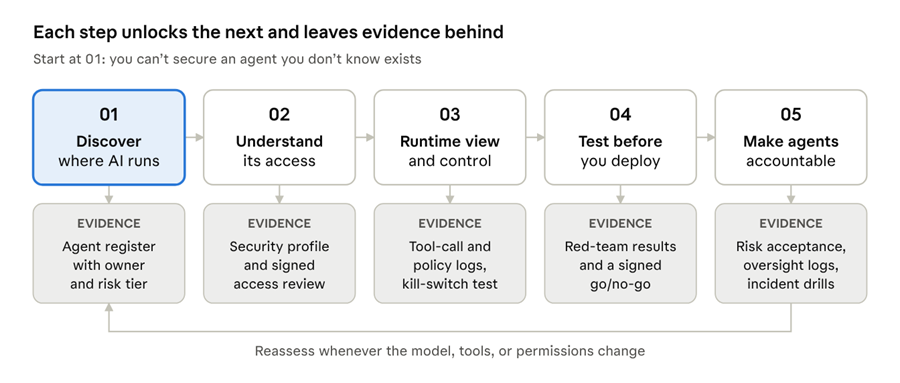
AI agent security baseline · 5 steps, each with its evidence
Read it left to right: each step depends on the one before it, and each leaves an artifact you can show an auditor. The loop at the bottom is the part most programs forget.
How the five steps map to the frameworks you’re already using
None of this needs a new framework. It is the agent-specific way to operate the ones you already have.
| Step | OWASP Agentic Top 10 | ISO/IEC 42001 | NIST AI RMF | EU AI Act |
| 01 Discover | ASI03, ASI04 | Cl. 4.3 scope; Annex A.4 resources (AI system inventory) | GOVERN 1.6 (AI inventory); MAP 1 | Art. 6 classification; Art. 26 deployer duties |
| 02 Access | ASI02, ASI03, ASI06 | Cl. 6.1.2 risk assessment; Annex A.7 data for AI systems; A.10 third-party | MAP 3–4 (capabilities, third-party risk) | Art. 10 data governance; Art. 15 cybersecurity |
| 03 Runtime | ASI01, ASI05, ASI08 | Cl. 8.1 operational control; Annex A.6.2.6 operation and monitoring; A.6.2.8 event logs | MANAGE 2–4; MEASURE 2.7 (security) | Art. 12 record-keeping; Art. 14 human oversight; Art. 72 post-market monitoring |
| 04 Test | ASI01–ASI10 | Annex A.6.2.4 verification and validation; Cl. 8.2 risk assessment | MEASURE 1–2 (TEVV) | Art. 9 risk management (testing); Art. 15 robustness |
| 05 Accountable | ASI09, ASI10 | Cl. 5.3 roles; Annex A.3.2 roles and responsibilities; Cl. 9–10 evaluation and improvement | GOVERN 2 (accountability); MANAGE 4 | Art. 14 oversight; Art. 73 serious incident reporting |
Verify clause, subcategory, and article references against the current texts before using this in an audit. EU AI Act obligations depend on your role (provider or deployer) and the system’s risk classification.
Why this is worth getting right
I don’t write about agent security because I want organizations to slow down. I write about it because the upside is real and worth protecting.
Agents that triage patient messages free clinicians for patients. Agents that comb through research literature speed up science. Agents that watch logs around the clock catch intrusions humans would miss at 3 a.m. Agents that handle routine paperwork give small teams the reach of large ones.
Every one of those benefits depends on trust. One high-profile agent incident, an exfiltrated data room, a wrong payment, a deleted production database, sets back adoption for everyone.
Security is what lets agents earn more autonomy, not what takes it away.
What I’ve seen in the field
When I led Virtual Data Room through ISO/IEC 42001 Stage 2 certification on the first audit attempt, the environment was a financial data room. Controls there get tested hard, because the data is M&A material and the auditors know it.
The MCP Governance Standard I wrote for ShareVault came from the same five questions in this post. Which agent connections exist? What can each reach? Who approved it? How do we see and stop it? Who owns it?
Three patterns show up again and again, at ShareVault-sized companies and larger ones:
- Shadow AI that skipped intake. The riskiest agent is usually the one nobody registered, because it also never got scoped, tested, or monitored.
- Oversight as a checkbox. “Human in the loop” means little if the record shows only an approval click. Real oversight leaves a log of what the reviewer saw, what they changed, and why.
- No retirement plan. Agents get deployed. They rarely get decommissioned. Their credentials outlive the project, and the pilot from last spring still has a live token.
None of these are exotic. All of them are fixable with the five steps above.
My perspective: where agent security stands today
Here is my honest read, as of late 2026.
Adoption is running well ahead of control. Agents are being deployed at the speed of a SaaS toggle. Security is moving at the speed of a policy review cycle. That gap is where incidents come from.
We are still securing the model instead of the agent. Too much effort goes into system prompts that say “never do X.” A prompt is an instruction, not a control. The model can be talked out of it. A policy engine sitting outside the model cannot.
Identity is the weakest link. Most agents I review don’t have their own identity. They borrow a human’s OAuth token or share a service account. When something goes wrong, the logs can’t tell you whether a person or an agent did it. Non-human identity is now the front line.
MCP and agent-to-agent connections are the new supply chain. Teams install MCP servers the way they once installed browser extensions: quickly and without review. Every connection is a trust decision, and most are being made by default.
Testing is still demo-driven. Very few organizations run adversarial tests before go-live, and fewer re-run them when the model or tools change. An agent that passed last quarter’s review may be a different agent today.
The good news: the frameworks have caught up. The OWASP Top 10 for Agentic Applications, ISO/IEC 42001, and the NIST AI RMF give us a shared language. What’s missing is execution, not guidance.
How to improve it, starting this quarter
- Give every agent its own identity. Short-lived, scoped credentials. No shared keys. No borrowed human tokens. This one change makes steps 02, 03, and 05 possible.
- Move authorization out of the prompt. High-impact actions get approved by a policy engine or a human, never by the model’s own judgment. Practice least agency, not just least privilege.
- Treat MCP servers, plugins, and skills like third-party software. Approved registry, version pinning, vendor review, and the ability to revoke fast.
- Make testing continuous. Every change to the model, prompt, tools, or permissions triggers the regression suite. Red-team at least before launch and after major changes.
- Log for reconstruction, not just debugging. Can you replay what the agent saw, decided, called, and changed? If not, you can’t investigate an incident or defend one to an auditor.
- Define the off switch before the on switch. Kill switch, credential revocation, and rollback, tested and dated, before any privileged agent goes live.
- Govern it as a management system. Agents change weekly. A one-time assessment ages fast. ISO/IEC 42001 gives you the loop: assess, treat, monitor, improve, repeat.
The organizations that get this right won’t be the ones with the fewest agents. They’ll be the ones that can say, for every agent, what it is, what it can touch, what it did, and who answers for it.
Free tool: find out where your agents are exposed
If you read the five steps and weren’t sure how you’d score, start with the DISC InfoSec AI Vulnerability Scorecard. It’s free and gives you a quick, honest view of where your AI systems are exposed.
What you get:
- A score across the AI security areas that matter for agents
- A view of your weakest areas, so you know which step to start with
- A report delivered to your inbox that you can share with your team
How to read your results through this post: if your lowest scores sit around inventory and ownership, start at step 01. You’re securing agents you can’t see. If they sit around access and logging, jump to steps 02 and 03. That’s where your blast radius lives.
Take the free AI Vulnerability Scorecard → AI Vulnerability Scorecard: Discover Your AI Attack Surface Before Attackers Do
How DISC InfoSec can help
| Service | Steps covered | Best for |
| AI Governance Gap Assessment | 01, 02, 05 | Teams that need a fast baseline of where they stand against ISO/IEC 42001 and the NIST AI RMF |
| AI Agent and Application Security Assessment | 02, 03, 04 | Teams putting agents, MCP servers, or AI features into production |
| AI Governance Quick-Start (7–10 days) | 01, 02, 05 | Organizations that need an agent inventory, risk tiers, and ownership in place quickly |
| ISO/IEC 42001 AIMS Implementation | 01–05 | B2B SaaS and financial services firms facing customer or regulatory AI governance deadlines |
| vCAIO / vCISO Retainer | 01–05, ongoing | Leadership teams that want an experienced practitioner running the program continuously |
See all services and free tools on the AI Governance page, or book a free call.
DISC InfoSec (Deura Information Security Consulting LLC) is a boutique AI governance and cybersecurity consultancy in Petaluma, California, serving B2B SaaS and financial services firms. We are a PECB Authorized Training Partner. Hugh “Disc” Deura, Principal Consultant, holds the CISSP, CISM, ISO/IEC 42001 Lead Implementer, and ISO/IEC 27001 Lead Implementer credentials, and led ShareVault through ISO/IEC 42001 Stage 2 certification on the first audit attempt. Contact: info@deurainfosec.com · (707) 998-5164 · calendly.com/hd-deurainfosec
Sources
- “Where organizations should start” five-step graphic (supplied image)
- OWASP Top 10 for Agentic Applications (OWASP Agentic Security Initiative)
- ISO/IEC 42001:2023, Artificial Intelligence Management System
- NIST AI Risk Management Framework 1.0 and NIST AI 600-1 Generative AI Profile
- EU AI Act, Regulation (EU) 2024/1689
- MITRE ATLAS
- Previous DISC InfoSec post: “Your AI Agent Is Only as Secure as Its Harness“
DISC Infosec AI Services and additional free tools: https://www.deurainfosec.com/disc-infosec-home/aims-iso42001-ai-governance/
- Your Agents Already Have Keys. Do You Know Which Doors They Open?
- 178 Brands. Zero Breaches of Their Own. One Trusted Script
- Your AI Policy Covers Launch Day. Who Governs Everything After?
- The Reporting Clock: How Long Until Anyone Knows Your AI Agent Went Out of Bounds?
- You Can’t Fence Off Superintelligence: AI Governance Starts With You