A Simple 4-Step Path to ISO 42001 for SMBs
Practical AI Governance for Compliance, Risk, and Security Leaders
Artificial Intelligence is moving fast—but regulations, customer expectations, and board-level scrutiny are moving even faster. ISO/IEC 42001 gives organizations a structured way to govern AI responsibly, securely, and in alignment with laws like the EU AI Act.
For SMBs, the good news is this: ISO 42001 does not require massive AI programs or complex engineering changes. At its core, it follows a clear four-step process that compliance, risk, and security teams already understand.
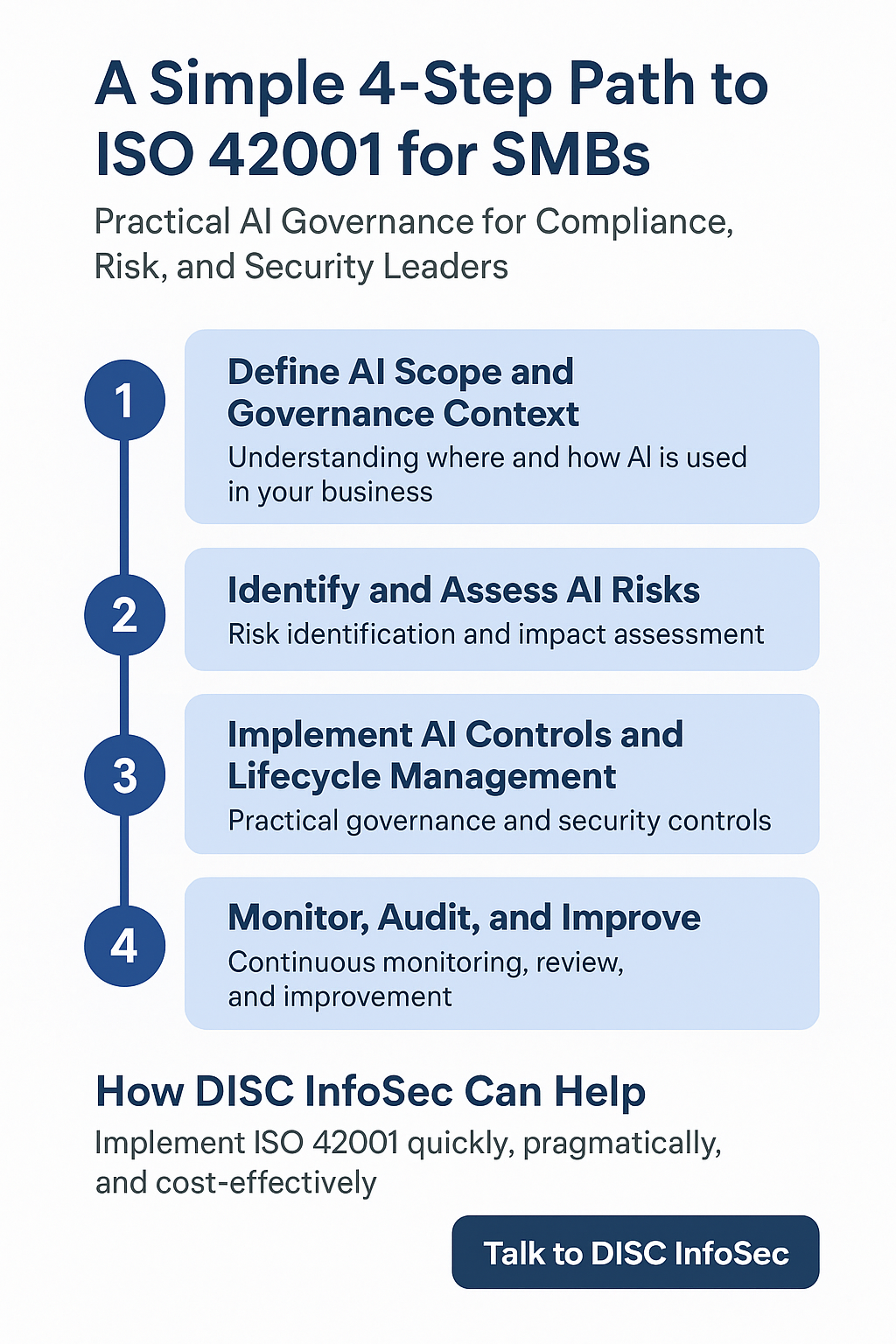
Step 1: Define AI Scope and Governance Context
The first step is understanding where and how AI is used in your business. This includes internally developed models, third-party AI tools, SaaS platforms with embedded AI, and even automation driven by machine learning.
For SMBs, this step is about clarity—not perfection. You define:
- What AI systems are in scope
- Business objectives and constraints
- Regulatory, contractual, and ethical expectations
- Roles and accountability for AI decisions
This mirrors how ISO 27001 defines ISMS scope, making it familiar for security and compliance teams.
Step 2: Identify and Assess AI Risks
Once AI usage is defined, the focus shifts to risk identification and impact assessment. Unlike traditional cyber risk, AI introduces new concerns such as bias, model drift, lack of explainability, data misuse, and unintended outcomes.
In this step, organizations:
- Identify AI-specific risks across the lifecycle
- Evaluate business, legal, and security impact
- Consider affected stakeholders (customers, employees, regulators)
- Prioritize risks based on likelihood and severity
This step aligns closely with enterprise risk management and can be integrated into existing risk registers.
Step 3: Implement AI Controls and Lifecycle Management
With risks prioritized, the organization selects practical governance and security controls. ISO 42001 does not prescribe one-size-fits-all solutions—it focuses on proportional controls based on risk.
Typical activities include:
- AI policies and acceptable use guidelines
- Human oversight and approval checkpoints
- Data governance and model documentation
- Secure development and vendor due diligence
- Change management for AI updates
For SMBs, this is about leveraging existing ISO 27001, SOC 2, or NIST-aligned controls and extending them to cover AI.
Step 4: Monitor, Audit, and Improve
AI governance is not a one-time exercise. The final step ensures continuous monitoring, review, and improvement as AI systems evolve.
This includes:
- Ongoing performance and risk monitoring
- Internal audits and management reviews
- Incident handling and corrective actions
- Readiness for certification or regulatory review
This step closes the loop and ensures AI governance stays aligned with business growth and regulatory change.
Why This Matters for SMBs
Regulators and customers are no longer asking if you use AI—they’re asking how you govern it. ISO 42001 provides a defensible, auditable framework that shows due diligence without slowing innovation.
How DISC InfoSec Can Help
DISC InfoSec helps SMBs implement ISO 42001 quickly, pragmatically, and cost-effectively—especially if you’re already aligned with ISO 27001, SOC 2, or NIST. We translate AI risk into business language, reuse what you already have, and guide you from scoping to certification readiness.
👉 Talk to DISC InfoSec to build AI governance that satisfies regulators, reassures customers, and supports safe AI adoption—without unnecessary complexity.
Tufte_iso42001_pdf
- How ISO 27001 Lead Auditors Should Evaluate AI Risks in an ISMS
- Secure Your Web & API Applications Before Attackers Do: Reduce Vulnerabilities
- Is ISO 27001 Training Right for You? Here’s Who Should Consider It
- Top 15 Kali Linux Tools for AI Governance with Use Cases
- Risk Management with GRC platform: Mapping ISO 42001 Clause 6 to AI Governance
InfoSec services | InfoSec books | Follow our blog | DISC llc is listed on The vCISO Directory | ISO 27k Chat bot | Comprehensive vCISO Services | ISMS Services | Security Risk Assessment Services | Mergers and Acquisition Security