The Great AI Pullback: Sovereignty, Small Models, and the Runtime Controls Regulated Industries Now Demand
Oct 18, 2026 · @disc
Regulated firms are not abandoning AI. They are taking it back in-house. The question in the boardroom has changed from “which model is smartest?” to “who controls the model, the data, the runtime, and the off switch?”
That shift is rational. A frontier model wired into a loan decision, a claims workflow, or a financial data room is no longer a productivity tool. It is a third-party dependency with access to your crown jewels, an attack surface that takes instructions from untrusted text, and a regulated system whose evidence trail you may not own.
This post covers five things:
- Why the pullback is happening now, and why it is accelerating in financial services, healthcare, defense, and public sector.
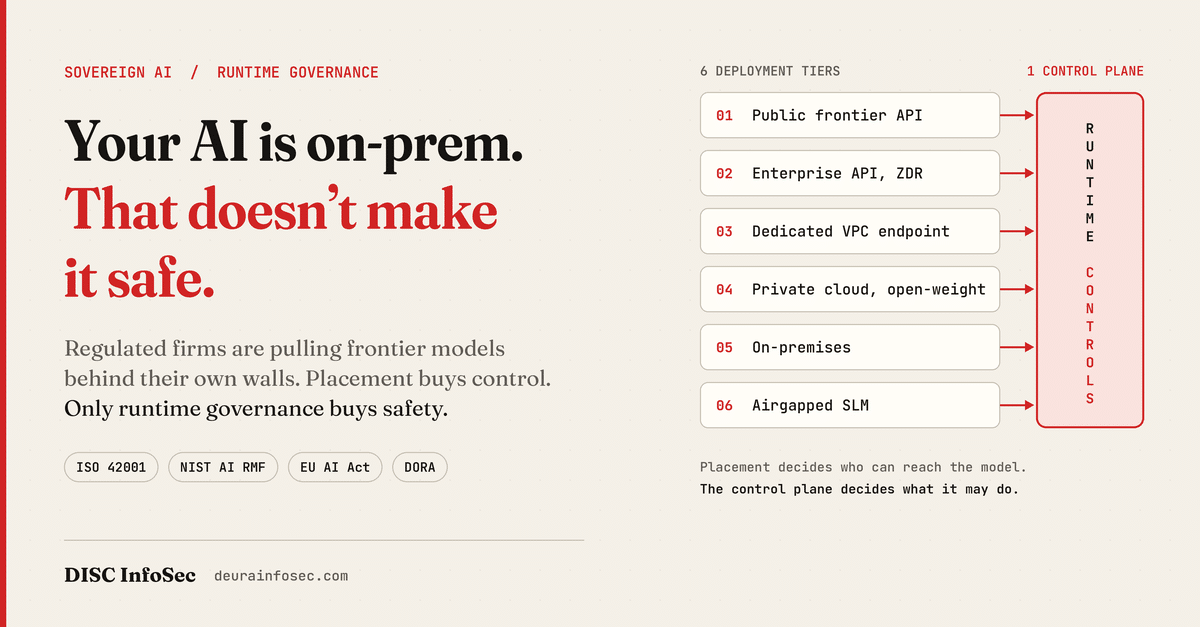
- The sovereignty spectrum: six deployment tiers, from public API to airgapped small language model (SLM).
- The threat model that applies at every tier, and the dangerous assumption that an airgap makes AI safe.
- The bespoke runtime governance layer that must travel with the model wherever it runs.
- A decision framework, a compliance crosswalk, and a 90-day plan.
The short version: sovereignty buys you control. It does not buy you safety. Only runtime governance does that.
Why the pullback is happening now
Six forces converged in 2026. Any one of them would justify a second look at a frontier dependency. Together they explain why risk committees are pulling production AI back behind their own walls.
1. Model access is now a continuity risk. On June 12, 2026, a U.S. Commerce Department export-control directive led Anthropic to suspend global access to Claude Fable 5 and Mythos 5, three days after launch. The controls were lifted on June 30 and access returned from July 1 (Engadget, The Next Web). The governance lesson is not about one vendor. It is that a hosted frontier model can disappear from your production path for reasons entirely outside your contract, your SLA, and your control. Analysts flagged it as the first time government intervention suspended general access to a model (The Batch).
2. Bank regulators carved generative and agentic AI out for separate treatment. The April 17, 2026 interagency model risk guidance (Fed SR 26-2) replaced SR 11-7 and described generative and agentic AI as novel and rapidly evolving, with a request for information on AI to follow (OCC). Commentators note it keeps banks fully responsible for third-party models, even when they cannot validate them (JD Supra). Translation: you own the risk of a model you cannot inspect.
3. Data sovereignty and foreign-access exposure. Every inference call to a hosted API is a data transfer. For EU banks under DORA, that call is an ICT third-party dependency subject to concentration-risk scrutiny. For anyone, it raises questions about jurisdiction, government access requests, and retention you cannot verify.
4. Agents changed the blast radius. A chatbot that answers wrong is an embarrassment. An agent with tool access that is manipulated by injected text can move money, export data, or change configurations. Runtime authority, not model quality, is now the dominant risk variable.
5. Evidence you do not own is evidence you cannot produce. ISO/IEC 42001 auditors, EU AI Act conformity assessors, and bank examiners ask for logs, version histories, and oversight records. If the model version, safety filters, and retention live on a vendor’s side, your evidence chain has a gap you cannot close by contract alone.
6. Small models got good enough for bounded work. Open-weight and small language models now handle classification, extraction, summarization, and retrieval-grounded Q&A well enough for many regulated workflows, at a fraction of the cost and inside your perimeter.
None of this means frontier models are leaving regulated industries. It means they are being demoted from “default for everything” to “governed exception for the work that genuinely needs them.”
The threat model that applies at every tier
Where a model runs changes who can reach it. It does not change how it fails. Start every review from one rule: treat every model output as untrusted input, and every input the model reads as potentially adversarial instructions.
The table maps the threats that matter most in regulated production to the OWASP Top 10 for LLM Applications and the OWASP Agentic Security Initiative (ASI) categories, and shows how the risk shifts when you move from a hosted frontier API to a private or airgapped deployment.
| Threat | OWASP mapping | Hosted frontier API | Private / airgapped model |
| Prompt injection, direct and indirect | LLM01, ASI01 Goal Hijack | Present. Any document, email, or ticket the model reads can carry instructions | Unchanged. Internal content is still untrusted content |
| Tool misuse and excessive agency | LLM06, ASI02 | Present wherever agents hold tools | Unchanged, often worse: internal agents get broader access because “it’s inside” |
| Sensitive data disclosure | LLM02 | Higher: prompts, files, and outputs leave your perimeter | Lower in transit, but outputs can still leak across user and tenant boundaries |
| Identity and privilege abuse | ASI03 | Shared API keys, over-scoped service accounts | Same, plus local admin and GPU-host credentials |
| Model and data supply chain | LLM03, LLM04, ASI04 | Vendor-controlled: silent version changes, provider outages, access suspension | Shifts to you: weight provenance, unsafe serialization formats, poisoned fine-tune data |
| Memory and context poisoning | ASI06 | Present in agent memory and RAG stores | Unchanged. Sovereign RAG is still poisonable RAG |
| Unbounded consumption | LLM10 | Cost and rate-limit exposure | Capacity exhaustion on finite GPUs, which becomes an availability risk |
| Cascading and rogue agent behavior | ASI08, ASI10 | Present in multi-agent workflows | Unchanged |
| Model weight theft | Supply chain and insider | Not your asset to lose | New crown jewel to protect, especially for fine-tuned models trained on regulated data |
One test cuts through most of this: the lethal trifecta. An agent with access to private data, exposure to untrusted content, and a way to communicate externally can be steered to read secrets and send them out. Break any one leg and the attack path closes. Airgapping removes much of the third leg. It does nothing about the first two.
The sovereignty fallacy: what an airgap does not fix
The most dangerous sentence in a regulated AI program right now is “it’s on-prem, so it’s safe.” Bringing a model home moves risk around. It does not remove it. Here is what stays with you, or gets worse.
You inherit the vendor’s job. With a hosted API, the provider runs red-teaming, safety classifiers, abuse monitoring, and patching. Self-host an open-weight model and all of that becomes your control obligation, with your headcount and your evidence.
SLMs fail differently, not less. Small models are less capable at refusing manipulation, more prone to confident errors outside their training distribution, and rarely ship with mature safety tooling. A model that is “good enough” on your accuracy benchmark may be untested against adversarial inputs.
Insiders become the primary threat actor. An airgap removes most external attackers and concentrates risk in the people and processes with legitimate access: data scientists with weight access, admins with GPU-host root, contractors loading “helpful” fine-tunes.
Supply chain risk moves inside the wall. Weights downloaded from public hubs, pickle-based checkpoints that execute code on load, unpinned model versions, and fine-tuning datasets of unknown provenance all cross the airgap on removable media. Poisoned training data is effectively unrecoverable once baked into weights.
Airgaps get bridged. Patches, new weights, retrieval corpora, and log exports all need a transfer path. Every transfer path is an ingress and egress control that needs ownership, scanning, and an approval record.
Monitoring goes dark. Many observability, DLP, and AI-security products assume cloud connectivity. Teams that airgap the model often airgap their visibility with it.
Model drift becomes model rot. A frozen private model does not get vendor improvements or safety fixes. Without a deliberate update and re-evaluation cycle, it ages in place while threats evolve.
The conclusion is not “don’t go sovereign.” It is that sovereignty is a placement decision, and placement is only one layer of control. The layer that actually decides what a model may do is the runtime.
Bespoke runtime governance: the controls that travel with the model
Runtime governance is the set of controls that sit between the model and everything it can touch, enforced by deterministic code rather than by the model’s good behavior. It is “bespoke” because it must encode your data classes, your authority limits, and your regulatory obligations. A vendor’s generic guardrail cannot know that your agent may draft a wire instruction but never release one.
The key property: these controls are model-agnostic. Swap a frontier API for a private SLM, or move from cloud to airgap, and the control plane stays. That is what makes sovereignty survivable.
| Layer | What it enforces | Minimum control |
| 1. Identity | Every agent and model call is attributable | Unique agent identity, short-lived scoped credentials, no shared admin keys, token audience validation |
| 2. Input boundary | Untrusted content is labeled and isolated | Provenance tags on retrieved content, separation of instructions from data, injection detection as depth (never as the control) |
| 3. Policy decision point | What the model may do, outside the model | Allowlisted tools, parameter-level policy checks, risk-tiered approval lanes, deny by default |
| 4. Tool and MCP gateway | How actions reach real systems | Signed tool manifests, pinned versions, OAuth 2.1 with PKCE, confused-deputy protections, no dynamic tool loading in privileged flows |
| 5. Egress control | Where data can go | Destination allowlists, SSRF protection, DLP on outputs, no open internet for privileged agents |
| 6. Output validation | What leaves the model and enters a sink | Schema validation, encoding for downstream systems, PII and secrets scanning |
| 7. Model routing | Which model handles which data class | Data-class-aware routing: restricted data only to sovereign tiers, frontier calls only for approved classes |
| 8. Evidence and monitoring | Proof of what happened | Immutable logs of prompts, retrieved context, tool calls, approvals, and model version; behavioral baselines; drift alerts |
| 9. Containment | Stopping it fast | Kill switch per agent, credential revocation, rollback, blast-radius budgets, fail-closed defaults |
Two ideas from earlier DISC InfoSec posts plug directly into layer 3. First, approve the envelope, not the edit: pre-authorize bounded classes of action, enforce them at runtime, and reserve synchronous human approval for actions that escape the envelope. Second, your system prompt is production code: guidance lives in the prompt, but enforcement cannot. Anything you rely on the prompt to prevent needs a matching control in this table.
Layer 7 deserves emphasis because it is how most regulated firms will actually operate: not “sovereign or frontier,” but a router that sends each request to the cheapest tier allowed for its data class and risk level, and logs why.
Decision framework: match the workload to the tier
Place each AI use case by two questions: how sensitive is the data it touches, and how much authority does it hold? The answer picks the lowest-cost tier that is still defensible to an auditor.
| Workload profile | Example | Recommended tier | Model class | Non-negotiable controls |
| Public data, advisory output | Marketing drafts, public research summaries | Hosted frontier API | Frontier | Acceptable-use policy, output review, no regulated data |
| Internal data, advisory output | Policy Q&A, meeting summaries | Enterprise API with zero data retention, or dedicated tenant | Frontier or mid-size | DLP on inputs, contract terms on retention and training, logging |
| Confidential data, bounded actions | Ticket triage, document classification, KYC extraction | VPC or private cloud | Open-weight mid-size or SLM | Tool allowlists, egress control, schema-validated outputs |
| Regulated data, consequential decisions | Credit, claims, fraud, clinical triage | Private cloud or on-prem | Fine-tuned SLM, frontier only for approved sub-tasks | Model routing by data class, human approval lanes, full evidence chain, TEVV |
| Classified, export-controlled, or critical infrastructure | Defense, grid operations, national-security workloads | Airgapped | Vetted SLM or open-weight | Controlled transfer path, insider controls, weight protection, offline monitoring |
When an SLM is the right call. The task is narrow and repeatable (classify, extract, route, summarize against a known corpus), latency or cost matters at volume, the data cannot leave your perimeter, and you can evaluate the model against a labeled test set you own.
When you still need a frontier model. The task requires open-ended reasoning, long multi-step planning, complex code, or broad world knowledge, and errors are recoverable. In regulated flows, route only de-identified or minimized context to it, keep the action authority on your side of the policy engine, and keep a tested fallback path for the day access disappears.
The continuity test. For every production use of a hosted model, answer one question in writing: if this model were unavailable for three weeks starting tomorrow, what happens? If the answer is “the business process stops,” you have a concentration risk to treat, not just a vendor to monitor.
Compliance crosswalk
The good news: none of this requires a new framework. The controls above map cleanly to the ones auditors and examiners already use. Build once, evidence many times.
| Control theme | ISO/IEC 42001 | ISO/IEC 27001:2022 | NIST AI RMF | EU AI Act | DORA (EU financial) |
| AI system inventory and tiering | Clause 6.1, A.6 life cycle | 5.9 asset inventory | MAP 1, GOVERN 1.6 | Art. 6 classification, Art. 9 risk management | ICT asset register |
| Model and vendor dependency | A.10 third-party relationships | 5.19 to 5.23 supplier and cloud services | GOVERN 6, MANAGE 3 | GPAI provider duties, Arts. 53 to 55 | Arts. 28 and 29, third-party and concentration risk |
| Continuity and exit for hosted models | Clause 8.1 operational control | 5.30 ICT readiness for continuity | MANAGE 2.4 | Art. 15 robustness | Exit strategies under Art. 28 |
| Data residency and leakage | A.7 data for AI systems | 8.12 data leakage prevention | MAP 4, MEASURE 2.10 | Art. 10 data governance | ICT data security |
| Runtime authorization and oversight | A.6.2.6 operation and monitoring | 8.2 privileged access | MANAGE 2, MEASURE 3 | Art. 14 human oversight | Access and change control |
| Logging and evidence | Clause 9.1, A.6.2.8 event logs | 8.15 logging, 8.16 monitoring | MEASURE 4 | Art. 12 record-keeping | Incident detection and reporting |
| Adversarial testing | Clause 8.2 risk assessment | 8.29 security testing | MEASURE 2.7 | Art. 15 cybersecurity | Digital operational resilience testing |
Timing matters. Under the Digital Omnibus, EU AI Act high-risk obligations now apply from 2 December 2027, which sounds distant but is barely enough time to stand up a governed sovereign deployment with a defensible evidence trail. U.S. banks should expect the promised interagency AI request for information to ask exactly the questions in this table.
email info@deurainfosec.com. or comment on the LinkedIn post if you have a question
- If Your Frontier Model Vanished for 3 Weeks, Would Your Business Stop?
- The Evidence Lifecycle: Which Organizational Events to Log for Liability — and How Long to Keep Them
- 14 Months to Comply. 12 Months of Work. The High-Risk AI Playbook Nobody Has Started
- Your biggest AI risk isn’t hackers. It’s your own data walking out the door
- The cheapest security control you’ll ever implement is the component you decided not to build