What Claude Fable 5’s Launch Teaches Us About AI Governance (An ISO 42001 Reading)
In June 2026, Anthropic released Claude Fable 5 — the most capable AI model ever made generally available. But the more interesting story isn’t the benchmarks. It’s the governance architecture wrapped around the release.
Because here’s the thing: while most organizations are still deciding whether they need an AI management system, Anthropic just ran one in public, at frontier scale, with the whole industry watching. And nearly every design decision they made maps cleanly onto a clause or control that ISO/IEC 42001 asks of every organization deploying AI.
If you’re a B2B SaaS or financial services leader wondering what “AI governance” actually looks like in practice — not the policy binder version, the operational version — Fable 5 is the best case study you’ll get this year.
The setup: one model, two risk treatments
Fable 5 is what Anthropic calls a Mythos-class model. The same underlying model exists in two commercial forms:
Claude Fable 5 — generally available, wrapped in the strongest safeguards Anthropic has ever shipped. When its classifiers detect a request touching high-risk cybersecurity, biology/chemistry, or model-distillation territory, the request is automatically handled by an earlier, less capable model (Opus 4.8) — and the user is told this happened.
Claude Mythos 5 — the same capabilities without those classifiers, restricted to vetted organizations in a trusted-access program (Project Glasswing), where cyber defenders use it to find and fix vulnerabilities in critical software before attackers do.
Same model. Two deployment contexts. Two risk treatments. If you’ve ever built a Statement of Applicability, that structure should feel familiar.
The ISO 42001 translation
Let’s walk the mapping, clause by clause.
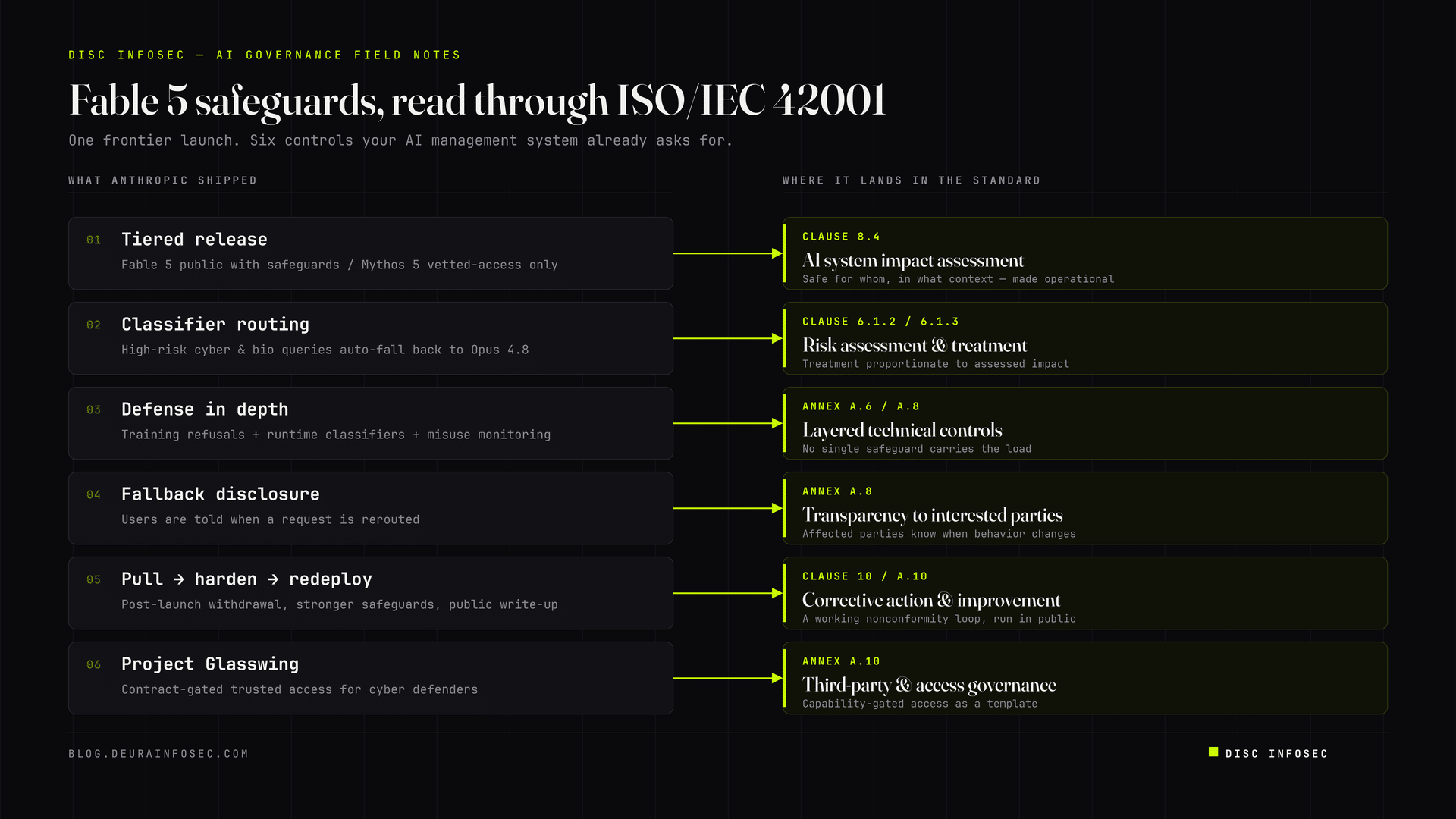
Risk assessment and treatment (Clauses 6.1.2, 6.1.3). Anthropic didn’t treat “model capability” as one undifferentiated risk. They decomposed it: which capabilities, in which domains, reachable by which users, create unacceptable harm potential? Cyber-offense and bio-chem capability got a different treatment (blocking and fallback) than general reasoning capability (released broadly). That’s exactly the discipline 42001 asks for — risk treatment proportionate to assessed impact, not blanket policies.
AI system impact assessment (Clause 8.4 / Annex A.5). The tiered Fable/Mythos release is an impact assessment made operational. The question wasn’t “is this model safe?” but “safe for whom, in what context, with what safeguards?” Vetted defenders under contractual and technical controls get one answer; the general public gets another. Most organizations doing impact assessments stop at a document. This one shipped as product architecture.
Technical controls and defense in depth (Annex A.6, A.8). No single safeguard carries the load. Training-time refusals, runtime classifiers, automatic fallback routing, retroactive misuse-pattern analysis — each imperfect alone, meaningful in combination. Anthropic explicitly framed it as defense in depth. If your AI governance program hinges on one control (usually “we have an AI policy”), this is your gap.
Transparency to users (Annex A.8). When a Fable 5 request gets rerouted to the fallback model, the user is informed. That’s a small detail with a big principle behind it: affected parties should know when and how an AI system’s behavior changes. If your product silently swaps models, degrades outputs, or applies filters your customers can’t see, expect procurement teams to start asking about it.
Incident response and continual improvement (Clause 10, Annex A.10). Weeks after launch, Anthropic briefly pulled Fable 5 from deployment, strengthened safeguards, and redeployed it — publicly documenting what changed. Whatever you think of the specifics, that’s a functioning nonconformity-and-corrective-action loop, executed under scrutiny. Ask yourself: if your AI feature misbehaved in production tomorrow, do you have a defined path from detection to correction to communication? Or would you be improvising?
Third-party and access governance (Annex A.10). Project Glasswing is a trusted-access program: vetted counterparties, defined use cases, contractual controls around a higher-risk capability tier. For any organization providing AI capabilities to others — which, increasingly, is every SaaS company — this is the template for capability-gated access.
Why this matters if you’re not a frontier lab
You’re not shipping a Mythos-class model. But if you’re building on one — or on any foundation model — Fable 5 changes your governance posture in concrete ways:
Your vendor’s controls are now part of your risk surface. Fable 5 can decline or reroute requests. If your product integration doesn’t handle refusals and fallback behavior, that’s an availability and quality risk you haven’t assessed. Under ISO 42001, third-party model behavior belongs in your risk register, not just your vendor file.
Data retention terms are diverging by model. Fable 5 carries 30-day retention and isn’t available under zero-data-retention terms. If you’ve made ZDR commitments to your customers — common in financial services — model selection is now a compliance decision, not just an engineering one.
Procurement is watching. Enterprise buyers saw this launch too. The questions in security questionnaires are already shifting from “do you use AI?” to “how do you govern the AI you use — including what your model provider does on your behalf?” An AIMS aligned to ISO 42001 is how you answer that with evidence instead of adjectives.
The takeaway
The most advanced AI company in the world didn’t govern its most capable model with a policy document. It governed it with risk-tiered access, layered technical controls, user transparency, and a working corrective-action loop — the operational skeleton of ISO/IEC 42001.
That’s the bar. Not because a standard says so, but because it’s what responsible deployment of consequential technology actually requires. The organizations that internalize this now will walk into 2027 procurement cycles and regulatory deadlines with answers. The rest will be writing their AI policy the week a customer asks for it.
DISC InfoSec helps B2B SaaS and financial services firms build audit-ready AI management systems — including the first-attempt ISO 42001 Stage 2 certification we led for VDR organization. If you want to know where your AI governance stands today, start with our free AI Governance Maturity Calculator or book a call at calendly.com/hd-deurainfosec.
notes
- AI governance, ISO 42001, Claude Fable 5, AI management system
- Claude Fable 5’s launch is the most public AI risk treatment exercise yet. Here’s what its governance architecture maps to in ISO 42001 — and what to borrow.
- /fable-5-iso-42001-ai-governance
- VDR case study, AI Governance Maturity Calculator, AIMS/ISMS Readiness Ladder post, AI Governance Quick-Start service page
- Anthropic’s Fable 5 announcement (anthropic.com/news/claude-fable-5-mythos-5), ISO/IEC 42001 overview page
- Diagram mapping Claude Fable 5’s tiered safeguards to ISO 42001 clauses and Annex A controls
Download the AI Governance & Cybersecurity pdf file
MachineLearning & Artificial Intelligence
AI Vulnerability Scorecard: Discover Your AI Attack Surface Before Attackers Do
Your Shadow AI Problem Has a Name-And Now It Has a Score
Most AI Security Tools Won’t Pass an Audit. Here’s a 15-Minute Way to Find Out.
InfoSec services | InfoSec books | Follow our blog | DISC llc is listed on The vCISO Directory | ISO 27k Chat bot | Comprehensive vCISO Services | ISMS Services | AIMS Services | Security Risk Assessment Services | Mergers and Acquisition Securit
DISC InfoSec blog | DISC InfoSec Site
- Frontier Model, Familiar Framework: Reading Fable 5’s Guardrails Through ISO 42001
- ISO 42001 Evidence Checklist: What Auditors Actually Look For (2026)
- Agents don’t produce wrong answers anymore They take wrong actions – A practitioner’s guide to agent security
- AI Governance for Bay Area Startups: What to Put in Place Before Enterprise Customers Ask
- How Much of Your Job Can Become an AI-Executable Workflow — and What’s Left Standing When It Does