
Everyone Is Learning to Build With AI. Almost Nobody Is Learning to Govern It.
I keep meeting people who are burning nights and weekends teaching themselves to build with AI. Agents, RAG pipelines, orchestration frameworks, the whole stack. I understand the instinct completely. The tooling is genuinely exciting, the demand looks self-evident, and nobody wants to be the person the wave passes by.
But it’s worth asking a harder question before you spend another six months on it: who actually gets displaced first?
If your value proposition is that you can prompt a model into producing something useful, you are competing against every other person who can prompt a model into producing something useful — and against the model itself, which gets better at doing that unsupervised every quarter.
That isn’t a prediction. It already happened once. “Prompt Engineer” peaked as a standalone job title and then quietly disappeared from job boards. The skill didn’t vanish; it got absorbed. LinkedIn postings tagging prompt engineering as a skill grew sharply while postings with it in the title declined. The people who survived that transition weren’t the prompt whisperers. They were the engineers, product managers, and risk owners who happened to also prompt well.
Something similar is working its way through the entry-level engineering market right now. Employment for developers aged 22 to 25 has fallen roughly 20% since generative AI tools went mainstream. Entry-level hiring at the largest tech firms dropped about 25% between 2023 and 2024. The mechanism isn’t mysterious: AI is very good at exactly the codified, well-bounded work that used to be the first rung of the ladder.
Meanwhile, there’s a job almost nobody is lining up for.
The questions nobody in the building can answer
Somebody has to sit in a room and answer, in writing, with their name on it:
- Can this AI system be trusted with customer data, and what evidence supports that answer?
- Can this output be defended in an audit twelve months from now?
- Is the vendor’s model quietly training on our information, and does the contract actually prohibit it?
- Does the feature the dev team shipped last month violate three controls nobody checked?
- If a regulator asks how we govern AI, what document do we hand them?
Right now, in most organizations, the honest answer to all five is nobody knows.
This gap is measurable, not theoretical
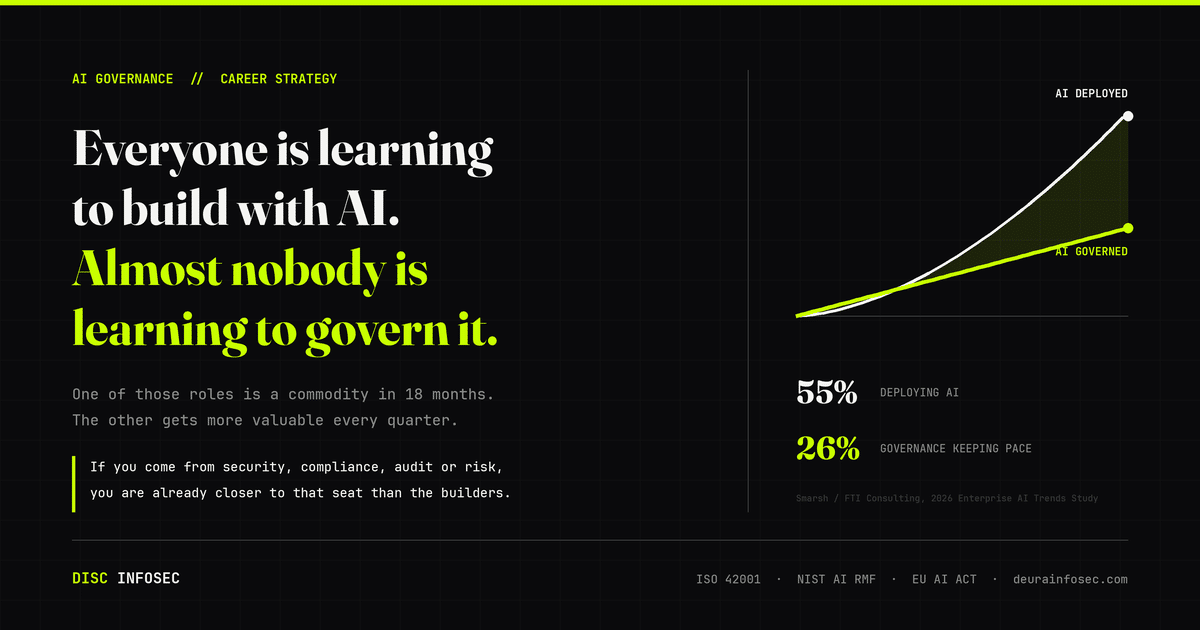
The 2026 Enterprise AI Trends Study from Smarsh, conducted by FTI Consulting, found that 55% of enterprises are actively deploying AI while only 26% say their governance frameworks are keeping pace with that deployment. Just 30% report comprehensive capability to detect and manage shadow AI — the unsanctioned tools employees are already using.
Other 2026 data points in the same direction. ISACA found that a quarter of organizations have no active AI policy at all. Roughly 80% report moderate to pervasive shadow AI use, while only about 25% have real visibility into how employees are using it. The Verizon DBIR flagged shadow AI as one of the most common non-malicious insider actions in DLP data, with source code the most frequently submitted data type to unauthorized external models.
Read that last one again. The most common thing leaving organizations through an ungoverned channel is their own intellectual property.
This shows up in assessments constantly. Not as a philosophical concern about AI risk — as a specific finding, on a specific system, with a specific owner who cannot produce the evidence.
What the market is paying for the seat
The labor data is unusually clean for an emerging field.
LinkedIn’s 2026 Skills on the Rise report put year-over-year demand growth for AI governance skills at 150%, with AI ethics at 125% — among the fastest-growing categories it tracks. The IAPP reports that 98.5% of organizations say they need more AI governance professionals than they currently have. By late 2025, LinkedIn was already showing over 14,000 open roles carrying some form of AI governance title.
Axial Search’s analysis of roughly 2,000 US postings found the market averaging about 71 new AI governance roles per week through the first seven months of 2026, with no seasonal collapse — median pay around $169,000, with a heavy concentration in professional services (about 35% of postings) and financial services. Notably, 27% of postings reference NIST frameworks specifically. IAPP data also shows a measurable certification premium: roughly 13% for one relevant credential, around 27% for a stacked combination.
Steady weekly volume matters more than the headline growth number. It means the market has stabilized into a standing capability rather than a hype spike.
The regulatory clock makes this structural
Career bets built on hype decay. Career bets built on statutory deadlines do not.
The EU AI Act (Regulation (EU) 2024/1689) is phasing in on a fixed schedule. GPAI obligations under Articles 53–55 have applied since 2 August 2025, with the GPAI Code of Practice as the primary compliance path. Article 50 transparency requirements for new systems hit 2 August 2026. Following the AI Omnibus revisions agreed in May 2026, the full high-risk obligations for Annex III standalone systems — Article 9 risk management, Article 10 data governance, Article 11 technical documentation, Article 14 human oversight, Article 15 accuracy and cybersecurity — now apply from 2 December 2027, with Annex I embedded systems following on 2 August 2028.
That extension is not a reprieve. It is an eighteen-month runway during which every provider and deployer in scope has to build a conformity assessment capability from scratch, and penalties under Article 99 reach €35M or 7% of global turnover for prohibited practices, €15M or 3% for provider and deployer violations.
Underneath the regulation sits the standards layer that organizations will actually implement against: ISO/IEC 42001:2023, the first international AI management system standard, and the NIST AI Risk Management Framework (AI RMF 1.0). Neither is going anywhere. Both are already showing up in contracts, RFPs, and customer security questionnaires — which is usually the real forcing function, well ahead of the regulator.
If you already work in security, compliance, audit, or risk, you are closer than you think
Here’s what most people in the field don’t realize: the AI governance frameworks are deliberately built on structures you already know.
ISO 42001 follows the Annex SL High Level Structure — the same Clause 4 through 10 skeleton as ISO 27001. Context, leadership, planning, support, operation, performance evaluation, improvement. If you have run an ISMS, you have run 70% of an AIMS. What’s new is the AI-specific content bolted into that skeleton: the AI System Impact Assessment under Clause 6.1.2, documented intended purpose for every system in scope, human oversight controls for decisions affecting individuals, and data quality controls for training, validation, and test data.
The NIST AI RMF maps the same way. Four functions — GOVERN, MAP, MEASURE, MANAGE — with GOVERN underpinning the rest, exactly as it does in CSF 2.0. Here’s the translation:
| What you already do | Where it lands in AI governance |
|---|---|
| Risk register, risk appetite, board reporting | GOVERN (GV-1 to GV-6), ISO 42001 Clause 5 and 6 |
| Asset inventory | AI system inventory — first-party models, LLM features, embedded third-party AI, AI in HR and customer decisions |
| Business impact analysis | MAP + the AI System Impact Assessment (severity, reversibility, affected population, human oversight) |
| Control testing and evidence collection | MEASURE — accuracy on data slices, fairness metrics, robustness, explainability |
| Vendor security assessment | Third-party model risk — training data provenance, retention terms, subprocessor chains |
| Incident response | MANAGE (MG-3) — AI incident triggers: accuracy degradation, bias threshold breach, jailbreak in the wild, drift |
| Internal audit | Stage 1 / Stage 2 readiness against ISO 42001 |
The security-specific slice is the part that genuinely requires new study, and it’s the part that makes you hard to replace: prompt injection and indirect injection through untrusted content, agent privilege boundaries, MCP and tool-invocation security, output handling, and the uncomfortable fact that an instruction file like CLAUDE.md is an advisory control, not an enforced one. Anyone who tells an executive that model-level instructions constitute a control has misunderstood the threat model.
You do not need to become an AI developer to do this work. You need to become the person who can tell an executive whether the AI they just bought is safe, legal, and defensible — and produce the artifact that proves it.
A realistic path in
If you’re coming from security, GRC, audit, privacy, or risk, this is roughly the sequence that works:
- Build the inventory skill first. Most organizations underestimate their AI footprint by an order of magnitude. Shadow AI, embedded vendor features, AI in hiring and pricing. Inventory is unglamorous, it’s the mandatory first step in every framework, and almost nobody has done it.
- Learn one framework properly, not four superficially. ISO 42001 if your world is certification and enterprise sales. NIST AI RMF if your world is US enterprise risk. They map to each other; pick your entry point.
- Add the EU AI Act classification workflow. Provider vs. deployer, prohibited practices screen, risk tier, obligations. This is a repeatable analysis, and executives will pay for a defensible answer.
- Get the AI security slice. Prompt injection, agent boundaries, third-party model risk. This is where security backgrounds create separation from the legal-and-policy entrants.
- Produce one real artifact. An AI system inventory, an AISIA, a gap assessment with evidence requirements. One completed artifact beats three certifications with nothing behind them.
Certifications help — AIGP, ISO 42001 Lead Implementer or Lead Auditor, stacked on a CISSP or CIPP — but they’re an accelerant, not the substance.
The asymmetry
Both paths involve real work. The difference is what happens to that work over time.
The ability to prompt a model into producing an output is on a curve toward commodity. Every model release erodes the moat, and the tooling is explicitly designed to remove the human from the loop.
The ability to determine whether an AI system is safe, legal, and defensible moves the other way. Every new deployment expands the surface. Every new regulation adds an obligation. Every audit cycle adds an evidence requirement. And critically, the accountability cannot be delegated to the model — a regulator asking “who signed off on this” will not accept “the AI did.”
One of those roles is a commodity in eighteen months. The other one gets more valuable every quarter.
FAQ
Do I need to be able to code to work in AI governance? No, but you need to be technically literate enough to ask a dev team the right questions and recognize a bad answer. The people who struggle in this role are the ones who can only speak policy. The ones who thrive can read an architecture diagram, understand where the model sits in the data flow, and tell you what a prompt injection actually does.
Is ISO 42001 or NIST AI RMF the better starting point? ISO 42001 if you need a certifiable management system — it’s what enterprise customers and procurement teams increasingly ask for. NIST AI RMF if you need a risk framework for internal use without a certification driver. They’re structurally compatible; most mature programs end up running both.
Should a mid-sized company hire a full-time AI governance person? Usually not as the first move. Document the framework, assign an existing owner — typically the person already running security or compliance — and bring in fractional expertise for the assessment and design work. Add headcount when the workload genuinely exceeds what that owner can carry.
How long does this transition take from a security or compliance background? Six to twelve months to be credible, if you’re producing real artifacts along the way. Considerably longer if you’re only collecting credentials.
DISC InfoSec is a boutique AI governance and cybersecurity consultancy in Petaluma, California, serving B2B SaaS and financial services organizations across the North Bay and beyond. We led VDR through ISO 42001 Stage 2 certification on the first audit attempt. If you need to know whether the AI you’ve deployed is safe, legal, and defensible — that’s the assessment we run.
Book a conversation: info@deurainfosec.com · (707) 998-5164
Download the AI Governance & Cybersecurity pdf file
MachineLearning & Artificial Intelligence
AI Vulnerability Scorecard: Discover Your AI Attack Surface Before Attackers Do
Your Shadow AI Problem Has a Name-And Now It Has a Score
Most AI Security Tools Won’t Pass an Audit. Here’s a 15-Minute Way to Find Out.

InfoSec services | InfoSec books | Follow our blog | DISC llc is listed on The vCISO Directory | ISO 27k Chat bot | Comprehensive vCISO Services | ISMS Services | AIMS Services | Security Risk Assessment Services | Mergers and Acquisition Securit
DISC InfoSec blog | DISC InfoSec Site | Contact us at info@deurainfosec.com
- Traditional vs. Agent Frameworks: Same Dimensions, Different Liabilities
- The Controls Are Still Being Written: Governing AI When the Technology Outruns the Audit
- If Your Frontier Model Vanished for 3 Weeks, Would Your Business Stop?
- The Evidence Lifecycle: Which Organizational Events to Log for Liability — and How Long to Keep Them
- 14 Months to Comply. 12 Months of Work. The High-Risk AI Playbook Nobody Has Started





