
The Colorado AI Act Is 70 Days Away. Here’s How to Know If You’re Ready.
A clause-by-clause maturity assessment for developers and deployers of high-risk AI systems under SB 24-205 — and what to do with the score.
Days Remaining 70
On August 28, 2025, Governor Polis signed SB 25B-004 and quietly bought every AI developer and deployer in Colorado an extra five months. The original effective date of February 1, 2026 became June 30, 2026. The intervening special legislative session collapsed, four amendment bills died on the floor, and despite intense lobbying by more than 150 industry representatives, the law’s core framework survived intact.
That is the headline most general counsel offices missed: nothing fundamental changed. The risk assessments, impact assessments, transparency requirements, and duty of reasonable care that drive Colorado SB 24-205 are all still there. The clock just got pushed.
If your organization develops or deploys high-risk AI systems that touch Colorado consumers — and “Colorado consumer” is a much wider net than most companies realize — you have roughly ten weeks of meaningful runway before enforcement begins. That window closes on a duty of reasonable care, which is to say: when something goes wrong on July 1, the question won’t be whether you complied with a checklist. The question will be whether a reasonable program existed at all.
Why a gap assessment beats reading the statute again
SB 24-205 runs 33 pages. Every reading of it produces the same outcome: a longer list of unanswered questions about your own organization. Reading it twice does not tell you whether your AI risk management policy holds up under § 6-1-1703(2). Reading it three times does not tell you whether your impact assessment template covers all nine statutory elements. Reading it a fourth time does not tell you whether your vendor contracts cover developer disclosure obligations under § 6-1-1702.
A structured gap assessment does. And done right, it produces three things you can actually act on: a maturity score that gives leadership a defensible number, a ranked list of where you are weakest, and a 90-day roadmap that closes the worst gaps first.
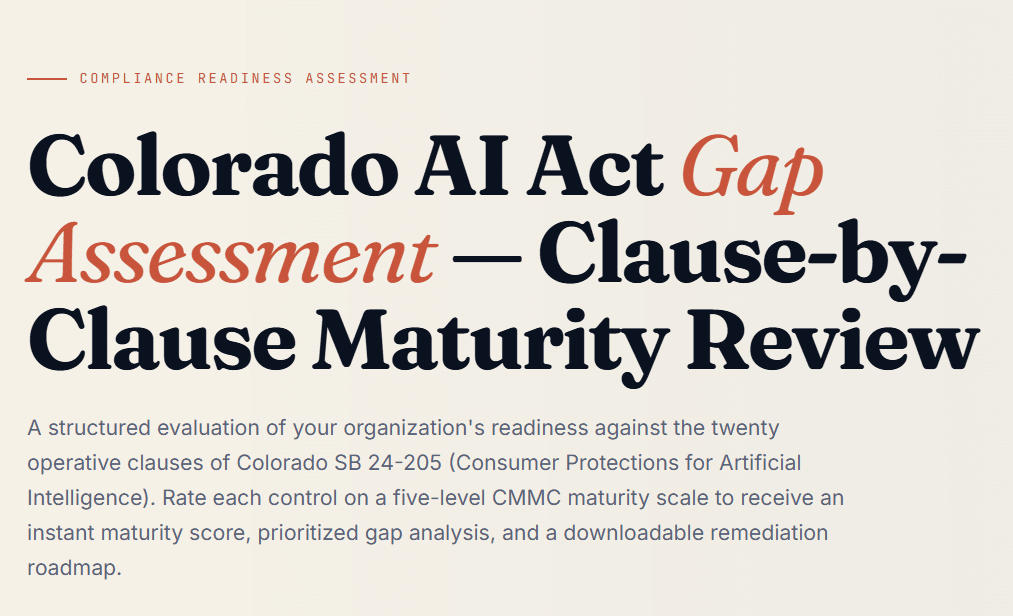
That is precisely what we built. Last week we released a free, twenty-clause Colorado AI Act Gap Assessment that walks any organization through the operative duties of SB 24-205 in about fifteen minutes. It returns an instant CMMC-aligned maturity score, identifies your top five priority gaps, and produces a downloadable PDF report you can take into your next compliance steering committee.
Maximum Penalty · Per Affected Consumer $20K
Violations are counted separately for each consumer or transaction involved. A single non-compliant decisioning system processing 1,000 Colorado consumers carries up to $20 million in exposure.
The twenty operative clauses we assess
Walk through Sections 6-1-1701 through 6-1-1706 of the Colorado Revised Statutes and you will find roughly twenty distinct, operative duties. They split cleanly into five buckets.
Developer duties (§ 6-1-1702) govern any organization doing business in Colorado that builds or substantially modifies a high-risk AI system. These cover the duty of reasonable care, the deployer disclosure package, impact-assessment documentation, the public website statement summarizing high-risk systems, and the 90-day Attorney General disclosure of any newly discovered discrimination risk.
Deployer duties (§ 6-1-1703) govern anyone who uses a high-risk AI system to make consequential decisions about Colorado consumers. These are the bulk of the statute: the duty of reasonable care, the risk management policy and program, impact assessments at deployment and annually thereafter, the annual review requirement, and the small-business exemption test.
Consumer rights (§ 6-1-1704) establish the pre-decision notice, the adverse-decision explanation right, the right to correct personal data, the right to appeal with human review where technically feasible, the public deployer transparency statement, and the deployer’s own 90-day Attorney General notification duty.
AI interaction disclosure (§ 6-1-1705) requires that consumers be informed when they are interacting with an AI system — chatbot, voice agent, recommender — unless it would be obvious to a reasonable person.
The affirmative defense posture (§ 6-1-1706) contains, in our view, the single most important sentence in the statute for compliance teams. We come back to it below.
§ 6-1-1703(3) · Deployer Impact Assessment
An example of statutory specificity that surprises most teams
A deployer’s impact assessment must cover, at minimum, nine statutory elements: purpose, intended use, deployment context, benefits, categories of data processed, outputs produced, monitoring metrics, transparency mechanisms, and post-deployment safeguards. It must be completed before deployment, refreshed annually, and re-run within 90 days of any “intentional and substantial modification.” Most teams discover this the week of an audit.
Why a five-level maturity scale, not a yes/no checklist
A binary checklist tells you whether something exists. It does not tell you whether it works. A vendor risk policy that lives in SharePoint and was last opened in 2023 is technically “in place.” It is not, in any practical sense, going to survive an Attorney General inquiry into how your organization manages algorithmic discrimination.
The CMMC five-level scale — Initial, Managed, Defined, Quantitative, Optimizing — exists precisely to capture that gap between “we have a document” and “we have a working program.” A Level 2 control is documented but inconsistently applied. A Level 3 control is standardized organization-wide with assigned roles, training, and a review cadence. A Level 4 control is measured with KPIs. A Level 5 control is continuously improved through feedback and benchmarking.
For a regulator weighing whether your organization exercised reasonable care, the difference between Level 2 and Level 3 is the difference between an enforcement action and a closed inquiry.
The affirmative defense play most teams are missing
Buried in § 6-1-1706 is a sentence that should drive every compliance program decision your organization makes between now and June 30: a developer, deployer, or other person has an affirmative defense if they are in compliance with a “nationally or internationally recognized risk management framework for artificial intelligence systems.” The statute, the legislative history, and the rulemaking guidance to date all point in the same direction — that means NIST AI RMF or ISO/IEC 42001.
“Recognized framework adoption is not a nice-to-have. Under § 6-1-1706, it is the strongest enforcement defense the statute makes available to you.”
Translation: every dollar your organization spends on a structured ISO 42001 implementation or a documented NIST AI RMF adoption is a dollar buying down enforcement risk in a way that ad-hoc policy work cannot. We have been operating from this premise on every Colorado AI Act engagement we run. We have also deployed an ISO 42001 management system end-to-end at ShareVault, a virtual data room platform serving M&A and financial services clients — so we have a working view of what a defensible program actually looks like under audit.
What the assessment report tells you
When you complete the assessment, the report produces four things in sequence.
An overall maturity score from 0 to 100, calibrated to a five-tier readiness narrative ranging from Initial Exposure (significant remediation required) to Optimizing (exemplary readiness, likely qualifying for the affirmative defense). The score is the arithmetic mean of your twenty clause ratings, multiplied by twenty.
A maturity distribution across the five CMMC levels, so leadership can see at a glance how many clauses sit at each tier. A program with twelve clauses at Level 3 looks very different from one with twelve clauses at Level 2, even when the average score is identical.
Your top five priority gaps, ranked by ascending score and broken out clause-by-clause with descriptions and concrete remediation guidance. These are the items that give you the largest reduction in enforcement exposure for the least implementation effort.
A downloadable, branded PDF report with a 90-day roadmap split into Stabilize (days 1–30), Formalize (days 31–60), and Operationalize (days 61–90). The PDF is the artifact you take into a board update, a budget conversation, or a kickoff meeting with implementation counsel.
The four mistakes we see most often
1) Treating the small-business exemption as a free pass
The exemption for organizations with fewer than 50 full-time employees only applies if you do not use your own data to train or fine-tune the AI system. Most B2B SaaS companies use their own customer data to fine-tune models. The exemption evaporates the moment you do.
2) Confusing developer with deployer
A SaaS vendor that builds an AI feature and sells it is a developer. A SaaS vendor that uses that AI feature internally for hiring or pricing is also a deployer. Many companies are both, and the duties stack rather than substitute. Your assessment needs to cover both roles where they apply.
3) Assuming the law does not apply to general-purpose generative AI
Generative AI systems are out of scope only when they are not making or substantially influencing consequential decisions. The moment a chatbot is gating access to a service, screening a job application, or driving a credit determination, it is in scope — full stop.
4) Waiting for Attorney General rulemaking before acting
The duty of reasonable care exists on June 30, 2026, with or without finalized rules. The rules will sharpen specific documentation requirements; they will not create or excuse the underlying duties. Waiting for clarity is not, itself, a reasonable-care posture.
What to do this week
If you have not already inventoried which of your AI systems qualify as “high-risk” under the statute, do that first — it is the prerequisite for every other duty. The systems most likely to qualify are anything that touches employment, education, financial services, healthcare, housing, insurance, legal services, or essential government services in a way that materially affects Colorado consumers.
Second, take the gap assessment. It is free, takes about fifteen minutes, and produces a defensible artifact you can put in front of leadership the same day. The link is below. If your score lands above 70, you are in solid shape and the report will help you focus your final pre-effective-date polish. If your score lands below 55, the report becomes the project plan for the next ten weeks.
Third — and this is the harder conversation — decide whether you are going to pursue the § 6-1-1706 affirmative defense posture. ISO 42001 certification is a six-to-nine month engagement when run by a team that has done it before. NIST AI RMF adoption is faster but produces a less audit-ready artifact. Both are materially better than ad-hoc compliance. Neither is something you start the week of the deadline.
Free Assessment Tool
Take the Colorado AI Act Gap Assessment
Twenty clauses. Five maturity levels. An instant score, your top five priority gaps, and a downloadable PDF report with a 90-day roadmap. Built by the team that delivered ISO 42001 certification at ShareVault.
A closing note on enforcement reality
Colorado’s Attorney General has exclusive enforcement authority under the statute, and violations are counted per consumer or per transaction. Five hundred Colorado consumers screened by a non-compliant employment AI system carries up to ten million dollars in penalty exposure. One thousand consumers carries twenty. Those numbers are why we keep writing about this law: the math punishes inaction at a scale most product, legal, and security teams have not internalized yet.
The good news is that ten weeks is more time than it sounds. We have stood up defensible AI governance programs in less. The first step is knowing exactly where you stand.
Perspective: Why AI Governance Enforcement Is the Key
AI governance fails when it remains theoretical. Policies, frameworks, and ethics statements mean little unless they are enforced at execution time. The shift happening now—driven by regulations and real-world risk—is from “intent” to “proof.” Organizations are no longer judged by what policies they publish, but by what they can demonstrably enforce and audit.
Enforcement is the missing link because it creates accountability, consistency, and evidence:
- Accountability: Every AI decision is evaluated against rules.
- Consistency: Policies apply uniformly across all systems and channels.
- Evidence: Audit trails are generated automatically, not reconstructed later.
In simple terms:
Without enforcement, governance is documentation.
With enforcement, governance becomes control.
That’s why AI governance enforcement is not just a feature—it’s the foundation for making AI governance actually work at scale.
## Ready to Operationalize AI Governance?
If you’re serious about moving from **AI governance theory → real enforcement**,
DISC InfoSec can help you build the control layer your AI systems need.
Book a free consultation: [info@deurainfosec.com]
Written by
DISC InfoSec

InfoSec services | InfoSec books | Follow our blog | DISC llc is listed on The vCISO Directory | ISO 27k Chat bot | Comprehensive vCISO Services | ISMS Services | AIMS Services | Security Risk Assessment Services | Mergers and Acquisition Security
DISC InfoSec is an AI governance and cybersecurity consulting firm serving B2B SaaS and financial services organizations. Our virtual Chief AI Officer (vCAIO) model puts one seasoned expert on your program — no coordination overhead, no theory-only deliverables. We are a PECB Authorized Training Partner with active engagements implementing ISO/IEC 42001, NIST AI RMF, ISO/IEC 27001, EU AI Act, and Colorado SB 24-205 programs.
CISSP · CISM · ISO 27001 LI · ISO 42001 LI · 16+ years
- The Evidence Lifecycle: Which Organizational Events to Log for Liability — and How Long to Keep Them
- 14 Months to Comply. 12 Months of Work. The High-Risk AI Playbook Nobody Has Started
- Your biggest AI risk isn’t hackers. It’s your own data walking out the door
- The cheapest security control you’ll ever implement is the component you decided not to build
- AI Handoffs: How Uncertainty Propagates—and How to Fix It




April 21st, 2026 4:21 pm
[…] fast. Twelve months ago, “we’re still figuring it out” was a defensible answer. The Colorado AI Act is 70 days away. Today, with regulators issuing guidance, customers writing AI clauses into MSAs, and insurers […]