A reliable industry context about AI and cybersecurity frameworks from recent market and trend reports. I’ll then give a clear opinion at the end.
1. AI Is Now Core to Cyber Defense
Artificial Intelligence is transforming how organizations defend against digital threats. Traditional signature-based security tools struggle to keep up with modern attacks, so companies are using AI—especially machine learning and behavioral analytics—to detect anomalies, predict risks, and automate responses in real time. This integration is now central to mature cybersecurity programs.
2. Market Expansion Reflects Strategic Adoption
The AI cybersecurity market is growing rapidly, with estimates projecting expansion from tens of billions today into the hundreds of billions within the next decade. This reflects more than hype—organizations across sectors are investing heavily in AI-enabled threat platforms to improve detection, reduce manual workload, and respond faster to attacks.
3. AI Architectures Span Detection to Response
Modern frameworks incorporate diverse AI technologies such as natural language processing, neural networks, predictive analytics, and robotic process automation. These tools support everything from network monitoring and endpoint protection to identity-based threat management and automated incident response.
4. Cloud and Hybrid Environments Drive Adoption
Cloud migrations and hybrid IT architectures have expanded attack surfaces, prompting more use of AI solutions that can scale across distributed environments. Cloud-native AI tools enable continuous monitoring and adaptive defenses that are harder to achieve with legacy on-premises systems.
5. Regulatory and Compliance Imperatives Are Growing
As digital transformation proceeds, regulatory expectations are rising too. Many frameworks now embed explainable AI and compliance-friendly models that help organizations demonstrate legal and ethical governance in areas like data privacy and secure AI operations.
6. Integration Challenges Remain
Despite the advantages, adopting AI frameworks isn’t plug-and-play. Organizations face hurdles including high implementation cost, lack of skilled AI security talent, and difficulties integrating new tools with legacy architectures. These challenges can slow deployment and reduce immediate ROI. (Inferred from general market trends)
7. Sophisticated Threats Demand Sophisticated Defenses
AI is both a defensive tool and a capability leveraged by attackers. Adversarial AI can generate more convincing phishing, exploit model weaknesses, and automate aspects of attacks. A robust cybersecurity framework must account for this dual role and include AI-specific risk controls.
8. Organizational Adoption Varies Widely
Enterprise adoption is strong, especially in regulated sectors like finance, healthcare, and government, while many small and medium businesses remain cautious due to cost and trust issues. This uneven adoption means frameworks must be flexible enough to suit different maturity levels. (From broader industry reports)
9. Frameworks Are Evolving With the Threat Landscape
Rather than static checklists, AI cybersecurity frameworks now emphasize continuous adaptation—integrating real-time risk assessment, behavioral intelligence, and autonomous response capabilities. This shift reflects the fact that cyber risk is dynamic and cannot be mitigated solely by periodic assessments or manual controls.
Opinion
AI-centric cybersecurity frameworks represent a necessary evolution in defense strategy, not a temporary trend. The old model of perimeter defense and signature matching simply doesn’t scale in an era of massive data volumes, sophisticated AI-augmented threats, and 24/7 cloud operations. However, the promise of AI must be tempered with governance rigor. Organizations that treat AI as a magic bullet will face blind spots and risks—especially around privacy, explainability, and integration complexity.
Ultimately, the most effective AI cybersecurity frameworks will balance automated, real-time intelligence with human oversight and clear governance policies. This blend maximizes defensive value while mitigating potential misuse or operational failures.
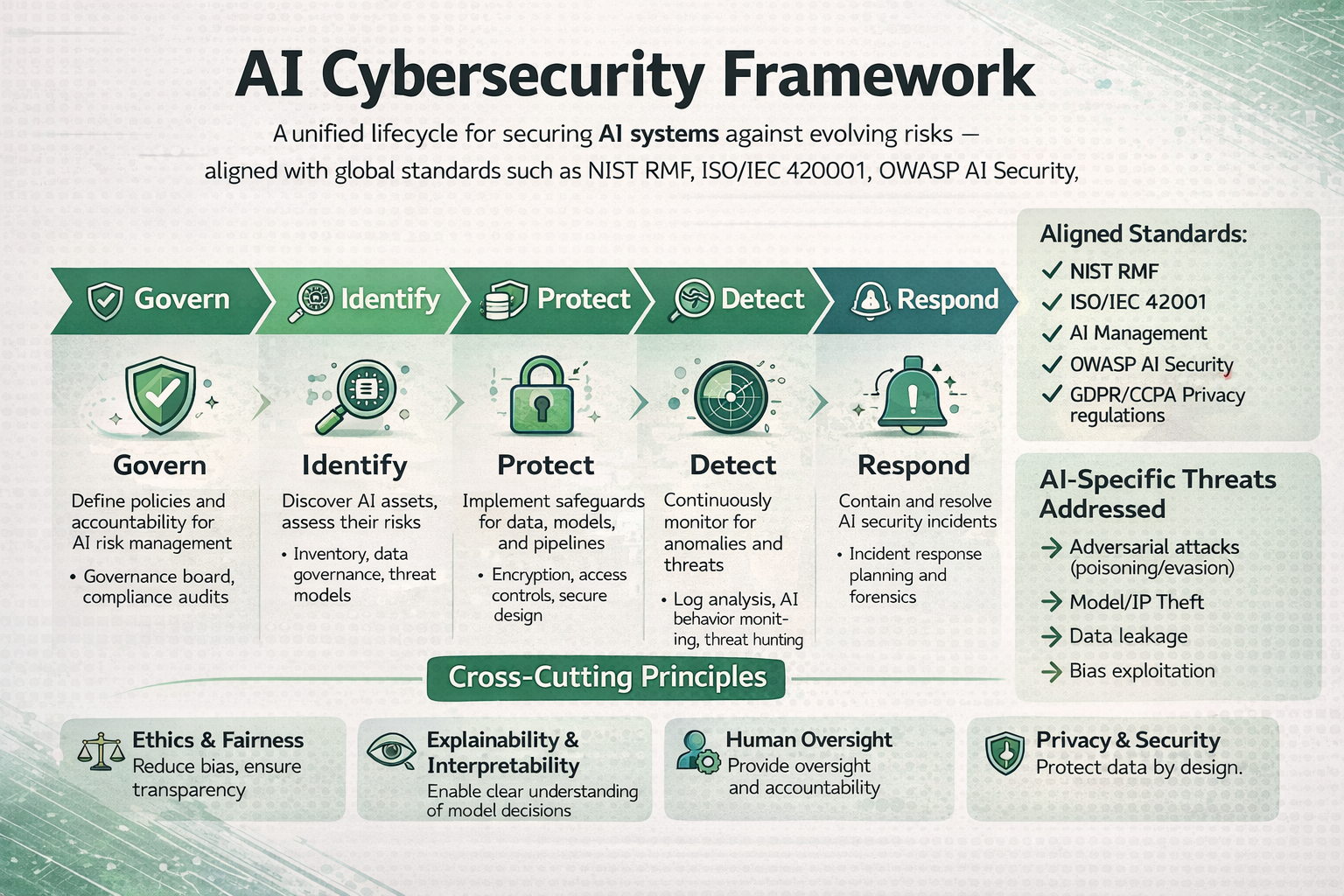
AI Cybersecurity Framework — Summary
AI Cybersecurity framework provides a holistic approach to securing AI systems by integrating governance, risk management, and technical defense across the full AI lifecycle. It aligns with widely-accepted standards such as NIST RMF, ISO/IEC 42001, OWASP AI Security Top 10, and privacy regulations (e.g., GDPR, CCPA).
1️⃣ Govern
Set strategic direction and oversight for AI risk.
- Goals: Define policies, accountability, and acceptable risk levels
- Key Controls: AI governance board, ethical guidelines, compliance checks
- Outcomes: Approved AI policies, clear governance structures, documented risk appetite
2️⃣ Identify
Understand what needs protection and the related risks.
- Goals: Map AI assets, data flows, threat landscape
- Key Controls: Asset inventory, access governance, threat modeling
- Outcomes: Risk register, inventory map, AI threat profiles
3️⃣ Protect
Implement safeguards for AI data, models, and infrastructure.
- Goals: Prevent unauthorized access and protect model integrity
- Key Controls: Encryption, access control, secure development lifecycle
- Outcomes: Hardened architecture, encrypted data, well-trained teams
4️⃣ Detect
Find signs of attack or malfunction in real time.
- Goals: Monitor models, identify anomalies early
- Key Controls: Logging, threat detection, model behavior monitoring
- Outcomes: Alerts, anomaly reports, high-quality threat intelligence
5️⃣ Respond
Act quickly to contain and resolve security incidents.
- Goals: Minimize damage and prevent escalation
- Key Controls: Incident response plans, investigations, forensics
- Outcomes: Detailed incident reports, corrective actions, improved readiness
6️⃣ Recover
Restore normal operations and reduce the chances of repeat incidents.
- Goals: Service continuity and post-incident improvement
- Key Controls: Backup and recovery, resilience testing
- Outcomes: Restored systems and lessons learned that enhance resilience
Cross-Cutting Principles
These safeguards apply throughout all phases:
- Ethics & Fairness: Reduce bias, ensure transparency
- Explainability & Interpretability: Understand model decisions
- Human-in-the-Loop: Oversight and accountability remain essential
- Privacy & Security: Protect data by design
AI-Specific Threats Addressed
- Adversarial attacks (poisoning, evasion)
- Model theft and intellectual property loss
- Data leakage and inference attacks
- Bias manipulation and harmful outcomes
Overall Message
This framework ensures trustworthy, secure, and resilient AI operations by applying structured controls from design through incident recovery—combining cybersecurity rigor with ethical and responsible AI practices.
InfoSec services | InfoSec books | Follow our blog | DISC llc is listed on The vCISO Directory | ISO 27k Chat bot | Comprehensive vCISO Services | ISMS Services | Security Risk Assessment Services | Mergers and Acquisition Security
- How ISO 27001 Lead Auditors Should Evaluate AI Risks in an ISMS
- Secure Your Web & API Applications Before Attackers Do: Reduce Vulnerabilities
- Is ISO 27001 Training Right for You? Here’s Who Should Consider It
- Top 15 Kali Linux Tools for AI Governance with Use Cases
- Risk Management with GRC platform: Mapping ISO 42001 Clause 6 to AI Governance