
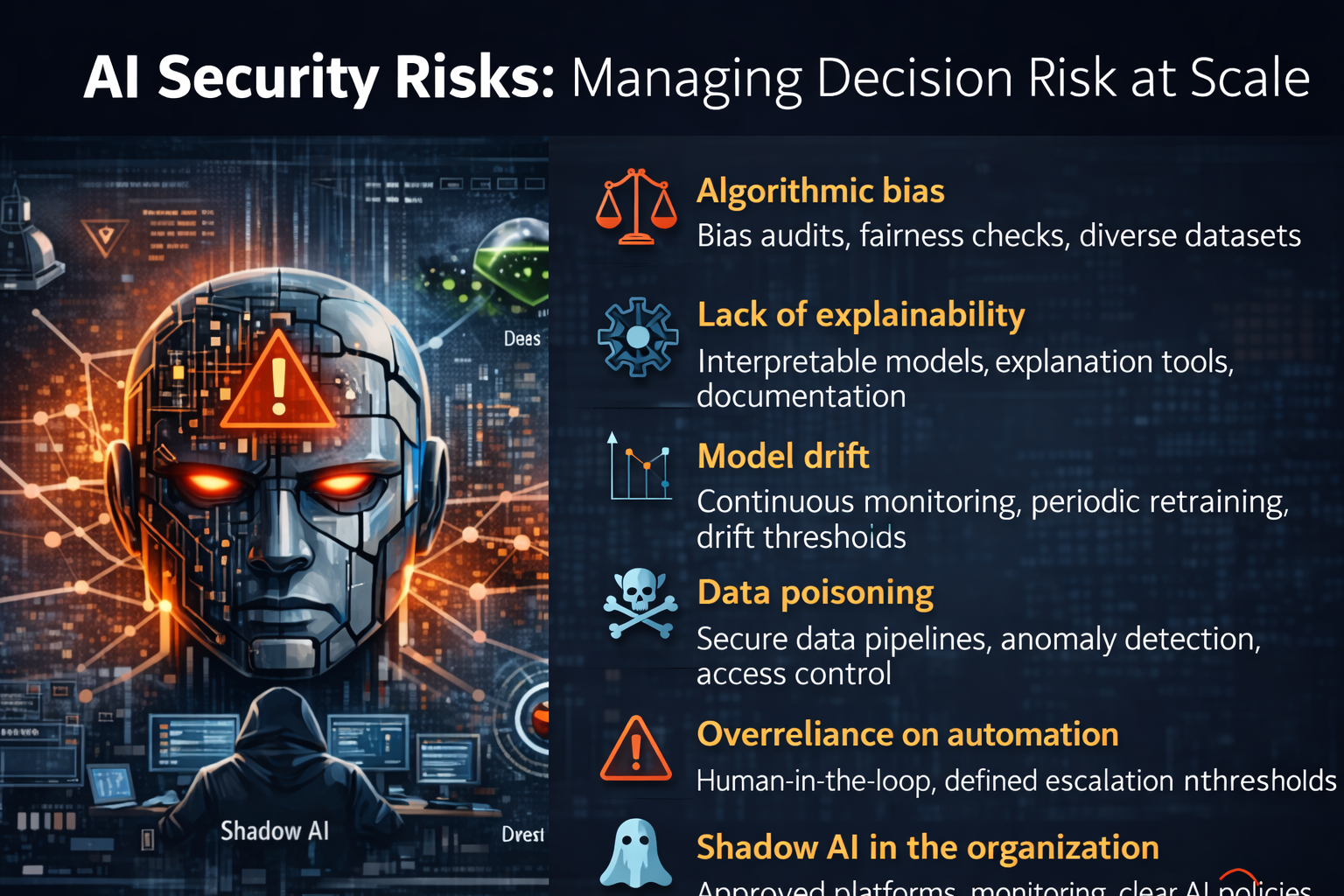
Artificial Intelligence introduces a new class of security risks because it combines data, code, automation, and autonomous decision-making at scale. Unlike traditional software, AI systems continuously learn, adapt, and influence business outcomes — often without full transparency. This creates compounded risk across data integrity, compliance, ethics, operational resilience, and governance. When poorly governed, AI doesn’t just fail quietly; it can amplify errors, bias, and security weaknesses across the enterprise in real time.
Algorithmic bias occurs when models produce systematically unfair or discriminatory outcomes due to biased training data or flawed assumptions. This can expose organizations to regulatory, reputational, and legal risk.
Remediation: Implement diverse and representative datasets, conduct bias testing before deployment, perform fairness audits, and establish AI governance committees that review high-impact use cases.
Lack of explainability refers to “black box” models whose decisions cannot be clearly interpreted or justified. This becomes critical in regulated industries where decisions must be defensible.
Remediation: Use interpretable models where possible, deploy explainability tools (e.g., SHAP, LIME), document model logic, and enforce transparency requirements for high-risk AI systems.
Model drift happens when model performance degrades over time because real-world data changes from the original training environment. This silently increases operational and decision risk.
Remediation: Continuously monitor performance metrics, implement automated retraining pipelines, define drift thresholds, and establish lifecycle governance with periodic validation.
Data poisoning is a security threat where attackers manipulate training data to influence model behavior, potentially creating backdoors or skewed outputs.
Remediation: Secure data pipelines, validate data integrity, restrict training data access, use anomaly detection, and implement supply chain security controls for third-party datasets.
Overreliance on automation occurs when organizations defer too much authority to AI without sufficient human oversight. This increases systemic failure risk when models make incorrect or unsafe decisions.
Remediation: Maintain human-in-the-loop controls for high-impact decisions, define escalation thresholds, and conduct regular performance and scenario testing.
Shadow AI in the organization mirrors Shadow IT — employees deploying AI tools without governance, security review, or compliance alignment. This creates uncontrolled data exposure and compliance violations.
Remediation: Establish clear AI usage policies, provide approved AI platforms, monitor AI-related API traffic, conduct awareness training, and align AI governance with enterprise risk management.
Perspective: AI Risk = Decision Risk at Scale
Traditional IT risk is system risk. AI risk is decision risk — multiplied. AI systems don’t just process data; they make or influence decisions that affect customers, finances, compliance, and operations. When a flawed model is deployed, its errors scale instantly across thousands or millions of transactions. That’s why AI governance is not simply a technical concern — it is a board-level risk issue.
Organizations that treat AI risk as decision governance — integrating security, compliance, model validation, and executive oversight — will reduce loss expectancy while improving operational efficiency. Those that don’t will eventually discover that unmanaged AI doesn’t fail gradually — it fails at scale.

InfoSec services | InfoSec books | Follow our blog | DISC llc is listed on The vCISO Directory | ISO 27k Chat bot | Comprehensive vCISO Services | ISMS Services | AIMS Services | Security Risk Assessment Services | Mergers and Acquisition Security
At DISC InfoSec, we help organizations navigate this landscape by aligning AI risk management, governance, security, and compliance into a single, practical roadmap. Whether you are experimenting with AI or deploying it at scale, we help you choose and operationalize the right frameworks to reduce risk and build trust. Learn more at DISC InfoSec.
- Measure What Matters: Security & AI Readiness Scorecard
- Security Is a People Problem: Culture, Behavior, and Decisions Drive Cyber Resilience
- Security Driven by Business Value: Focus, Prioritize, Protect What Matters Most
- Claude Mythos and the Future of Cybersecurity: Powerful—and Potentially Dangerous
- Hackers at Machine Speed: The AI Cybersecurity Reality





