Jan 26 2026

Why Defining Risk Appetite, Risk Tolerance, and Risk Capacity Is Essential to Effective Risk Management

Category: Risk Assessment,Security Risk Assessmentdisc7 @ 11:57 am

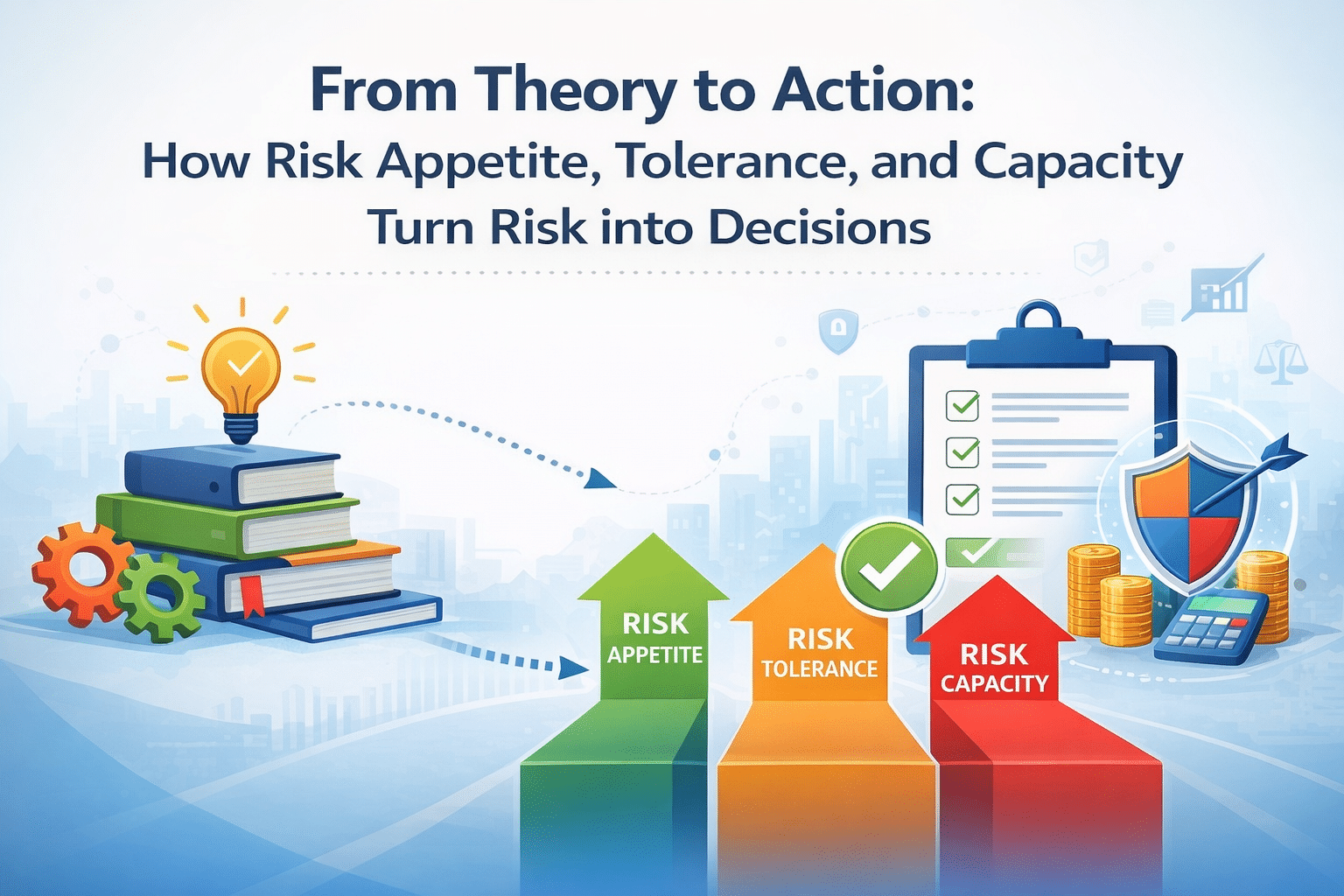
Defining risk appetite, risk tolerance, and risk capacity is foundational to effective risk management because they set the boundaries for decision-making, ensure consistency, and prevent both reckless risk-taking and over-conservatism. Each plays a distinct role:


1. Risk Appetite – Strategic Intent

What it is:
The amount and type of risk an organization is willing to pursue to achieve its objectives.

Why it’s necessary:

  • Aligns risk-taking with business strategy
  • Guides leadership on where to invest, innovate, or avoid
  • Prevents ad-hoc or emotion-driven decisions
  • Provides a top-down signal to management and staff

Example:

“We are willing to accept moderate cybersecurity risk to accelerate digital innovation, but zero tolerance for regulatory non-compliance.”

Without a defined appetite, risk decisions become inconsistent and reactive.


2. Risk Tolerance – Operational Guardrails

What it is:
The acceptable variation around the risk appetite—usually expressed as measurable limits.

Why it’s necessary:

  • Translates strategy into actionable thresholds
  • Enables monitoring and escalation
  • Supports objective decision-making
  • Prevents “death by risk avoidance” or uncontrolled exposure

Example:

  • Maximum acceptable downtime: 4 hours
  • Acceptable phishing click rate: <3%
  • Financial loss per incident: <$250K

Risk appetite without tolerance is too abstract to manage day-to-day risk.


3. Risk Capacity – Hard Limits

What it is:
The maximum risk the organization can absorb without threatening survival (financial, legal, operational, reputational).

Why it’s necessary:

  • Establishes non-negotiable boundaries
  • Prevents existential or catastrophic risk
  • Informs stress testing and scenario analysis
  • Ensures risk appetite is realistic, not aspirational

Example:

  • Cash reserves can absorb only one major ransomware event
  • Loss of a specific license would shut down operations

Risk capacity is about what you can survive, not what you prefer.


How They Work Together

ConceptQuestion It AnswersFocus
Risk AppetiteWhat risk do we want to take?Strategy
Risk ToleranceHow much deviation is acceptable?Operations
Risk CapacityHow much risk can we survive?Survival

Golden Rule:

Risk appetite must always stay within risk capacity, and risk tolerance enforces appetite in practice.


Why This Matters (Especially for Governance & Compliance)

  • Required by ISO 27001, ISO 31000, COSO ERM, NIST, ISO 42001
  • Enables defensible decisions for auditors and regulators
  • Strengthens board oversight and executive accountability
  • Critical for cyber risk, AI risk, third-party risk, and resilience planning

In One Line

Defining risk appetite, tolerance, and capacity ensures an organization takes the right risks, in the right amount, without risking its existence.

Risk appetite, risk tolerance, and risk capacity describe different but closely related dimensions of how an organization deals with risk. Risk appetite defines the level of risk an organization is willing to accept in pursuit of its objectives. It reflects intent and ambition: too little risk appetite can result in missed opportunities, while staying within appetite is generally acceptable. Exceeding appetite signals that mitigation is required because the organization is operating beyond what it has consciously agreed to accept.

Risk tolerance translates appetite into measurable thresholds that trigger action. It sets the boundaries for monitoring and review. When outcomes fall below tolerance, they are usually still acceptable, but when outcomes sit within tolerance limits, mitigation may already be required. Once tolerance is exceeded, the situation demands immediate escalation, as predefined limits have been breached and governance intervention is needed.

Risk capacity represents the absolute limit of risk an organization can absorb without threatening its viability. It is non-negotiable. Operating below capacity still requires mitigation, operating within capacity often demands immediate escalation, and exceeding capacity is simply not acceptable. At that point, the organization’s survival, legal standing, or core mission may be at risk.

Together, these three concepts form a hierarchy: appetite expresses willingness, tolerance defines control points, and capacity marks the hard stop.


Opinion on the statement

The statement “When appetite, tolerance, and capacity are clearly defined (and consistently understood), risk stops being theoretical and becomes a practical decision guide” is accurate and highly practical, especially in governance and security contexts.

Without clear definitions, risk discussions stay abstract—people debate “high” or “low” risk without shared meaning. When these concepts are defined, risk becomes operational. Decisions can be made quickly and consistently because everyone knows what is acceptable, what requires action, and what is unacceptable.

Example (Information Security / vCISO context):
An organization may have a risk appetite that accepts moderate operational risk to enable faster digital transformation. Its risk tolerance might specify that any vulnerability with a CVSS score above 7.5 must be remediated within 14 days. Its risk capacity could be defined as “no risk that could result in regulatory fines exceeding $2M or prolonged service outage.”
With this clarity, a newly discovered critical vulnerability is no longer a debate—it either sits within tolerance (monitor), exceeds tolerance (mitigate and escalate), or threatens capacity (stop deployment immediately).

Example (AI governance):
A company may accept some experimentation risk (appetite) with internal AI tools, tolerate limited model inaccuracies under defined error rates (tolerance), but have zero capacity for risks that could cause regulatory non-compliance or IP leakage. This makes go/no-go decisions on AI use cases clear and defensible.

In practice, clearly defining appetite, tolerance, and capacity turns risk management from a compliance exercise into a decision-making framework. It aligns leadership intent with operational action—and that is where risk management delivers real value.

InfoSec services | InfoSec books | Follow our blog | DISC llc is listed on The vCISO Directory | ISO 27k Chat bot | Comprehensive vCISO Services | ISMS Services | AIMS Services | Security Risk Assessment Services | Mergers and Acquisition Security

At DISC InfoSec, we help organizations navigate this landscape by aligning AI risk management, governance, security, and compliance into a single, practical roadmap. Whether you are experimenting with AI or deploying it at scale, we help you choose and operationalize the right frameworks to reduce risk and build trust. Learn more at DISC InfoSec.

Tags: risk appetite, risk capacity, Risk management, risk tolerance


Sep 20 2023

Balancing budget and system security: Approaches to risk tolerance

Category: Risk Assessment,Security Risk Assessmentdisc7 @ 10:56 am

Recently, it was revealed that Nickelodeon, an American TV channel and brand, has been the victim of a data leak. According to sources, the breach occurred at the beginning of 2023, but much of the data involved was “related to production files only, not long-form content or employee or user data, and (appeared) to be decades old.” The implication of this ambiguous statement: because the data is old and not related to individuals’ personally identifiable information (PII) or any proprietary information that hasn’t already been publicly released, this is a non-incident.

Let’s say Nickelodeon didn’t suffer any material harm because of this incident — great! It’s probable, though, that there are facts we don’t know. Any time proprietary data ends up where it shouldn’t, warning bells should go off in security professionals’ heads. What would be the outcome if the “decades old” files did contain PII? Some of the data would be irrelevant, but some could be crucial. What if the files contained other protected or private data? What if they compromised the integrity of the brand? All organizations need to think through the “what ifs” and apply the worst and base case scenarios to their current security practices.

The Nickelodeon case raises the question of whether keeping “decades old” data is necessary. While holding onto historical data can, in some cases, benefit the organization, every piece of kept data increases the company’s attack surface and increases risk. Why did Nickelodeon keep the old files in a location where it could be easily accessed? If the files were in a separate location, the security team likely did not apply adequate controls to accessing the files. Given that the cost of securing technology and all its inherent complexity is already astronomically high, CISOs need to prioritize budgetary and workforce allocation for all security projects and processes, including those for all past, present, and future data protection.

In a slow economy, balancing system security and budget requires skill and savvy. Even in boom times, though, throwing more money at the problem doesn’t always help. There is no evidence that an increase in security spending proportionately improves an organization’s security posture. In fact, some studies suggest that an overabundance of security tools leads to more confusion and complexity. CISOs should therefore focus on business risk tolerance and reduction.

Approaches to cyber risk management

Because no two organizations are alike, every CISO must find a cyber risk management approach that aligns with the goals, culture, and risk tolerance of the organization. Budget plays an important role here, too, but securing more budget will be an easier task if the security goals align with those of the business. After taking stock of these considerations, CISOs may find that their organizations fall into one or more core approaches to risk management.

Risk tolerance-based approach

Every company– and even every department within a company– has a tolerance for the amount and type of risk they’re willing to take. Security-specific tolerance levels must be based on desired business outcomes; cyber security risk cannot be determined or calculated based on cybersecurity efforts alone, rather how those efforts support the larger business.

To align cybersecurity with business risk, security teams must address business resilience by considering the following questions:

  • How would the business be impacted if a cybersecurity event were to occur?
  • What are the productivity, operational, and financial implications of a cyber event or data breach?
  • How well equipped is the business to handle an event internally?
  • What external resources would be needed to support internal capabilities?

With answers to these types of questions and metrics to support them, cyber risk levels can be appropriately set.

Maturity-based approach

Many companies today estimate their cyber risk tolerance based on how mature they perceive their cybersecurity team and controls to be. For instance, companies with an internal security operations center (SOC) that supports a full complement of experienced staff might be better equipped to handle continuous monitoring and vulnerability triage than a company just getting its security team up and running. Mature security teams are good at prioritizing and remediating critical vulnerabilities and closing the gaps on imminent threats, which generally gives them a higher security risk tolerance.

That said, many SOC teams are too overwhelmed with data, alerts, and technology maintenance to focus on risk reduction. The first thing a company must do if it decides to take on a maturity-based approach is to honestly assess its own level of security maturity, capabilities, and efficacy. A truly mature cybersecurity organization isbetter equipped to manage risk, but self-awareness is vital for security teams regardless of maturity level.

Budget-based approach

Budget constraints are prevalent in all aspects of business today, and running a fully staffed, fully equipped cybersecurity program is no bargain in terms of cost. However, organizations with an abundance of staff and technology don’t necessarily perform better security- or risk-wise. It’s all about being budget savvy for what will be a true compliment to existing systems.

Invest in tools that move the organization toward a zero trust-based architecture, focusing on security foundation and good hygiene first. By laying the right foundations, and having competent staff to manage them, cybersecurity teams will be better off than having the latest and greatest tools implemented without mastering the top CIS Controls: Inventory and control of enterprise and software assets, basic data protection, secure configuration management, hardened access management, log management, and more.

Threat-based approach

An important aspect of a threat-based approach to risk management is understanding that vulnerabilities and threats are not the same thing. Open vulnerabilities can lead to threats (and should therefore be a standard part of every organization’s security process and program). “Threats,” however, refer to a person/persons or event in which a vulnerability has the potential to be exploited. Threats also rely on context and availability of a system or a resource.

For instance, the Log4Shell exploit took advantage of a Log4j vulnerability. The vulnerability resulted in a threat to organizations with an unpatched version of the utility running. Organizations that were not running unpatched versions — no threat.

It is therefore imperative for organizations to know concretely:

  • All assets and entities present in their IT estates
  • The security hygiene of those assets (point in time and historical)
  • Context of the assets (non-critical, business-critical; exposed to the internet or air-gapped; etc.)
  • Implemented and operational controls to secure those assets

With this information and context, security teams can start to build threat models appropriate for the organization and its risk tolerance. The threat models used will, in turn, allow teams to prioritize and manage threats and more effectively reduce risk.

People, process and technology-based approach

People, process, and technology (PPT) are often considered the “three pillars” of technology. Some security pros consider PPT to be a framework. Through whatever lens PPT is viewed, it is the most comprehensive approach to risk management.

A PPT approach has the goal of allowing security teams to holistically manage risk while incorporating an organization’s maturity, budget, threat profile, human resources, skill sets, and the entirety of the organization’s tech stack, as well as its operations and procedures, risk appetite, and more. A well-balanced PPT program is a multi-layered plan that relies evenly on all three pillars; any weakness in one of the areas tips the scales and makes it harder for security teams to achieve success — and manage risk.

The wrap up

Every organization should carefully evaluate its individual capabilities, business goals, and available resources to determine the best risk management strategy for them. Whichever path is chosen, it is imperative for security teams to align with the business and involve organizational stakeholders to ensure ongoing support.

RISK ASSESSMENT: AN INDEPTH GUIDE TO PRINCIPLES, METHODS, BEST PRACTISE, AND INTERVIEW QUESTIONS AND ANSWERS

InfoSec tools | InfoSec services | InfoSec books | Follow our blog | DISC llc is listed on The vCISO Directory

Tags: risk tolerance