When AI becomes the gatekeeper of human consciousness. We keep asking if AI will take the throne. I think we already handed it over.
Nov 19, 2026 · @disc
The inscription above the gate
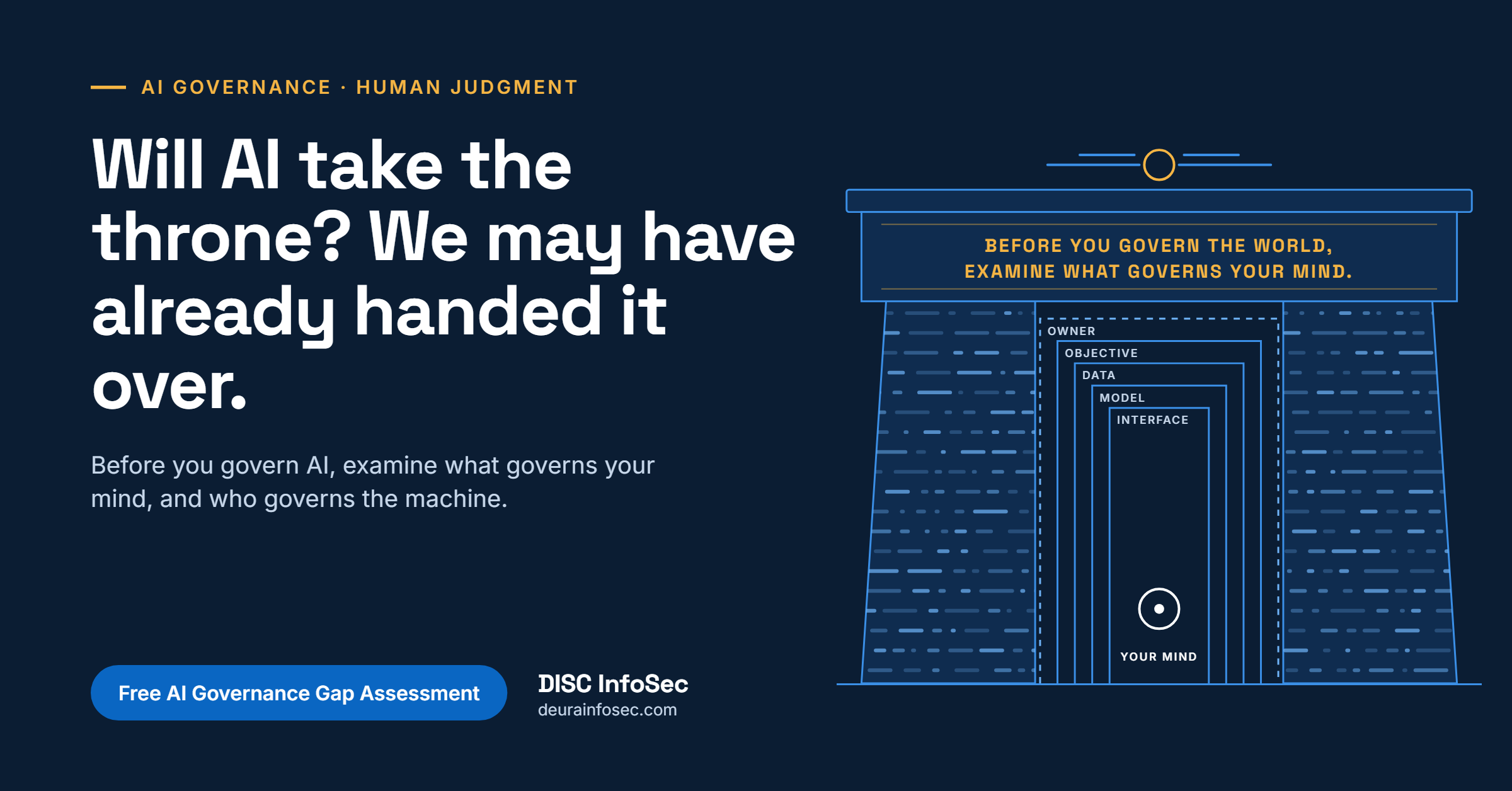
Above the entrance, one line is carved into the stone: “Before you govern the world, examine what governs your mind.”
The initiate does not get the answers at the door. He earns them. Through discipline, through silence, through years of learning which questions are worth asking.
Fast forward a few thousand years. We are standing in front of another temple.
Its walls are made of data. Its priests are algorithms. Its inner chambers belong to whoever owns the compute, the models, and the platforms.
And something fundamental has flipped.
The ancient initiate found wisdom by questioning. The modern citizen increasingly receives the answer before discovering which question deserved to be asked.
AI is not just speeding up human thought. It is becoming part of the architecture that organizes thought, validates it, and monetizes it.
So before we argue about governing AI, I want to ask an older, harder question.
Do we actually understand our own minds? Have we conquered them? Or are we handing the keys to a temple we never finished exploring?
The governance paradox
Here is the paradox I keep running into.
We spend enormous energy debating whether machines will become intelligent enough to govern humanity. Conferences, op-eds, think-tank reports.
Meanwhile, we pay far too little attention to the institutions that already govern the machines.
Who picked the training data? Who decided what the model optimizes for? Who tuned the ranking that decides which answer you see first? Who profits when you stop asking and start accepting?
Those decisions are being made right now. Mostly in rooms most of us will never enter.
In my last post, Where Organizations Should Start With Their AI Agent Security, I argued that step one is discovery: you can’t secure an agent you can’t see. This post takes that idea one level deeper.
You can’t govern a mind, yours or your organization’s, if you can’t see what is shaping it.
Have we conquered our own minds?
Honest answer: no. Not individually, and certainly not collectively.
As Earth Soldier Unveiled reminds us, cognition is never fully neutral. Our thinking carries the imprint of trauma, history, culture, inherited beliefs, and influences we never consciously signed up for.
We perceive the world through experiences we didn’t always choose, shaped by environments we didn’t design.
Now take all of that conditioned human experience and turn it into training data.
That is exactly what AI learns from. It inherits fragments of our collective consciousness:
- our brilliance and our prejudices
- our creativity and our contradictions
- our hard-won knowledge and our unexamined assumptions
Then it processes those fragments at extraordinary speed and scale. And it hands back interpretations that feel objective, simply because they came from a machine.
That is the trap. A biased answer from a person invites a second opinion. A biased answer from a system carries the borrowed authority of math.
So let me say it plainly:
Speed is not wisdom. Prediction is not understanding. Infinite information is not infinite consciousness.
In security terms, this is an integrity problem. Not of a file or a database. Of human judgment itself.
Who governs the machine that shapes your mind
If AI is becoming a gatekeeper of thought, governance has to reach every layer of the gate. In practice I see five. Each one shapes what you end up believing, and each one needs an owner, a control, and proof.
1. The data: what the machine remembers
The model only knows what it was fed. Gaps, skew, and poisoned samples become its worldview.
- Risk: inherited bias and blind spots presented as neutral fact.
- Threats: data and model poisoning (OWASP Top 10 for LLM Applications, LLM04); training-data poisoning in MITRE ATLAS.
- Control: documented data provenance, quality checks, and representativeness review before training or fine-tuning.
- Evidence: a data lineage record and a signed-off data quality assessment per dataset.
2. The model: what the machine believes
The model compresses that data into patterns. It can be confidently wrong, and it can be pushed.
- Risk: hallucination and misinformation delivered with machine confidence.
- Threats: misinformation (LLM09), prompt injection (LLM01), evasion techniques catalogued in MITRE ATLAS.
- Control: pre-release evaluation for accuracy, bias, and robustness, plus adversarial testing.
- Evidence: evaluation results and red-team reports tied to the exact version you shipped.
3. The objective: what the machine wants
Every system optimizes for something: engagement, conversion, time on page, cost per answer. That target quietly decides what “good” means.
- Risk: a system tuned to keep you clicking, not to keep you informed.
- Threats: excessive agency (LLM06) when objectives drive autonomous action; manipulation that the EU AI Act treats as a prohibited practice.
- Control: objectives documented and approved against intended purpose, with an AI system impact assessment covering individuals and society.
- Evidence: an approved intended-use statement and a completed impact assessment.
4. The interface: what the machine shows you
Ranking, defaults, summaries, and auto-complete decide which answer arrives first. The first answer usually wins.
- Risk: answers arriving before questions; people stop verifying.
- Threats: sensitive information disclosure (LLM02) and system prompt leakage (LLM07) at the interface; overreliance on output.
- Control: transparency that the user is interacting with AI, source attribution, and human oversight where decisions matter.
- Evidence: a disclosure on the interface and an oversight log showing what reviewers saw, changed, and why.
5. The owner: who governs all of the above
Someone owns the infrastructure, the roadmap, and the revenue model. That is the real throne.
- Risk: authority concentrated where nobody inside your organization can see it.
- Threats: supply chain risk (LLM03), vendor features switched on by default, shadow AI that skipped intake.
- Control: named accountability, an AI inventory, and supplier assessment for every third-party model.
- Evidence: an AI inventory with owners and a supplier review on file.
Across all five, my rule holds: if the artifact doesn’t exist, the control doesn’t either.
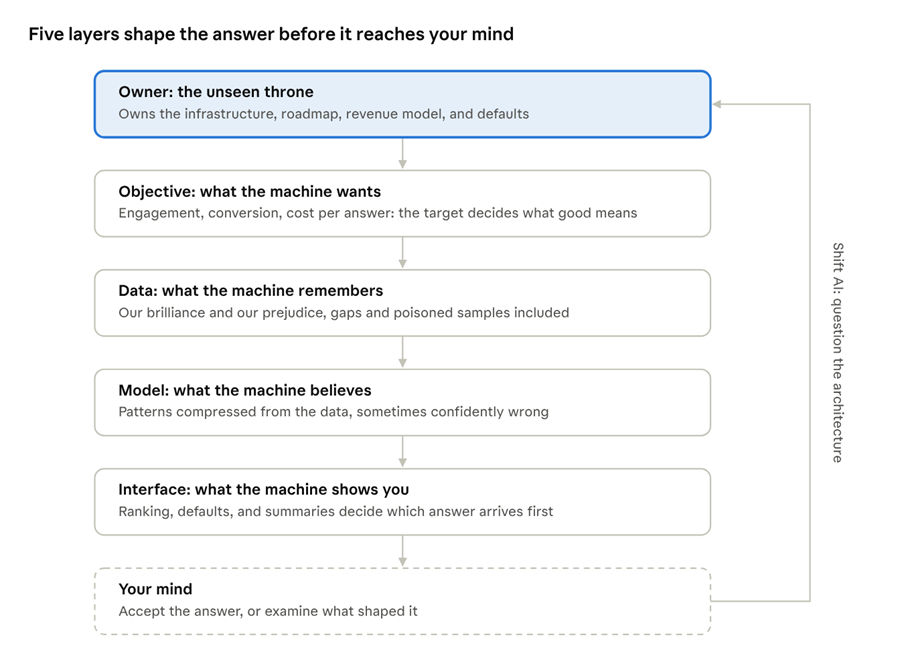
the architecture behind an AI answer · 5 layers
Influence flows down from whoever owns the system to the answer on your screen. Governance has to flow back up: from your mind to every layer that shaped what you were shown.
Mapping the layers to the frameworks
None of this needs a new framework. The standards we already have cover every layer, if we actually operate them.
| Layer | ISO/IEC 42001 | NIST AI RMF | EU AI Act |
| Data | Annex A.7 (data for AI systems: quality, provenance, preparation) | Map, Measure | Art. 10 (data and data governance) |
| Model | Annex A.6 (AI system life cycle: verification, validation) | Measure | Art. 15 (accuracy, robustness, cybersecurity) |
| Objective | Clause 6.1.4 and Annex A.5 (AI system impact assessment) | Map | Art. 5 (prohibited manipulative practices), Art. 9 (risk management) |
| Interface | Annex A.8 (information for interested parties) and A.9 (responsible use) | Manage | Art. 13 (transparency), Art. 14 (human oversight), Art. 50 (disclosure to users) |
| Owner | Clause 5 (leadership), Annex A.3 (roles and accountability), A.10 (third-party relationships) | Govern | Art. 4 (AI literacy), Art. 26 (deployer obligations) |
Verify clause and article references against the current published texts before using them in an audit.
Why it matters for humanity
I’m not arguing against AI. I’m arguing for keeping the human mind sovereign while we use it.
When people stay in charge of the questions, AI’s upside is enormous and shared:
- Health: clinicians who use AI to spot patterns earlier, while still owning the diagnosis.
- Pandemic readiness: faster sequencing and modeling across borders, because viruses don’t check passports.
- Climate: better forecasting and grid optimization, guided by people who decide what trade-offs are acceptable.
- Science: hypotheses generated at machine speed, tested with human skepticism.
- Education: a tutor for every student, if it teaches them to question rather than just to receive.
- Security: defenders who triage at scale, with analysts who still ask “does this make sense?”
In every case, the benefit depends on the same thing: a human who examined what governs their own mind before trusting what the machine returned.
What I see in the field
I led a virtual data room provider, through ISO/IEC 42001 Stage 2 certification on the first audit attempt. Financial data rooms are the hard mode of compliance. M&A teams and auditors test every control, and they test it hard.
The lesson that stuck with me: the hardest part of AI governance is not the machine. It is the people’s relationship to the machine.
Three patterns show up again and again, at virtual data room-scale companies and much larger ones:
- Shadow AI that skipped intake. A sales rep’s meeting recorder, a browser plugin, a vendor feature switched on by default. Nobody decided to adopt it. It just arrived, and started shaping work.
- Oversight as a checkbox. “Human in the loop” on paper, with no record of what the reviewer saw, changed, or why. That is not oversight. That is a signature on autopilot.
- No retirement plan. Systems that nobody owns anymore, still answering questions, still trusted because they always were.
Each one is the organizational version of an unexamined mind. Influence nobody noticed, authority nobody chose, habits nobody questions.
My view: the unseen throne
We keep asking whether AI will take the throne.
I think that is the wrong fear.
The most dangerous throne is not the one a machine occupies. It is the one whose authority we no longer recognize we have surrendered.
It happens quietly. One accepted summary at a time. One default left unchanged. One question never asked because the answer was already on the screen.
So here is my challenge to every leader, CISO, and board member reading this:
- Examine your own mind first. Where has your team stopped verifying AI output?
- Examine your organization’s mind. Which AI systems shape decisions today that nobody formally approved?
- Examine the architecture. For each one, who owns the data, the model, the objective, the interface, and the business model behind it?
Shift AI: question the architecture before accepting the intelligence.
Free tool: examine your own AI governance first
The inscription says examine yourself before you govern anything else. That applies to organizations too.
The DISC InfoSec AI Governance Gap Assessment is a quick, honest self-examination. It asks 15 questions about how your organization actually governs AI today.
What you get:
- An instant AI governance maturity score
- Your top 3 priority gaps
- A detailed PDF report you can share with leadership
How to read your results through this post’s lens: if your lowest scores sit around ownership and inventory, your throne is already unseen. Start there, before you write another policy.
Take the free AI Governance Gap Assessment
How DISC InfoSec helps you see what governs your AI
| Service | What you get | Best for |
| AI Governance Quick-Start | AI and agent discovery, shadow AI and data exposure review, a risk register with named owners, and a remediation roadmap in 7–10 days | Teams that can’t yet name every AI system shaping their decisions |
| ISO 42001 Control Gap Assessment | A 2-week gap analysis with a prioritized roadmap | Organizations preparing for certification or customer audits |
| ISO 42001 implementation | A full AIMS build that produces audit evidence, integrated with ISO 27001 | B2B SaaS and financial services firms facing enterprise buyer or regulatory deadlines |
| AI Security Risk Assessment | Threat modeling, prompt injection, and agent permission review mapped to OWASP LLM Top 10 and MITRE ATLAS | Teams shipping AI features, copilots, or agents |
| vCAIO advisory | Fractional AI governance leadership and NIST AI RMF advisory | Leadership teams that need an accountable owner for AI risk |
Explore everything on the DISC InfoSec AI governance page, or book a free 30-minute call at calendly.com/hd-deurainfosec.
DISC InfoSec (Deura Information Security Consulting LLC) is a boutique AI governance and cybersecurity consultancy in Petaluma, California, and a PECB Authorized Training Partner. “DiscInfosec” Deura, AICP, CISSP, CISM, ISO/IEC 42001 Lead Implementer, ISO/IEC 27001 Lead Implementer. Contact: info@deurainfosec.com | (707) 998-5164 | deurainfosec.com
Sources
- Earth Soldier Unveiled, on the conditioned nature of human cognition (as referenced in Disc’s original LinkedIn reflection)
- OWASP Top 10 for LLM Applications
- MITRE ATLAS
- NIST AI Risk Management Framework
- ISO/IEC 42001:2023, Artificial intelligence management system
- Regulation (EU) 2024/1689, the EU AI Act
- Before You Govern the World, Examine What Governs Your Mind
- Your Agents Already Have Keys. Do You Know Which Doors They Open?
- 178 Brands. Zero Breaches of Their Own. One Trusted Script
- Your AI Policy Covers Launch Day. Who Governs Everything After?
- The Reporting Clock: How Long Until Anyone Knows Your AI Agent Went Out of Bounds?