
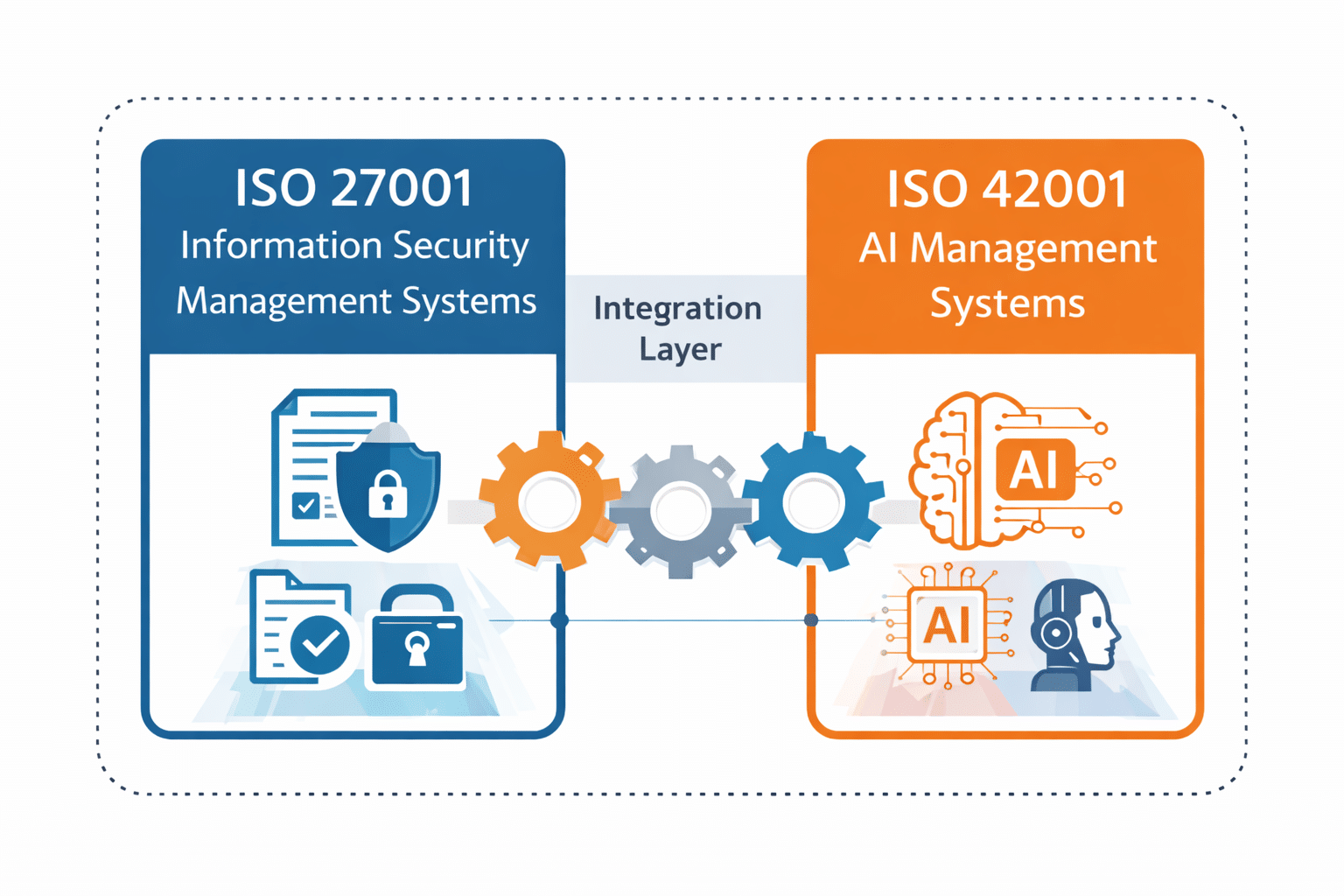
Key Implementation Steps
Defining Your AI Governance Scope
The first step in integrating AI management systems is establishing clear boundaries within your existing information security framework. Organizations should conduct a comprehensive inventory of all AI systems currently deployed, including machine learning models, large language models, and recommendation engines. This involves identifying which departments and teams are actively using or developing AI capabilities, and mapping how these systems interact with assets already covered under your ISMS such as databases, applications, and infrastructure. For example, if your ISMS currently manages CRM and analytics platforms, you would extend coverage to include AI-powered chatbots or fraud detection systems that rely on that data.
Expanding Risk Assessment for AI-Specific Threats
Traditional information security risk registers must be augmented to capture AI-unique vulnerabilities that fall outside conventional cybersecurity concerns. Organizations should incorporate risks such as algorithmic bias and discrimination in AI outputs, model poisoning and adversarial attacks, shadow AI adoption through unauthorized LLM tools, and intellectual property leakage through training data or prompts. The ISO 42001 Annex A controls provide valuable guidance here, and organizations can leverage existing risk methodologies like ISO 27005 or NIST RMF while extending them with AI-specific threat vectors and impact scenarios.
Updating Governance Policies for AI Integration
Rather than creating entirely separate AI policies, organizations should strategically enhance existing ISMS documentation to address AI governance. This includes updating Acceptable Use Policies to restrict unauthorized use of public AI tools, revising Data Classification Policies to properly tag and protect training datasets, strengthening Third-Party Risk Policies to evaluate AI vendors and their model provenance, and enhancing Change Management Policies to enforce model version control and deployment approval workflows. The key is creating an AI Governance Policy that references and builds upon existing ISMS documents rather than duplicating effort.
Building AI Oversight into Security Governance Structures
Effective AI governance requires expanding your existing information security committee or steering council to include stakeholders with AI-specific expertise. Organizations should incorporate data scientists, AI/ML engineers, legal and privacy professionals, and dedicated risk and compliance leads into governance structures. New roles should be formally defined, including AI Product Owners who manage AI system lifecycles, Model Risk Managers who assess AI-specific threats, and Ethics Reviewers who evaluate fairness and bias concerns. Creating an AI Risk Subcommittee that reports to the existing ISMS steering committee ensures integration without fragmenting governance.
Managing AI Models as Information Assets
AI models and their associated components must be incorporated into existing asset inventory and change management processes. Each model should be registered with comprehensive metadata including training data lineage and provenance, intended purpose with performance metrics and known limitations, complete version history and deployment records, and clear ownership assignments. Organizations should leverage their existing ISMS Change Management processes to govern AI model updates, retraining cycles, and deprecation decisions, treating models with the same rigor as other critical information assets.
Aligning ISO 42001 and ISO 27001 Control Frameworks
To avoid duplication and reduce audit burden, organizations should create detailed mapping matrices between ISO 42001 and ISO 27001 Annex A controls. Many controls have significant overlap—for instance, ISO 42001’s AI Risk Management controls (A.5.2) extend existing ISO 27001 risk assessment and treatment controls (A.6 & A.8), while AI System Development requirements (A.6.1) build upon ISO 27001’s secure development lifecycle controls (A.14). By identifying these overlaps, organizations can implement unified controls that satisfy both standards simultaneously, documenting the integration for auditor review.
Incorporating AI into Security Awareness Training
Security awareness programs must evolve to address AI-specific risks that employees encounter daily. Training modules should cover responsible AI use policies and guidelines, prompt safety practices to prevent data leakage through AI interactions, recognition of bias and fairness concerns in AI outputs, and practical decision-making scenarios such as “Is it acceptable to input confidential client data into ChatGPT?” Organizations can extend existing learning management systems and awareness campaigns rather than building separate AI training programs, ensuring consistent messaging and compliance tracking.
Auditing AI Governance Implementation
Internal audit programs should be expanded to include AI-specific checkpoints alongside traditional ISMS audit activities. Auditors should verify AI model approval and deployment processes, review documentation demonstrating bias testing and fairness assessments, investigate shadow AI discovery and remediation efforts, and examine dataset security and access controls throughout the AI lifecycle. Rather than creating separate audit streams, organizations should integrate AI-specific controls into existing ISMS audit checklists for each process area, ensuring comprehensive coverage during regular audit cycles.
My Perspective
This integration approach represents exactly the right strategy for organizations navigating AI governance. Having worked extensively with both ISO 27001 and ISO 42001 implementations, I’ve seen firsthand how creating parallel governance structures leads to confusion, duplicated effort, and audit fatigue. The Rivedix framework correctly emphasizes building upon existing ISMS foundations rather than starting from scratch.
What particularly resonates is the focus on shadow AI risks and the practical awareness training recommendations. In my experience at DISC InfoSec and through ShareVault’s certification journey, the biggest AI governance gaps aren’t technical controls—they’re human behavior patterns where well-meaning employees inadvertently expose sensitive data through ChatGPT, Claude, or other LLMs because they lack clear guidance. The “47 controls you’re missing” concept between ISO 27001 and ISO 42001 provides excellent positioning for explaining why AI-specific governance matters to executives who already think their ISMS “covers everything.”
The mapping matrix approach (point 6) is essential but often overlooked. Without clear documentation showing how ISO 42001 requirements are satisfied through existing ISO 27001 controls plus AI-specific extensions, organizations end up with duplicate controls, conflicting procedures, and confused audit findings. ShareVault’s approach of treating AI systems as first-class assets in our existing change management processes has proven far more sustainable than maintaining separate AI and IT change processes.
If I were to add one element this guide doesn’t emphasize enough, it would be the importance of continuous monitoring and metrics. Organizations should establish AI-specific KPIs—model drift detection, bias metric trends, shadow AI discovery rates, training data lineage coverage—that feed into existing ISMS dashboards and management review processes. This ensures AI governance remains visible and accountable rather than becoming a compliance checkbox exercise.
InfoSec services | InfoSec books | Follow our blog | DISC llc is listed on The vCISO Directory | ISO 27k Chat bot | Comprehensive vCISO Services | ISMS Services | AIMS Services | Security Risk Assessment Services | Mergers and Acquisition Security
At DISC InfoSec, we help organizations navigate this landscape by aligning AI risk management, governance, security, and compliance into a single, practical roadmap. Whether you are experimenting with AI or deploying it at scale, we help you choose and operationalize the right frameworks to reduce risk and build trust. Learn more at DISC InfoSec.
- Measure What Matters: Security & AI Readiness Scorecard
- Security Is a People Problem: Culture, Behavior, and Decisions Drive Cyber Resilience
- Security Driven by Business Value: Focus, Prioritize, Protect What Matters Most
- Claude Mythos and the Future of Cybersecurity: Powerful—and Potentially Dangerous
- Hackers at Machine Speed: The AI Cybersecurity Reality





