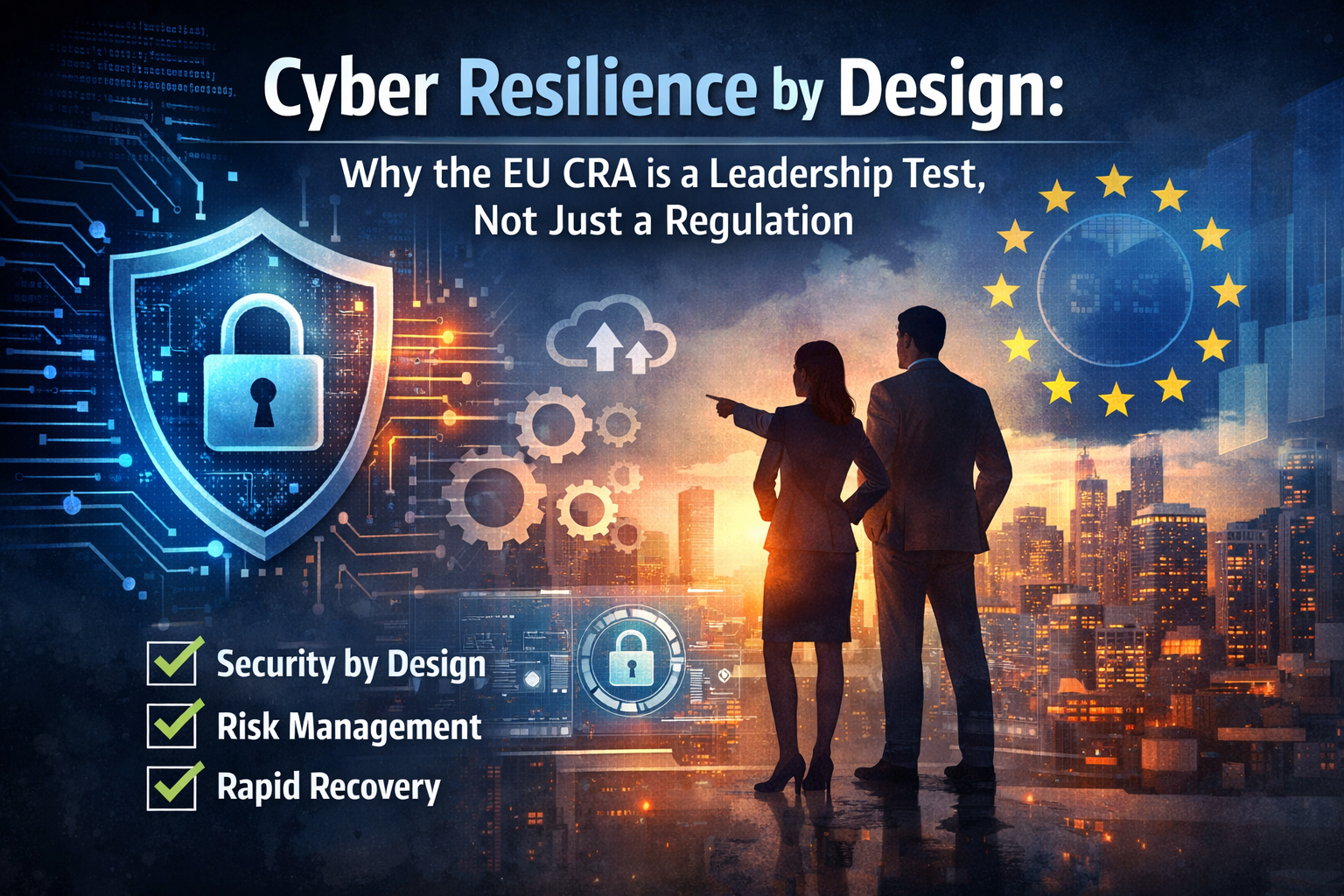
The EU Cyber Resilience Act (CRA) marks a significant shift in how cybersecurity is viewed across digital products and services. Rather than treating security as a post-development compliance task, the Act emphasizes embedding cybersecurity into products from the design stage and maintaining it throughout their entire lifecycle. This approach reframes cyber resilience as an ongoing responsibility that blends technical safeguards with organizational discipline.
At its core, the CRA reinforces the idea that resilience is not achieved through tools alone. Secure-by-design principles require coordinated processes, clear ownership, and accountability across product development, operations, and incident response. By aligning with lifecycle thinking—similar to disaster recovery planning—the Act pushes organizations to anticipate failure, prepare for disruption, and recover quickly when incidents occur.
Leadership plays a decisive role in making this shift effective. True cyber resilience demands a top-down commitment where executives actively prioritize security in strategic planning and resource allocation. When leaders set expectations that security is integral to innovation, teams are empowered to build resilient systems without viewing cybersecurity as a barrier to progress.
When organizations treat cybersecurity as a business enabler rather than a cost center, the benefits extend beyond compliance. They gain stronger risk management, greater operational continuity, and increased trust from customers and partners. In this way, the EU CRA aligns closely with disaster recovery principles—prepare early, plan holistically, and lead decisively—to create sustainable cyber resilience in an increasingly complex digital landscape.
My opinion:
The EU Cyber Resilience Act is one of the most pragmatic cybersecurity regulations to date because it shifts the conversation from after-the-fact compliance to engineering discipline and leadership accountability. That change is long overdue. Cybersecurity failures rarely happen because controls were unknown—they happen because security was deprioritized during design, delivery, or scaling.
What I particularly agree with is the implicit alignment between cyber resilience and disaster recovery thinking. Both accept that failure is inevitable and focus instead on preparedness, impact reduction, and rapid recovery. This mindset is far more realistic than the traditional “prevent everything” security narrative, especially in complex software supply chains.
However, regulation alone will not create resilience. Organizations that approach the CRA as a documentation exercise will miss its real value. The winners will be those whose leadership genuinely internalizes security as a strategic capability—one that protects innovation, brand trust, and long-term revenue. In that sense, the CRA is less a technical mandate and more a leadership test.
InfoSec services | InfoSec books | Follow our blog | DISC llc is listed on The vCISO Directory | ISO 27k Chat bot | Comprehensive vCISO Services | ISMS Services | AIMS Services | Security Risk Assessment Services | Mergers and Acquisition Security
At DISC InfoSec, we help organizations navigate this landscape by aligning AI risk management, governance, security, and compliance into a single, practical roadmap. Whether you are experimenting with AI or deploying it at scale, we help you choose and operationalize the right frameworks to reduce risk and build trust. Learn more at DISC InfoSec.
- From Risk to Resilience: A 5-Step Playbook for Securing AI in the Modern Threat Era
- Which AI Governance Framework Should You Adopt First? A Practical Guide for U.S., EU, and Global Organizations
- MITRE ATT&CK: Turning Blind Spots into Real-World Cyber Defense
- When AI Hacks Faster Than Humans: The Coming Collapse of Traditional Cybersecurity Value
- SOC 2 Isn’t Enough: Moving Beyond Compliance Theater to Real Risk Management