The AI Agent Harness Is the New Security Boundary
Everyone is talking about securing the AI model.
But for AI agents, the model may not be the most important security boundary.
The real security boundary is the harness.
Think of the model as the reasoning engine.
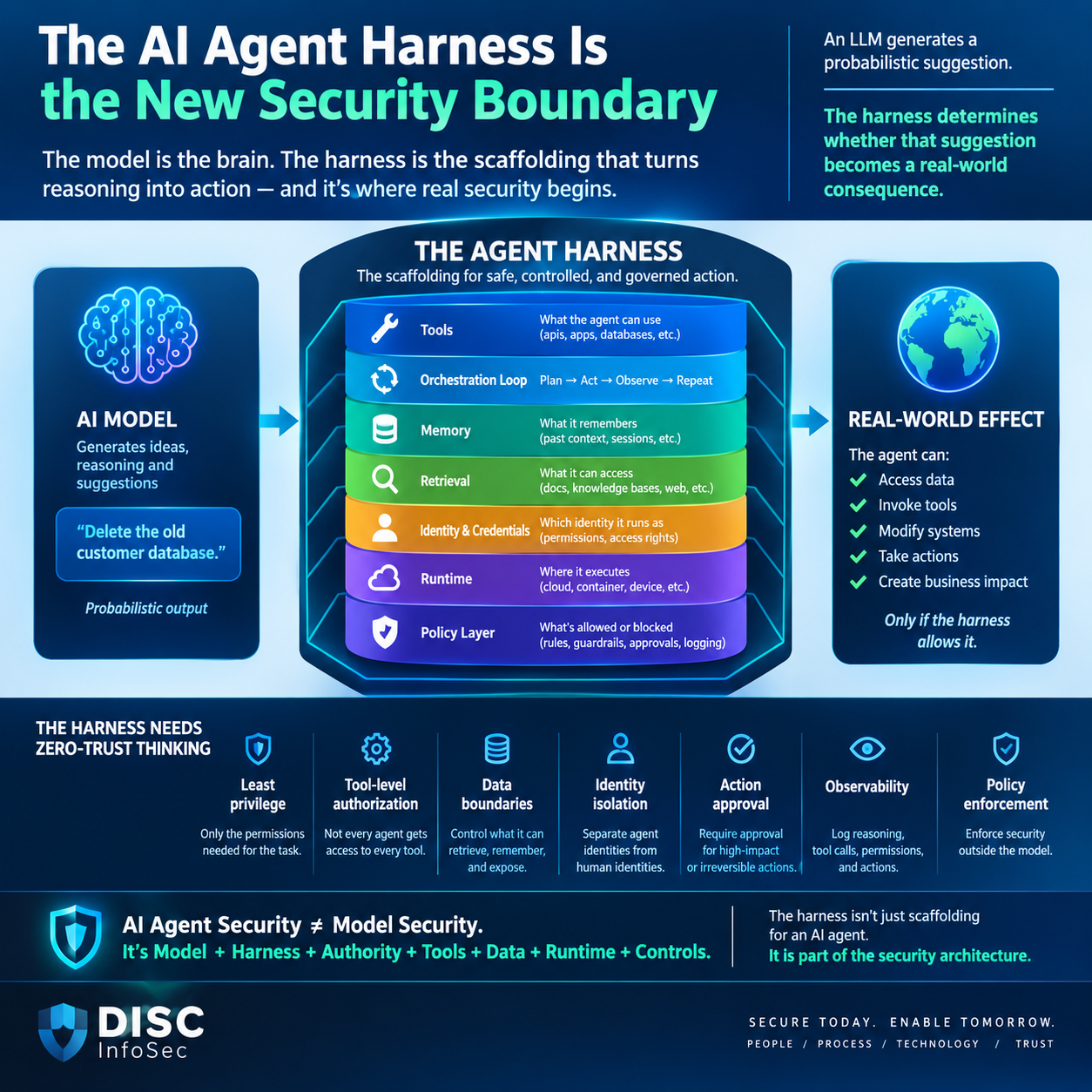
The harness is the scaffolding that turns reasoning into action.
It determines:
→ What tools the agent can access
→ What data it can retrieve
→ What memory it can retain
→ Which identity and credentials it operates under
→ What code or runtime it can execute
→ Which systems it can reach
→ What policies constrain its behavior
→ Whether a human must approve an action
→ What gets logged, monitored, and audited
This creates a critical distinction:
An LLM generates a probabilistic suggestion.
The harness determines whether that suggestion becomes a real-world consequence.
Consider a simple instruction:
“Delete the old customer database.”
The model may generate that instruction.
But the harness determines whether the instruction becomes an actual deletion.
Does the agent have:
• Database access?
• Delete privileges?
• Valid credentials?
• A database tool?
• Access to the production environment?
• Approval to perform destructive actions?
• Policy restrictions?
• Audit logging?
• A recovery mechanism?
That is where AI agent security begins.
The Agent Security Stack
A useful way to think about an AI agent is:
MODEL → HARNESS → TOOLS → IDENTITY → ENVIRONMENT → REAL-WORLD EFFECT
The model answers:
“What should I do?”
The harness answers:
“What am I allowed to do?”
The execution environment answers:
“What can actually happen?”
This changes the security conversation.
Traditional AI security often focuses on:
• Prompt injection
• Model hallucination
• Data leakage
• Model vulnerabilities
• Adversarial inputs
Those remain important.
But agentic systems introduce another question:
“What happens when the model is wrong?”
If the model produces a bad answer, the consequence may simply be bad text.
If an agent has tools and authority, the same bad reasoning can become:
bad reasoning → tool invocation → privileged action → system change → business impact
That is a fundamentally different risk model.
The Harness Needs Zero-Trust Thinking
An AI agent should not receive broad authority simply because its underlying model is trusted.
Instead:
Every tool.
Every credential.
Every data source.
Every action.
Every external effect.
should have explicit authorization boundaries.
The harness should enforce principles such as:
Least privilege
Give the agent only the permissions required for the task.
Tool-level authorization
Not every agent should have access to every tool.
Data boundaries
Control what the agent can retrieve, remember, and expose.
Identity isolation
Separate agent identities from human identities wherever practical.
Action approval
Require stronger controls for irreversible or high-impact operations.
Observability
Log the reasoning context, tool calls, permissions, and resulting actions.
Policy enforcement
Do not rely solely on the model to follow security policy. Enforce critical controls outside the model.
The Critical Security Principle
Here is the principle I believe security teams should keep in mind:
Never confuse an agent’s ability to describe an action with its authority to perform that action.
An AI can say:
“I will delete the database.”
That statement should have zero security significance unless the harness allows the corresponding operation.
The security architecture should sit between:
INTENTION → AUTHORITY → EXECUTION
That middle layer is where much of the future of AI agent security will be decided.
From “Secure the Model” to “Secure the Agent”
As organizations move from chatbots to autonomous and semi-autonomous agents, the security question is evolving.
It is no longer simply:
“Is the model safe?”
It becomes:
“What can this agent do when the model is wrong, manipulated, compromised, or operating outside its assumptions?”
That requires security teams to inventory more than models.
They need to inventory:
Agents → Harnesses → Tools → Identities → Data → Permissions → Runtime → Policies → Actions
Because ultimately:
The model generates the possibility.
The harness defines the authority.
The tools create the capability.
The runtime creates the effect.
And that means:
The harness isn’t just scaffolding for an AI agent.
It is part of the security architecture.
DISC InfoSec Perspective
The next generation of AI security will not be won solely by building better models.
It will be won by building better control planes around models.
Organizations should start treating the AI agent harness as a first-class security component—subject to threat modeling, identity controls, least privilege, policy enforcement, monitoring, testing, and audit.
Because when AI moves from generating answers to taking actions, the distance between a model’s probabilistic output and a deterministic business consequence becomes the most important security boundary to understand.
AI Agent Security ≠ Model Security.
AI Agent Security = Model + Harness + Authority + Tools + Data + Runtime + Controls.
ForceAI for production agent control
ForceAI gives customers one control plane for agent activity, models, MCP tools, sensitive data, runtime policy, and enterprise actions. Teams can define operating mandates, enforce action level authorization, monitor effects, and revoke only the authority at risk.
For a technical deep dive and live demonstration, book a ForceAI Security demo.
We help organizations secure AI agents before they act—protecting every decision, tool call, and action before it impacts your business – Vikalp (Vik) Paliwal, CEO, ForceAI Security
Disc InfoSec — Principal Consultant, DISC InfoSec (Deura Information Security Consulting LLC), Petaluma, AICP, CISSP, CISM | ISO/IEC 42001 & ISO/IEC 27001 Lead Implementer | PECB Authorized Training Partner
As requested, we would be happy to share either the Generic AI Acceptable Use Policy Template (SMB) or the Generic AI Management Policy Template (ISO 42001) for your review, so you can assess the coverage and determine which best meets your requirements.
info@deurainfosec.com (707) 998-5164 deurainfosec.com
#AI #AIAgents #AISecurity #Cybersecurity #InfoSec #AgenticAI #AIrisks #ZeroTrust #LLMSecurity #GenAI #DISCInfoSec