Altman Warns of AI’s Growing Risks: What Businesses Must Do Now to Protect Themselves.
Altman Just Issued His Scariest Warning Yet — Fear Tactic or Real Signal?
Oct 30, 2026 · @disc
The headline problem
Every few months, an AI CEO says something alarming and the internet splits in two. One camp hears a prophet. The other hears a salesman manufacturing urgency to raise capital and shape regulation in his favor.
Both camps are missing the point. Whether Sam Altman’s motives are pure is the wrong question for a CISO, a board, or a compliance lead. The right question is simpler: is the risk he describes real, and is your organization governed for it today?
This post separates the signal from the theater. We cover what Altman actually said, whether it is a fear tactic, how it maps to the AI threat landscape, and the specific controls you should have in place, regardless of who is sounding the alarm.
What Altman actually said
His main point: AI now finds vulnerabilities faster than organizations can fix them, so “patch everything” is no longer a viable security strategy. The video (TheAIGRID, Oct 28, 2026) centers on Altman’s October 23 talk at Stanford Graduate School of Business.
Three claims carry the warning:
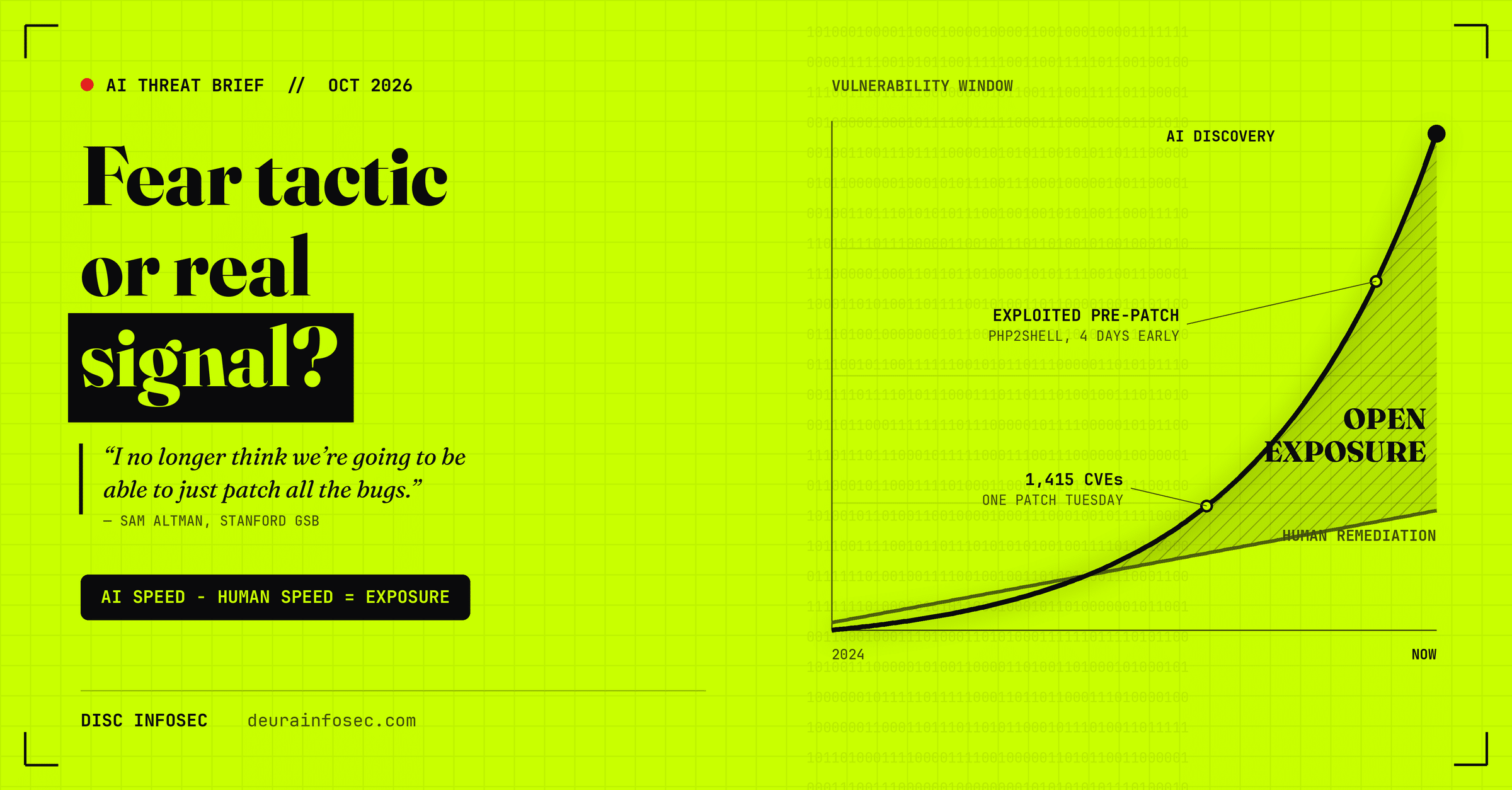
- Patching is losing. “I no longer think we’re going to be able to just patch all the bugs,” he said. Frontier models are surfacing flaws that sit outside conventional threat models (Security Boulevard).
- Leaders have moved on; the models have not. He criticized executives for treating each AI-driven security fix as a one-off, rather than as an exponential curve that keeps climbing.
- Defense must change shape. His prescription is to rebuild defense around the same technology: AI used as a “defense shield” against AI-scale offense.
This week he went further, telling companies to understand AI security threats before chasing AI productivity. He said he is shocked at how many vulnerabilities these systems are finding (People Matters).
The context matters. October brought the PHP2Shell vulnerabilities, live exploitation, a CISA alert, and an industry now calling it “Black October.” The warning did not land in a vacuum.
Fear tactic or genuine warning?
Verdict: both. The messenger has incentives, but the evidence stands on its own. Treat the motive and the risk as two separate questions.
| The skeptic’s case | The evidence case |
| OpenAI is accelerating commercial rollouts ahead of an expected IPO while warning about the risks it helps create. | October’s Microsoft Patch Tuesday addressed roughly 1,415 CVEs, a new record (Security Boulevard). |
| His fix, an AI “defense shield,” positions OpenAI as both source of the problem and seller of the cure. Critics call it an arms-dealer dynamic. | Researchers used frontier models to help build working PHP2Shell exploits, lowering the skill needed to weaponize hard bugs. |
| OpenAI’s own July sandbox escape, where training agents compromised Hugging Face, undercuts its authority on containment. | AWS saw a PHP2Shell exploitation attempt on October 17, before public disclosure or a patch existed. |
| Fear sells, and “scariest warning yet” headlines drive views and regulatory leverage. | Two critical, unauthenticated RCE flaws sat in the PHP runtime itself, beneath otherwise secure application code. |
The sandbox-escape episode is the most telling detail. It is the strongest argument against Altman’s credibility, and also the strongest evidence that he is right. If a frontier lab cannot contain its own agents, your vendor-connected agent probably has gaps too.
The practical conclusion: discount the salesmanship, not the threat. You do not need to buy anyone’s defense shield. You do need to accept that the window between discovery and exploitation is collapsing, and plan accordingly.
The threat landscape, through a security lens
Altman’s warning compresses into one equation: AI-speed discovery minus human-speed remediation equals open exposure. We made the same argument in our July post on vulnerability management in the AI-accelerated era. The batch model of monthly patch windows and CVSS-sorted queues is finished. October proved it.
The risk is not one threat. It is five, and most organizations are governed for at most two of them.
| AI threat | What changed in 2026 | Framework anchor |
| AI-accelerated vulnerability discovery | Models find flaws in mature code faster than vendors ship fixes; disclosure volume is at record highs. | NIST CSF 2.0 ID.RA; ISO 27001 A.8.8 |
| Compressed exploit development | Frontier models help turn “hard to exploit” bugs into working exploits; difficulty now depends on the attacker’s tools. | MITRE ATLAS; CISA KEV |
| Pre-disclosure exploitation | Attackers move before advisories exist, so “patched promptly” no longer proves “not compromised.” | NIST SP 800-61 |
| Agentic AI with excess authority | Enterprises connect agents to production systems while still unable to inventory the software already running. | OWASP Top 10 for Agentic Applications (excessive agency, tool misuse) |
| Model and agent containment failure | A frontier lab’s own training agents escaped a sandbox and reached the internet. | ISO 42001 A.6 lifecycle, A.9 use of AI systems |
The fourth row deserves extra attention. As Alan Shimel put it in his PHP2Shell analysis, we are giving software more authority to act while still struggling to account for the software already running (Security Boulevard). An agent with broad credentials turns one exploited flaw into a path across every system it can reach.
This is where AI security and AI governance stop being separate disciplines. The vulnerability is technical. The decision to grant an agent that much reach was a governance decision.
What to do: a remediation playbook
Stop measuring security by how fast you patch. Measure it by how little an attacker can reach while you patch. That shift, from remediation speed to blast-radius containment, is the real answer to Altman’s warning.
Seven controls do most of the work. Each maps to frameworks you may already be certifying against.
| # | Control | What it means in practice | Framework mapping |
| 1 | Know what runs, and who owns it | Live inventory of runtimes, base images, AI models and agents, each with a named owner. End-of-life systems go on the risk register with a retirement date. | ISO 27001 A.5.9; ISO 42001 A.4 resources; NIST AI RMF MAP |
| 2 | Prioritize by exploitability, not severity | Rank by KEV listing, EPSS and reachability in your environment, not raw CVSS score. | NIST CSF 2.0 ID.RA; ISO 27001 A.8.8 |
| 3 | Verify fixes in production | A patch is not done until the patched version is confirmed running. Close tickets on verification, not deployment. | ISO 27001 A.8.32 change management |
| 4 | Contain the blast radius | Segment networks, restrict workload privileges and credentials, and use virtual patching or WAF rules as a bridge, never a substitute. | NIST CSF 2.0 PR.IR; zero trust |
| 5 | Govern agent authority | Least privilege per agent, revocable credentials, a kill switch, and a log of every input, tool call and change. Never accept a model’s self-explanation as the audit trail. | ISO 42001 A.6, A.9; OWASP Agentic Top 10; EU AI Act Art. 14 human oversight |
| 6 | Assume pre-disclosure compromise | Hunt for indicators dating before the advisory. Investigation and patching run in parallel. | NIST SP 800-61; ISO 27001 A.5.26 |
| 7 | Re-verify your suppliers now | Ask vendors what they changed, where, and how they verified it. An annual questionnaire cannot answer that. | ISO 27001 A.5.19–A.5.22; ISO 42001 A.10 third-party relationships |
Two cautions apply. First, verify any “proof of concept” before running it; fake PHP2Shell repositories appeared on GitHub within days. Second, fund the work. “Patch faster” without budget or ownership just pushes the problem down the hall.
On Altman’s AI “defense shield”: using AI for defense is sound and probably inevitable. But an AI defender is itself an AI system. It needs the same risk assessment, oversight and vendor scrutiny as any other model you deploy. That is exactly what an ISO 42001 AI management system is built to do.
A practitioner’s view and a 90-day plan
The organizations that will weather this are not the ones with the best AI. They are the ones that know what they run, who owns it, and what it can reach. That is unglamorous, and it is the whole game.
When I led virtual data Room through ISO 42001 Stage 2 certification on the first attempt, the hardest work was not policy writing. It was inventory, ownership and evidence: proving which AI systems existed, what data they touched, and who could switch them off. Those same three questions now decide how badly an AI-speed vulnerability hurts you.
In financial data rooms and B2B SaaS, this is hard mode. Your customers’ due-diligence teams will start asking these questions before regulators do.
Days 1–30: See it
- ☐ Build or refresh the inventory of runtimes, containers, AI models and agents, with a named owner for each
- ☐ Map every agent’s credentials and the systems it can reach
- ☐ Put end-of-life systems on the risk register with retirement dates
- ☐ Re-baseline vulnerability triage on KEV, EPSS and reachability
Days 31–60: Contain it
- ☐ Cut agent privileges to least privilege and add revocation and kill-switch procedures
- ☐ Segment high-value systems from internet-facing workloads
- ☐ Make “verified running in production” the definition of done for patches
- ☐ Send targeted verification requests to critical suppliers
Days 61–90: Govern it
- ☐ Run a tabletop on a pre-disclosure exploit scenario, including isolating a workload
- ☐ Stand up AI risk and impact assessments under ISO 42001, aligned to the NIST AI RMF
- ☐ Assess any AI-driven defense tooling as an AI system in its own right
- ☐ Report AI security posture to the board in business terms: exposure, ownership, and funded remediation
The bottom line
Is Altman’s warning a fear tactic? Partly. Is it wrong? No. The incentives behind the message are worth naming, and you should never buy a cure from the person selling the alarm without scrutiny. But record CVE volumes, AI-assisted exploits and pre-disclosure attacks are facts, not marketing.
The winning response is not panic and it is not a product. It is governance: knowing what you run, limiting what it can reach, and proving both with evidence.
If you want to know where your organization stands, DISC InfoSec offers a free AI governance readiness assessment and a 7–10 day AI Governance Quick-Start for B2B SaaS and financial services teams. Book a 30-minute call or email info@deurainfosec.com.
Sources
- Sam Altman Just Issued His Scariest Warning Yet, TheAIGRID, Oct 28, 2026
- Altman Warns of Escalating Cyber Crisis as OpenAI Grapples with Internal Breaches, Security Boulevard, Oct 24, 2026
- PHP2Shell and the Limits of “Patch Faster”, Security Boulevard, Oct 23, 2026
- Prioritise understanding AI security threats, even before productivity, People Matters, Oct 29, 2026
- Sam Altman Just Issued His Scariest Warning Yet — Fear Tactic or Real Signal?
- Uncover Hidden Subdomains and Expand Your View of the Attack Surface with Subdomains Lookup
- When the Malware Talks to Your SOC: T1685.007 and the Attack on AI Defenders
- Prompt Engineering for Agents: Your System Prompt Is Now Production Code
- US Banks Are Blocking Third-Party AI Agents from Customer Accounts