No Breach. No Alerts. Still Stolen: The Model Extraction Problem
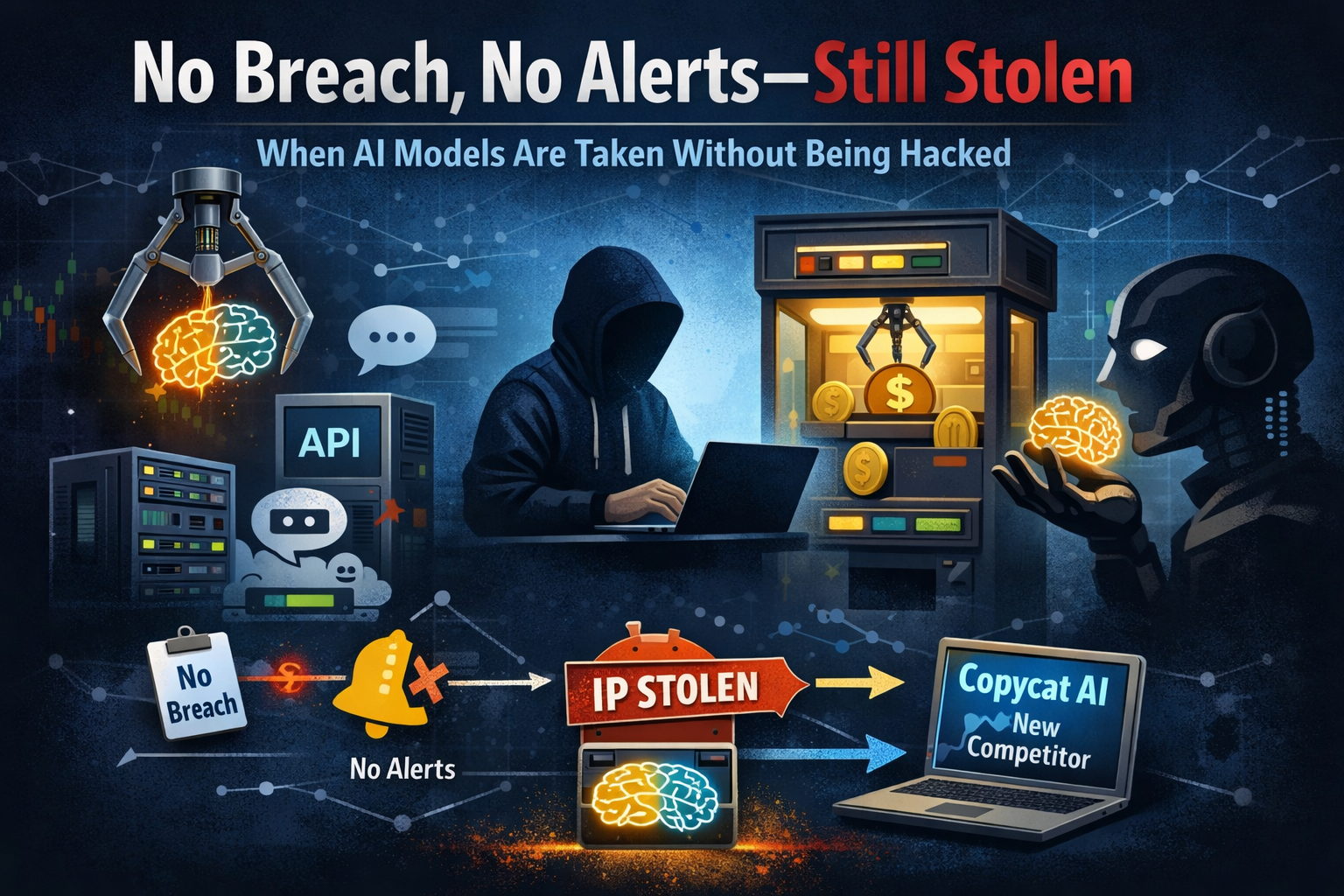
1. A company can lose its most valuable AI intellectual property without suffering a traditional security breach. No malware, no compromised credentials, no incident tickets—just normal-looking API traffic. Everything appears healthy on dashboards, yet the core asset is quietly walking out the door.
2. This threat is known as model extraction. It happens when an attacker repeatedly queries an AI model through legitimate interfaces—APIs, chatbots, or inference endpoints—and learns from the responses. Over time, they can reconstruct or closely approximate the proprietary model’s behavior without ever stealing weights or source code.
3. A useful analogy is a black-box expert. If I can repeatedly ask an expert questions and carefully observe their answers, patterns start to emerge—how they reason, where they hesitate, and how they respond to edge cases. Over time, I can train someone else to answer the same questions in nearly the same way, without ever seeing the expert’s notes or thought process.
4. Attackers pursue model extraction for several reasons. They may want to clone the model outright, steal high-value capabilities, distill it into a cheaper version using your model as a “teacher,” or infer sensitive traits about the training data. None of these require breaking in—only sustained access.
5. This is why AI theft doesn’t look like hacking. Your model can be copied simply by being used. The very openness that enables adoption and revenue also creates a high-bandwidth oracle for adversaries who know how to exploit it.
6. The consequences are fundamentally business risks. Competitive advantage evaporates as others avoid your training costs. Attackers discover and weaponize edge cases. Malicious clones can damage your brand, and your IP strategy collapses because the model’s behavior has effectively been given away.
7. The aftermath is especially dangerous because it’s invisible. There’s no breach report or emergency call—just a competitor releasing something “surprisingly similar” months later. By the time leadership notices, the damage is already done.
8. At scale, querying equals learning. With enough inputs and outputs, an attacker can build a surrogate model that is “good enough” to compete, abuse users, or undermine trust. This is IP theft disguised as legitimate usage.
9. Defending against this doesn’t require magic, but it does require intent. Organizations need visibility by treating model queries as security telemetry, friction by rate-limiting based on risk rather than cost alone, and proof by watermarking outputs so stolen behavior can be attributed when clones appear.
My opinion: Model extraction is one of the most underappreciated risks in AI today because it sits at the intersection of security, IP, and business strategy. If your AI roadmap focuses only on performance, cost, and availability—while ignoring how easily behavior can be copied—you don’t really have an AI strategy. Training models is expensive; extracting behavior through APIs is cheap. And in most markets, “good enough” beats “perfect.”
InfoSec services | InfoSec books | Follow our blog | DISC llc is listed on The vCISO Directory | ISO 27k Chat bot | Comprehensive vCISO Services | ISMS Services | AIMS Services | Security Risk Assessment Services | Mergers and Acquisition Security
- When AI Hacks Faster Than Humans: The Coming Collapse of Traditional Cybersecurity Value
- SOC 2 Isn’t Enough: Moving Beyond Compliance Theater to Real Risk Management
- When AI Becomes the Attack Surface: Lessons from the McKinsey Lilli Incident
- Why Every Company Needs a CISO (or at Least vCISO-Level Leadership)
- How ISO 27001 Lead Auditors Should Evaluate AI Risks in an ISMS