Dec 03 2025

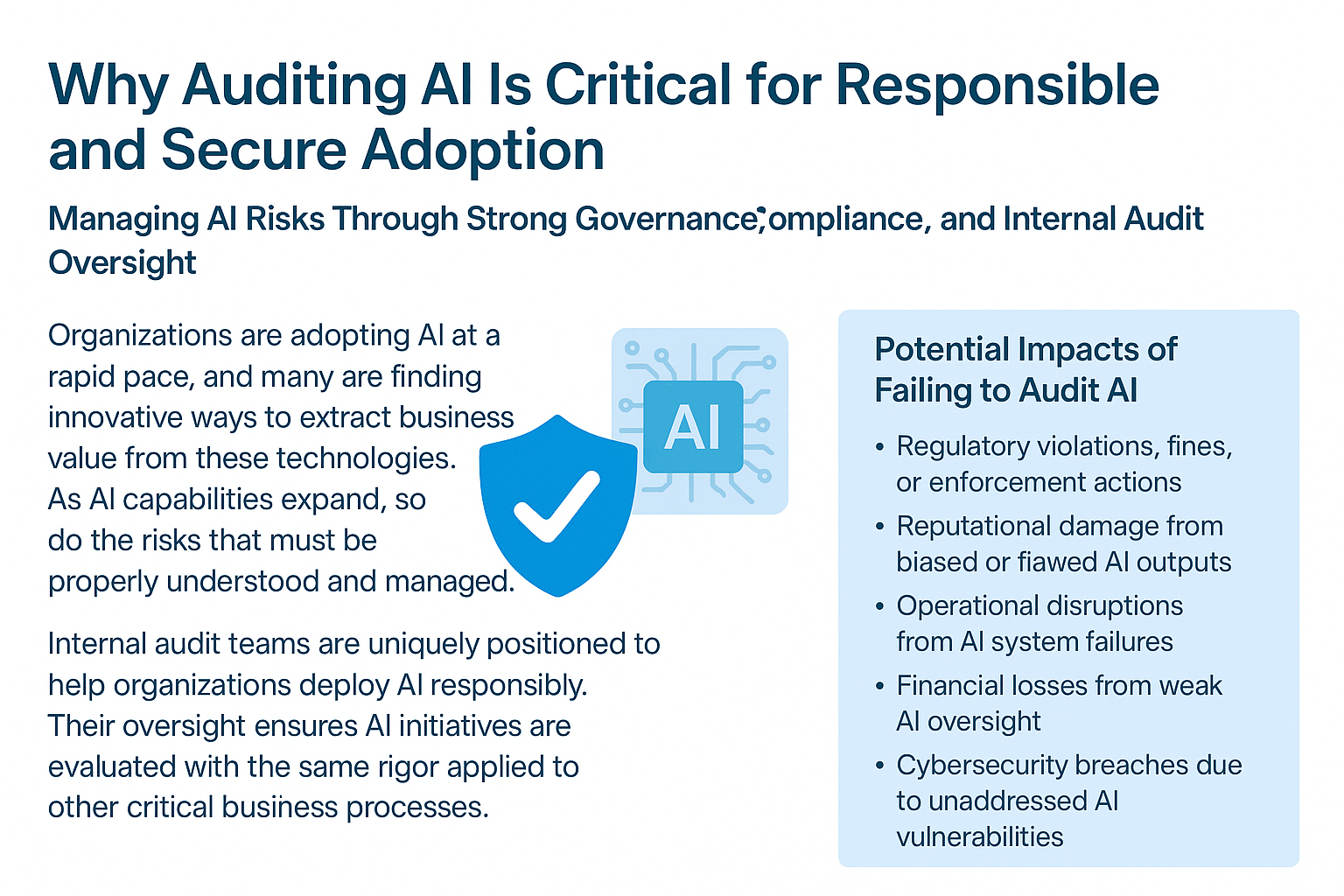
Why Auditing AI Is Critical for Responsible and Secure Adoption

Category: AI,AI Governance,Internal Auditdisc7 @ 1:51 pm

Managing AI Risks Through Strong Governance, Compliance, and Internal Audit Oversight

  1. Organizations are adopting AI at a rapid pace, and many are finding innovative ways to extract business value from these technologies. As AI capabilities expand, so do the risks that must be properly understood and managed.
  2. Internal audit teams are uniquely positioned to help organizations deploy AI responsibly. Their oversight ensures AI initiatives are evaluated with the same rigor applied to other critical business processes.
  3. By participating in AI governance committees, internal audit can help set standards, align stakeholders, and bring clarity to how AI is adopted across the enterprise.
  4. A key responsibility is identifying the specific risks associated with AI systems—whether ethical, technical, regulatory, or operational—and determining whether proper controls are in place to address them.
  5. Internal audit also plays a role in interpreting and monitoring evolving regulations. As governments introduce new AI-specific rules, companies must demonstrate compliance, and auditors help ensure they are prepared.
  6. Several indicators signal growing AI risk within an organization. One major warning sign is the absence of a formal AI risk management framework or any consistent evaluation of AI initiatives through a risk lens.
  7. Another risk indicator arises when new regulations create uncertainty about whether the company’s AI practices are compliant—raising concerns about gaps in oversight or readiness.
  8. Organizations without a clear AI strategy, or those operating multiple isolated AI projects, may fail to realize the intended benefits. Fragmentation often leads to inefficiencies and unmanaged risks.
  9. If AI initiatives continue without centralized governance, the organization may lose visibility into how AI is used, making it difficult to maintain accountability, consistency, and compliance.


Potential Impacts of Failing to Audit AI (Summary)

  • The organization may face regulatory violations, fines, or enforcement actions.
  • Biased or flawed AI outputs could damage the company’s reputation.
  • Operational disruptions may occur if AI systems fail or behave unpredictably.
  • Weak AI oversight can result in financial losses.
  • Unaddressed vulnerabilities in AI systems could lead to cybersecurity incidents.


My Opinion

Auditing AI is no longer optional—it is becoming a foundational part of digital governance. Without structured oversight, AI can expose organizations to reputational damage, operational failures, regulatory penalties, and security weaknesses. A strong AI audit function ensures transparency, accountability, and resilience. In my view, organizations that build mature AI auditing capabilities early will not only avoid risk but also gain a competitive edge by deploying trustworthy, well-governed AI at scale.

InfoSec services | ISMS Services | AIMS Services | InfoSec books | Follow our blog | DISC llc is listed on The vCISO Directory | ISO 27k Chat bot | Comprehensive vCISO Services | Security Risk Assessment Services | Mergers and Acquisition Security

Governance in The Age of Gen AI: A Director’s Handbook on Gen AI

Tags: AI Internal Audit


Mar 28 2025

Preparing for an ISO Audit: Essential Tips and Best Practices for a Successful Outcome

Category: Information Security,Internal Audit,ISO 27kdisc7 @ 2:44 pm

​”Preparing for an ISO Audit: Tips and Best Practices” is a comprehensive guide by AuditCo, published in February 2025, aimed at assisting organizations in effectively preparing for ISO audits. The article outlines several key strategies:​

  1. Understanding ISO Standards: It emphasizes the importance of familiarizing oneself with the specific ISO standards relevant to the organization.​
  2. Conducting a Pre-Audit: The guide recommends performing a self-assessment to identify and address areas of non-compliance before the official audit.​
  3. Organizing Documentation: Ensuring that all pertinent documents, such as policies and records, are well-organized and easily accessible is highlighted as a crucial step.​
  4. Training Employees: Providing staff with training on the audit process and their respective roles is advised to facilitate a smoother audit experience.​
  5. Engaging with Auditors: Establishing open communication with auditors to clarify expectations and address concerns is also recommended.

Additionally, the article suggests best practices like creating an audit checklist, involving top management to demonstrate commitment to compliance, monitoring corrective actions for identified non-conformities, and implementing improvements post-audit to enhance the management system.​

For a detailed exploration of these strategies, you can read the full article

 Full Preparation Plan for an ISO Audit

1.  Understand the ISO Standard :

– Familiarize yourself with the specific ISO standard relevant to your organization (e.g., ISO 27001 for Information Security, ISO 9001 for quality management, ISO 14001 for environmental management, ISO 45001 for occupational health and safety).

– Study the standard requirements and guidelines to fully grasp what is expected.

2. Gap Analysis :

– Conduct a thorough gap analysis to compare your current processes and systems against the ISO standard requirements.

– Identify areas that need improvement and document these gaps.

3. Develop an Implementation Plan :

– Create a detailed plan to address the gaps identified in the gap analysis.

– Assign responsibilities to team members, set timelines, and allocate necessary resources.

4. Training and Awareness :

– Train your employees on the ISO standard requirements and the importance of compliance.

– Ensure that everyone understands their roles and responsibilities related to the ISO standards.

5. Document Control :

– Develop or update documentation to meet ISO requirements, including policies, procedures, work instructions, and records.

– Implement a document control system to manage and maintain these documents efficiently.

6. Internal Audits :

– Conduct internal audits to evaluate your readiness for the ISO audit.

– Identify non-conformities and take corrective actions to address them.

– Internal audits should closely mimic the external audit process.

7. Management Review :

– Hold a management review meeting to assess the effectiveness of your ISO management system.

– Ensure top management is involved and committed to the process.

8. Pre-Audit Assessment :

– If possible, conduct a pre-audit assessment with an external consultant to get an objective evaluation of your readiness.

– Use the feedback to make any necessary adjustments before the actual audit.

9. Audit Logistics :

– Coordinate with the external auditor to schedule the audit.

– Prepare all necessary documentation and ensure key personnel are available during the audit.

10. Continuous Improvement :

– ISO audits are not a one-time event. Implement a culture of continuous improvement to maintain compliance and enhance your management system.

– Regularly review and update your processes and systems to ensure ongoing compliance.

ISO 27001 INTERNAL AUDITS & DATA PROTECTION: STRENGTHENING COMPLIANCE & SECURITY: A Practical Guide to Conducting Internal Audits and Safeguarding Sensitive Data (ISO 27001:2022)

InfoSec services | InfoSec books | Follow our blog | DISC llc is listed on The vCISO Directory | ISO 27k Chat bot | Comprehensive vCISO Services | ISMS Services | Security Risk Assessment Services

Tags: ISO 27001 Internal Audit, ISO Audit Plan


Feb 25 2025

Difference Between Internal and External Audit

Category: Internal Auditdisc7 @ 8:42 am
FeatureInternal AuditExternal Audit
ObjectiveEvaluates internal controls, risk management, and compliance to improve efficiency.Provides an independent opinion on financial statements and compliance with regulations.
Conducted ByInternal employees or outsourced auditors reporting to management or the board.Independent third-party auditors hired by shareholders or regulators.
FocusOperational effectiveness, risk management, and compliance.Accuracy and fairness of financial statements.
RegulationNot legally required but recommended for governance.Mandatory for public companies and regulated entities.
FrequencyOngoing, conducted throughout the year.Typically conducted annually.
ReportingReports to management and the board (Audit Committee).Reports to shareholders and regulatory authorities.
IndependenceMay lack full independence due to internal employment.Fully independent from the organization.

Internal audits help improve internal processes, while external audits ensure compliance and financial integrity. First party audits, known as internal audits, consider the effectiveness and efficiency of the Management System, whereas external audits consider only the effectiveness of the Management System.

ISO certification training courses.

ISMS and ISO 27k training

InfoSec services | InfoSec books | Follow our blog | DISC llc is listed on The vCISO Directory | ISO 27k Chat bot | Comprehensive vCISO Services | ISMS Services | Security Risk Assessment Services

Tags: External Audit, Internal audit