
DISC INFOSEC | AI GOVERNANCE
AI Log Retention: Why Every AI Log Doesn’t Deserve the Same Shelf Life
Your AI logs are either your best evidence or your biggest liability. The retention period decides which.
Most teams I assess have exactly one AI log retention setting: whatever the vendor or the SIEM shipped with. Thirty days here. Forever there. Nobody chose it, and nobody can defend it to an auditor.
That worked when AI was a pilot. It does not work when AI redacts personal data in a deal room, answers customer questions from confidential files, or takes actions through agents. Controls are rarely why organizations fail an AI audit. Evidence is. And a log you deleted too early, or kept too long, is evidence working against you.
This post explains why AI logs need to be categorized by risk, what the EU AI Act, GDPR and ISO/IEC 42001 actually require, and gives you a generic five-tier retention schedule (Tier A = critical) you can adapt this week.
Why one retention period fails in both directions
A single retention period for all AI logs is wrong for almost every AI feature you run. It is either too short for the risky ones or too long for the harmless ones.
Keep everything too briefly, and you lose the ability to prove anything.
- A customer finds a missed redaction eight months after the data room closed. Your redaction logs expired at 90 days. You cannot show what the model flagged, who approved it, or which model version ran.
- A regulator asks you to reconstruct how an AI answer was produced. The retrieval and permission-check logs are gone.
- For high-risk AI systems, the EU AI Act sets a floor of at least six months. Many vendor defaults sit below it.
Keep everything forever, and you create liability you did not need.
- GDPR’s storage limitation principle says personal data is kept no longer than necessary. “We might need it someday” is not a purpose.
- AI logs often carry prompts, pseudonymous user IDs, IP addresses and document references. Every extra year enlarges your breach blast radius.
- Everything you keep is discoverable in litigation, and it costs money to store, search and secure.
The fix is not a better single number. It is a small set of numbers, each tied to how much harm a specific AI function can cause.
What the frameworks actually require
No framework hands you a retention table. Each one pushes from a different side, and your schedule has to satisfy all of them at once.
| Framework | What it requires for AI logs | What it means for retention |
| EU AI Act (Reg. 2024/1689) | Art. 12: high-risk systems must log events automatically so their operation can be traced. Art. 19 (providers) and Art. 26(6) (deployers): keep those logs at least six months, or longer if other law requires. | Six months is the floor, not the target. Under the AI Omnibus timeline, Annex III high-risk obligations are set to apply from December 2027. |
| EU AI Act, Art. 18 and 73 | Technical documentation kept 10 years for high-risk systems; serious incidents reported to authorities. | Incident-linked logs need a legal hold, not a timer. |
| GDPR (Reg. 2016/679) | Art. 5(1)(c) data minimization; Art. 5(1)(e) storage limitation; Art. 5(2) accountability; Art. 17(3)(e) retention to defend legal claims; Art. 30 retention periods in records of processing. | A ceiling as well as a floor. Every period needs a written purpose. |
| ISO/IEC 42001:2023 | Annex A control A.6.2.8 (recording of event logs); Clause 7.5 documented information; Clause 9.2 internal audit. | An auditor will ask for your defined retention and evidence that deletion actually happens. |
| NIST AI RMF 1.0 | MEASURE and MANAGE functions expect traceability and incident response across the AI lifecycle. | Retention must outlast your monitoring and incident review cycles. |
Read together, the rule is simple: keep AI logs long enough to reconstruct and defend what the AI did, and no longer than that purpose requires. That is exactly why one number cannot work.
How to tier any AI log: four questions
Classify the AI function, not the log file. Every log that function produces inherits its tier. Score each function on four questions:
- Harm if wrong. If the output is incorrect, who gets hurt, and how badly? A mis-tagged folder is an annoyance. A missed redaction or a wrong credit decision is a breach or a rights violation.
- Reliance without review. Is the output used as-is, or does a human check it first? The less review, the higher the tier.
- Exposure. Can the function disclose personal data or confidential content, or change permissions, systems or money?
- Evidentiary value. Would you need this log to answer a regulator, defend a legal claim, or pass a customer’s due diligence?
Two or more “high” answers put a function in Tier A or B. Mostly “low” answers put it in Tier D or E. When in doubt, tier up; you can always justify shortening later with data.
The generic AI Log Categorization and Retention Schedule
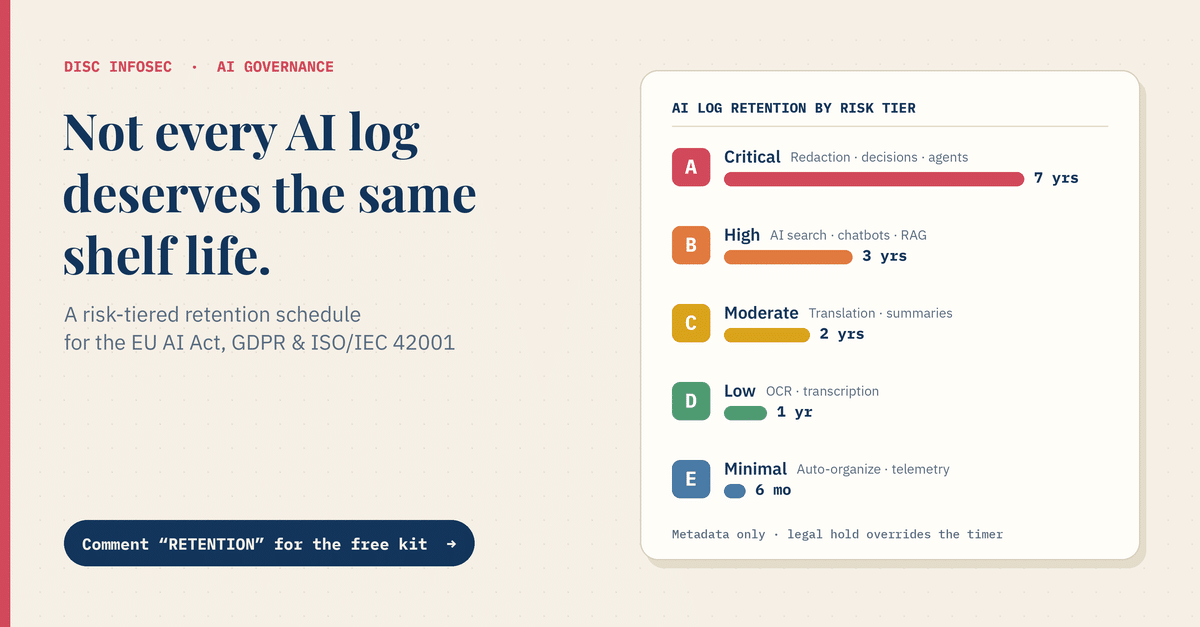
Five tiers, from seven years down to six months. Periods run from the date of the log event and act as both the minimum and the default maximum.
| Tier | Typical AI functions | Why this tier | Key log events (metadata only) | Retention | Primary basis |
| Tier A Critical | AI in decisions about people (credit, hiring, insurance, eligibility); privacy-protective AI (redaction, PII masking, DLP); agents that change systems, move money or send external messages | Direct harm to rights or data if wrong; outputs often relied on; primary evidence in breaches and legal claims | Decision or action taken; inputs referenced by ID; confidence scores; human approval, override or reversal; model, prompt and rule-set version; tool calls and their authorization | 7 years | GDPR Art. 5(2), 17(3)(e), 22, 32–34, 82; EU AI Act Art. 12, 14, 19, 26(6); ISO 42001 A.6.2.8; claim limitation periods |
| Tier B High | Customer-facing chatbots, RAG search and Q&A over confidential content, AI access-control decisions | Can surface content outside a user’s permissions; answers relied on; prompt-injection target; users interact with AI directly | Query metadata; documents retrieved and permission-check result; cited sources; guardrail and injection detections; AI disclosure shown; feedback flags | 3 years | EU AI Act Art. 12, 15, 50(1); GDPR Art. 5(1)(c), 25, 32; ISO 42001 A.6.2.6, A.6.2.8 |
| Tier C Moderate | Generative content people rely on after review: translation, summarization, drafting of contracts or reports | Errors can mislead, but a human reviews and the source stays authoritative | Job ID; source and output hashes; languages or template; quality score; human edit or approval; model version | 2 years | GDPR Art. 5(1)(e), 28, 32; EU AI Act Art. 50 transparency; ISO 42001 A.6.2.8 |
| Tier D Low | Extraction and enrichment feeding other systems: OCR, transcription, classification, entity tagging | Errors mostly reduce quality downstream; no direct disclosure | Job ID; document or file ID; page count; confidence; failures; engine version | 1 year | GDPR Art. 5(1)(c) and (e); EU AI Act six-month floor exceeded; ISO 42001 A.6.2.8 |
| Tier E Minimal | Internal productivity suggestions: auto-organize, tagging suggestions, autocomplete, performance telemetry | Human decides; no permission changes; lowest harm potential | Suggestion made; accepted or rejected; items affected; model version | 6 months | EU AI Act Art. 19 / 26(6) baseline; GDPR storage limitation |
Two things sit outside the tiers on purpose. AI configuration and model changes (enabling a feature, swapping a model, editing a system prompt or guardrail) are change records; keep them with your release records, typically five years. Raw prompt and output payloads captured for debugging are off by default, enabled per change request, and deleted within 30 days.
Six rules that make the schedule hold up in an audit
A table on its own is a policy. These rules turn it into evidence.
- Log metadata, not content. Record what happened, when, for whom and under which model. Do not store document text, OCR output, translations or full prompts in logs. Long retention is only defensible when the log is lean.
- Legal hold beats the timer. Any log tied to an AI incident, a personal data breach, litigation, a regulatory inquiry or a data subject request is frozen until released, then kept for the longer of its tier or the incident record.
- Dependencies inherit the higher tier. When OCR feeds redaction, the OCR job reference lives in the Tier A redaction log. Otherwise your Tier D deletion quietly breaks your Tier A evidence.
- Reclassify on change. A new model, a new provider or a new purpose triggers a re-tier before release. If a Tier E tool gains the power to change permissions, it is no longer Tier E.
- Put your vendors in scope. Your model provider may keep prompts and outputs on its own clock. Contract for no retention beyond processing and no training on customer content, and verify the settings at onboarding and every annual review.
- Prove deletion. Automate expiry, log the deletion job itself, and sample it in your internal audit. “We have a retention policy” fails; “here is last quarter’s deletion evidence” passes.
From the field: what a virtual data room taught us
Financial data rooms are the hard mode of compliance. When we took a Virtual Data Room organization through ISO/IEC 42001 certification and later rebuilt its Records Management Standard for AI, the same pattern showed up that I now see everywhere:
- The existing retention table covered contracts, audits and training records. It said nothing about AI.
- Five AI features (redaction, OCR, search, organize and translate) all shared one default log setting.
- Redaction was clearly the highest-risk function, yet its logs had the same life as auto-organize suggestions.
The fix was the tiered approach above: redaction at seven years, AI search at three, translation at two, OCR at one, auto-organize at six months, with a metadata-only logging rule that fits a content-blind platform. The policy change took days. Configuring the SIEM to honor five retention periods is the real work, so start that conversation with engineering early.
Five steps to implement this quarter
- Inventory every AI function in production, including vendor features you switched on.
- Tier each one with the four questions and record the rationale.
- Write the schedule and the six rules into your records management standard, with an owner for AI logs.
- Configure log retention and automated deletion per tier in your SIEM and at each model provider.
- Audit it: sample one log per tier, confirm content minimization, and show deletion evidence in your next management review.
Get the AI Log Retention Kit
I’ve packaged everything in this post into a ready-to-edit AI Log Retention Kit:
- The Tier A–E retention schedule as an editable Word table
- Drop-in policy language for a records management standard (scope, roles, the six rules, legal hold)
- The four-question tiering worksheet for your AI inventory
- An auditor-ready evidence checklist mapped to the EU AI Act, GDPR and ISO/IEC 42001
Comment “RETENTION” below and I’ll send it to you. Prefer a second pair of eyes on your own AI features? Book a free 30-minute AI log retention review at calendly.com/hd-deurainfosec and we’ll tier your AI functions together.
Hugh “Disc” Deura is Principal Consultant at DISC InfoSec, an ISO/IEC 42001 Lead Implementer, CISSP and CISM, and led a Virtual Data Room organization to ISO 42001 certification on its first Stage 2 audit.
This post is general guidance, not legal advice. Sector rules (for example, financial services recordkeeping) and national law may require longer periods.
#AIGovernance #ISO42001 #EUAIAct #GDPR #AISecurity #RecordsManagement #Compliance





