
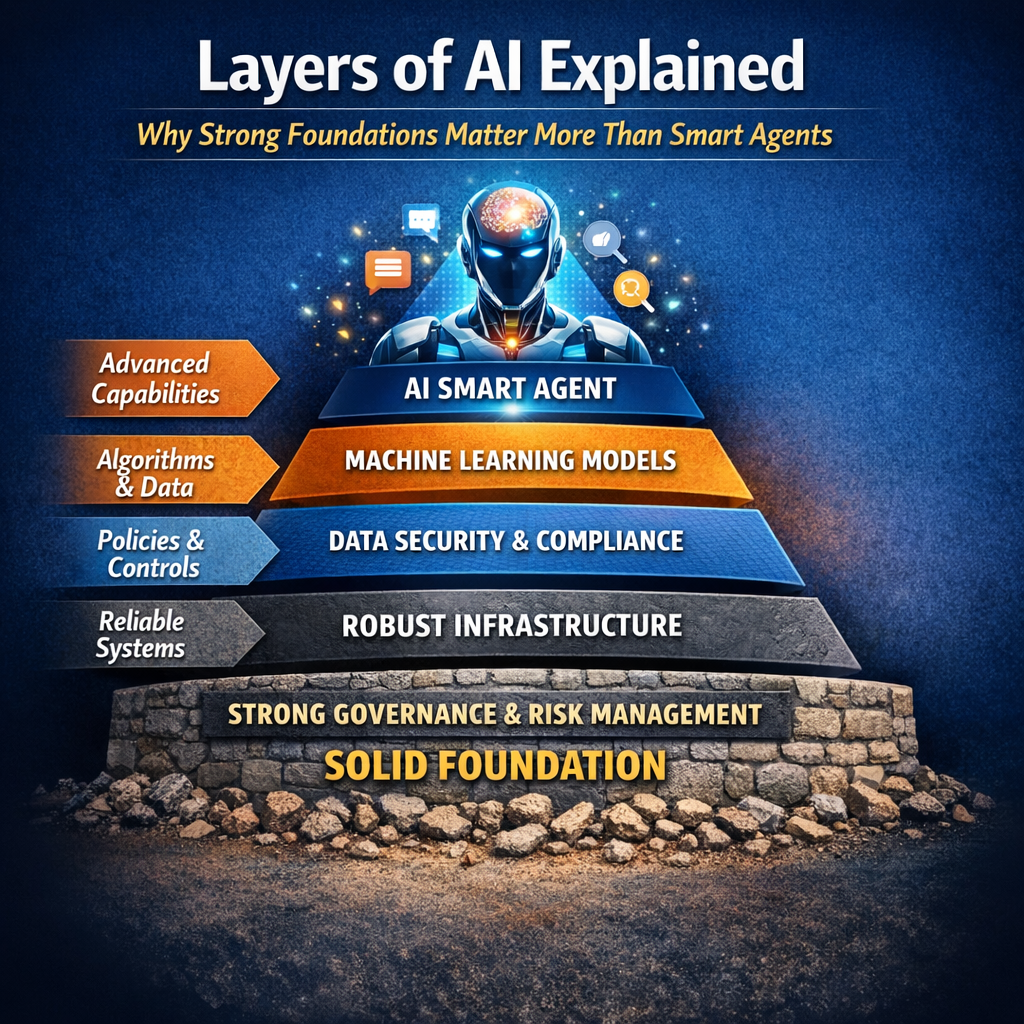
Explains the layers of AI
- AI is often perceived as something mysterious or magical, but in reality it is a layered technology stack built incrementally over decades. Each layer depends on the maturity and stability of the layers beneath it, which is why skipping foundations leads to fragile outcomes.
- The diagram illustrates why many AI strategies fail: organizations rush to adopt the top layers without understanding or strengthening the base. When results disappoint, tools are blamed instead of the missing foundations that enable them.
- At the base is Classical AI, which relies on rules, logic, and expert systems. This layer established early decision boundaries, reasoning models, and governance concepts that still underpin modern AI systems.
- Above that sits Machine Learning, where explicit rules are replaced with statistical prediction. Techniques such as classification, regression, and reinforcement learning focus on optimization and pattern discovery rather than true understanding.
- Neural Networks introduce representation learning, allowing systems to learn internal features automatically. Through backpropagation, hidden layers, and activation functions, patterns begin to emerge at scale rather than being manually engineered.
- Deep Learning builds on neural networks by stacking specialized architectures such as transformers, CNNs, RNNs, and autoencoders. This is the layer where data volume, compute, and scale dramatically increase capability.
- Generative AI marks a shift from analysis to creation. Models can now generate text, images, audio, and multimodal outputs, enabling powerful new use cases—but these systems remain largely passive and reactive.
- Agentic AI is where confusion often arises. This layer introduces memory, planning, tool use, and autonomous execution, allowing systems to take actions rather than simply produce outputs.
- Importantly, Agentic AI is not a replacement for the lower layers. It is an orchestration layer that coordinates capabilities built below it, amplifying both strengths and weaknesses in data, models, and processes.
- Weak data leads to unreliable agents, broken workflows result in chaotic autonomy, and a lack of governance introduces silent risk. The diagram is most valuable when read as a warning: AI maturity is built bottom-up, and autonomy without foundation multiplies failure just as easily as success.
This post and diagram does a great job of illustrating a critical concept in AI that’s often overlooked: foundations matter more than flashy capabilities. Many organizations focus on deploying “smart agents” or advanced models without first ensuring the underlying data infrastructure, governance, and compliance frameworks are solid. The pyramid/infographic format makes this immediately clear—visually showing that AI capabilities rest on multiple layers of systems, policies, and risk management.
My opinion: It’s a strong, board- and executive-friendly way to communicate that resilient AI isn’t just about algorithms—it’s about building a robust, secure, and governed foundation first. For practitioners, this reinforces the need for strategy before tactics, and for decision-makers, it emphasizes risk-aware investment in AI.
InfoSec services | InfoSec books | Follow our blog | DISC llc is listed on The vCISO Directory | ISO 27k Chat bot | Comprehensive vCISO Services | ISMS Services | AIMS Services | Security Risk Assessment Services | Mergers and Acquisition Security
At DISC InfoSec, we help organizations navigate this landscape by aligning AI risk management, governance, security, and compliance into a single, practical roadmap. Whether you are experimenting with AI or deploying it at scale, we help you choose and operationalize the right frameworks to reduce risk and build trust. Learn more at DISC InfoSec.
- We have guardrails for that is not a control – Here’s the difference
- Point-in-time remediation is dead against a persistent adversary
- Your Security Stack Isn’t Obsolete. Your Operating Model Is
- Thirty years of security assumed the attacker was unauthorized – Your agent isn’t
- Frontier Model, Familiar Framework: Reading Fable 5’s Guardrails Through ISO 42001





