Certified ≠ Compliant
1. The big picture
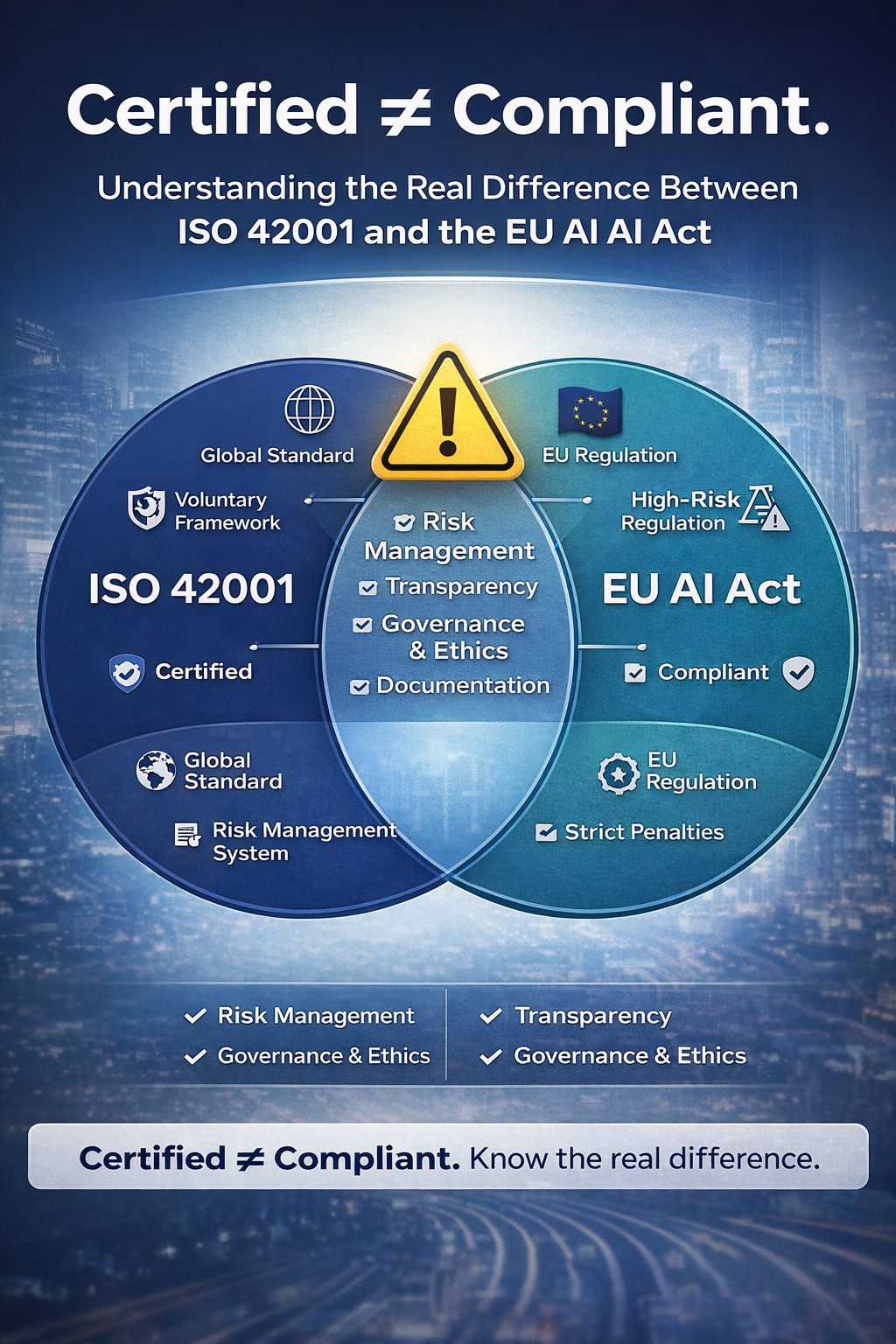
The image makes one thing very clear: ISO/IEC 42001 and the EU AI Act are related, but they are not the same thing. They overlap in intent—safe, responsible, and trustworthy AI—but they come from two very different worlds. One is a global management standard; the other is binding law.
2. What ISO/IEC 42001 really is
ISO/IEC 42001 is an international, voluntary standard for establishing an AI Management System (AIMS). It focuses on how an organization governs AI—policies, processes, roles, risk management, and continuous improvement. Being certified means you have a structured system to manage AI risks, not that your AI systems are legally approved for use in every jurisdiction.
3. What the EU AI Act actually does
The EU AI Act is a legal and regulatory framework specific to the European Union. It defines what is allowed, restricted, high-risk, or outright prohibited in AI systems. Compliance is mandatory, enforceable by regulators, and tied directly to penalties, market access, and legal exposure.
4. The shared principles that cause confusion
The overlap is real and meaningful. Both ISO 42001 and the EU AI Act emphasize transparency and accountability, risk management and safety, governance and ethics, documentation and reporting, data quality, human oversight, and trustworthy AI outcomes. This shared language often leads companies to assume one equals the other.
5. Where ISO 42001 stops short
ISO 42001 does not classify AI systems by risk level. It does not tell you whether your system is “high-risk,” “limited-risk,” or prohibited. Without that classification, organizations may build solid governance processes—while still governing the wrong risk category.
6. Conformity versus certification
ISO 42001 certification is voluntary and typically audited by certification bodies against management system requirements. The EU AI Act, however, can require formal conformity assessments, sometimes involving notified third parties, especially for high-risk systems. These are different auditors, different criteria, and very different consequences.
7. The blind spot around prohibited AI practices
ISO 42001 contains no explicit list of banned AI use cases. The EU AI Act does. Practices like social scoring, certain emotion recognition in workplaces, or real-time biometric identification may be illegal regardless of how mature your management system is. A well-run AIMS will not automatically flag illegality.
8. Enforcement and penalties change everything
Failing an ISO audit might mean corrective actions or losing a certificate. Failing the EU AI Act can mean fines of up to €35 million or 7% of global annual turnover, plus reputational and operational damage. The risk profiles are not even in the same league.
9. Certified does not mean compliant
This is the core message in the image and the text: ISO 42001 certification proves governance maturity, not legal compliance. The EU AI Act qualification proves regulatory alignment, not management system excellence. One cannot substitute for the other.
10. My perspective
Having both ISO 42001 certification and EU AI Act qualification exposes a hard truth many consultants gloss over: compliance frameworks do not stack automatically. ISO 42001 is a strong foundation—but it is not the finish line. Your certificate shows you are organized; it does not prove you are lawful. In AI governance, certified ≠ compliant, and knowing that difference is where real expertise begins.
InfoSec services | InfoSec books | Follow our blog | DISC llc is listed on The vCISO Directory | ISO 27k Chat bot | Comprehensive vCISO Services | ISMS Services | AIMS Services | Security Risk Assessment Services | Mergers and Acquisition Security
At DISC InfoSec, we help organizations navigate this landscape by aligning AI risk management, governance, security, and compliance into a single, practical roadmap. Whether you are experimenting with AI or deploying it at scale, we help you choose and operationalize the right frameworks to reduce risk and build trust. Learn more at DISC InfoSec.
- When AI Hacks Faster Than Humans: The Coming Collapse of Traditional Cybersecurity Value
- SOC 2 Isn’t Enough: Moving Beyond Compliance Theater to Real Risk Management
- When AI Becomes the Attack Surface: Lessons from the McKinsey Lilli Incident
- Why Every Company Needs a CISO (or at Least vCISO-Level Leadership)
- How ISO 27001 Lead Auditors Should Evaluate AI Risks in an ISMS