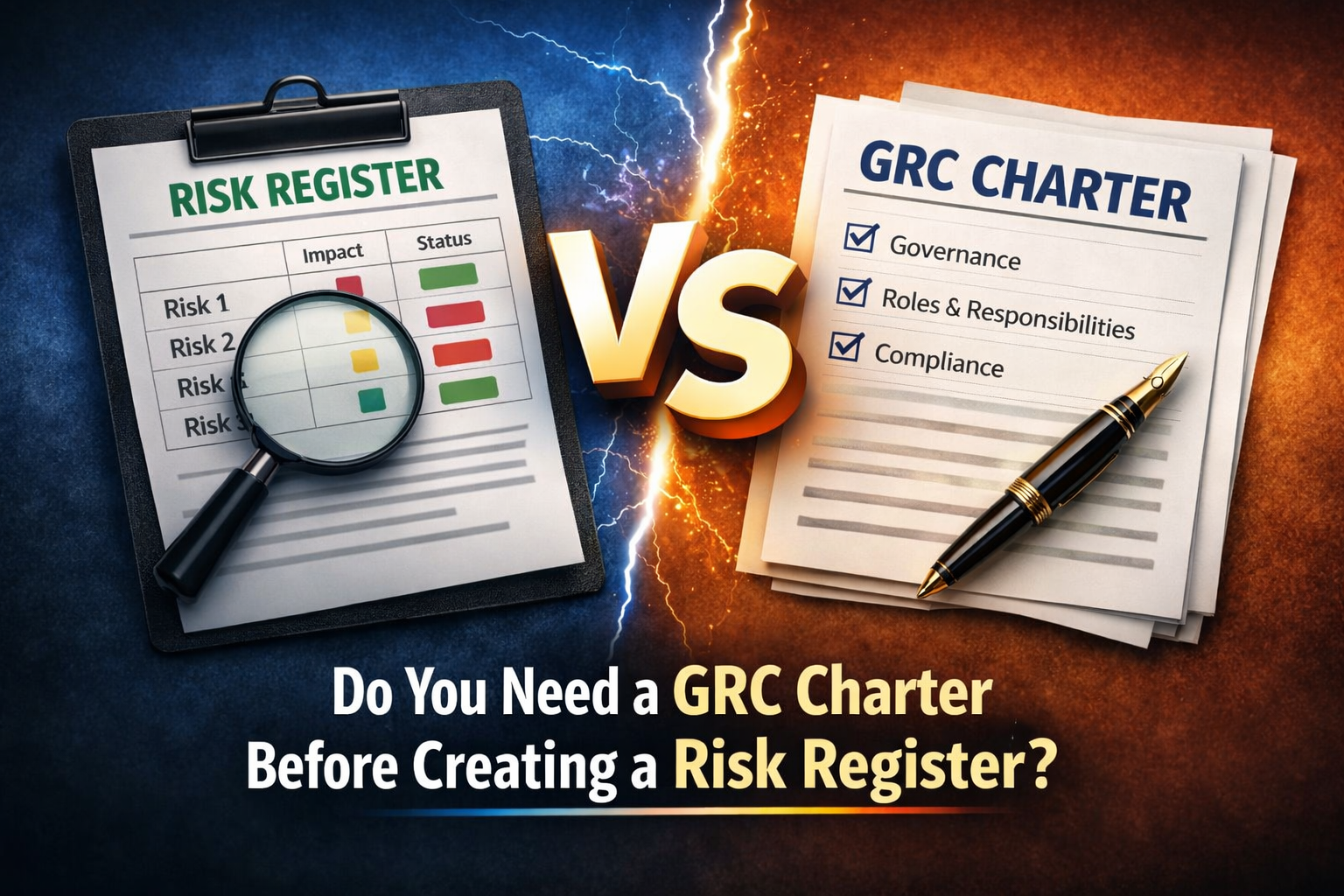
“You can’t have a risk register without an approved GRC charter.”
I hear this statement often — and it’s a myth worth clarifying.
A risk register is an operational tool. Many organizations create and use one long before they formalize governance structures. Major frameworks from the National Institute of Standards and Technology (NIST) and the International Organization for Standardization (ISO) don’t require a GRC charter as a prerequisite to building a risk register.
However, here’s the nuance: a GRC charter gives the risk register authority. It defines ownership, executive sponsorship, and decision rights. Without governance backing, a risk register can exist — but it risks becoming a passive checklist instead of a strategic decision tool.
The practical takeaway: you can start managing risks immediately, but for long-term effectiveness, formal governance should follow quickly. Mature organizations align their risk registers with a clear charter to ensure accountability and impact.
Risk management is not about paperwork — it’s about enabling better decisions.
Here’s a policy-style version you can use for internal documentation:
Risk Register Governance Policy Statement
The organization maintains a risk register as a formal mechanism to identify, assess, document, and monitor enterprise risks. The existence of a risk register does not depend on the prior approval of a formal Governance, Risk, and Compliance (GRC) charter; however, effective risk management requires clear governance authority and executive sponsorship.
Consistent with guidance from the National Institute of Standards and Technology and standards published by the International Organization for Standardization, the organization recognizes that a risk register is an operational tool that supports decision-making at all levels. A formal GRC charter strengthens the effectiveness of the risk register by defining roles, responsibilities, and accountability for risk ownership and acceptance.
Where a GRC charter is not yet established, management may initiate and maintain a risk register to support ongoing risk management activities. The organization will work toward formalizing governance structures to ensure that risks documented in the register are reviewed, prioritized, and acted upon with appropriate authority.
The objective of this policy is to ensure that the risk register functions as an living management instrument that informs strategic and operational decisions, rather than as a static compliance artifact.
#RiskRegister #GRCCharter

InfoSec services | InfoSec books | Follow our blog | DISC llc is listed on The vCISO Directory | ISO 27k Chat bot | Comprehensive vCISO Services | ISMS Services | AIMS Services | Security Risk Assessment Services | Mergers and Acquisition Security
At DISC InfoSec, we help organizations navigate this landscape by aligning AI risk management, governance, security, and compliance into a single, practical roadmap. Whether you are experimenting with AI or deploying it at scale, we help you choose and operationalize the right frameworks to reduce risk and build trust. Learn more at DISC InfoSec.
- Security Is a People Problem: Culture, Behavior, and Decisions Drive Cyber Resilience
- Security Driven by Business Value: Focus, Prioritize, Protect What Matters Most
- Claude Mythos and the Future of Cybersecurity: Powerful—and Potentially Dangerous
- Hackers at Machine Speed: The AI Cybersecurity Reality
- AI Security = API Security: The Case for Real-Time Enforcement