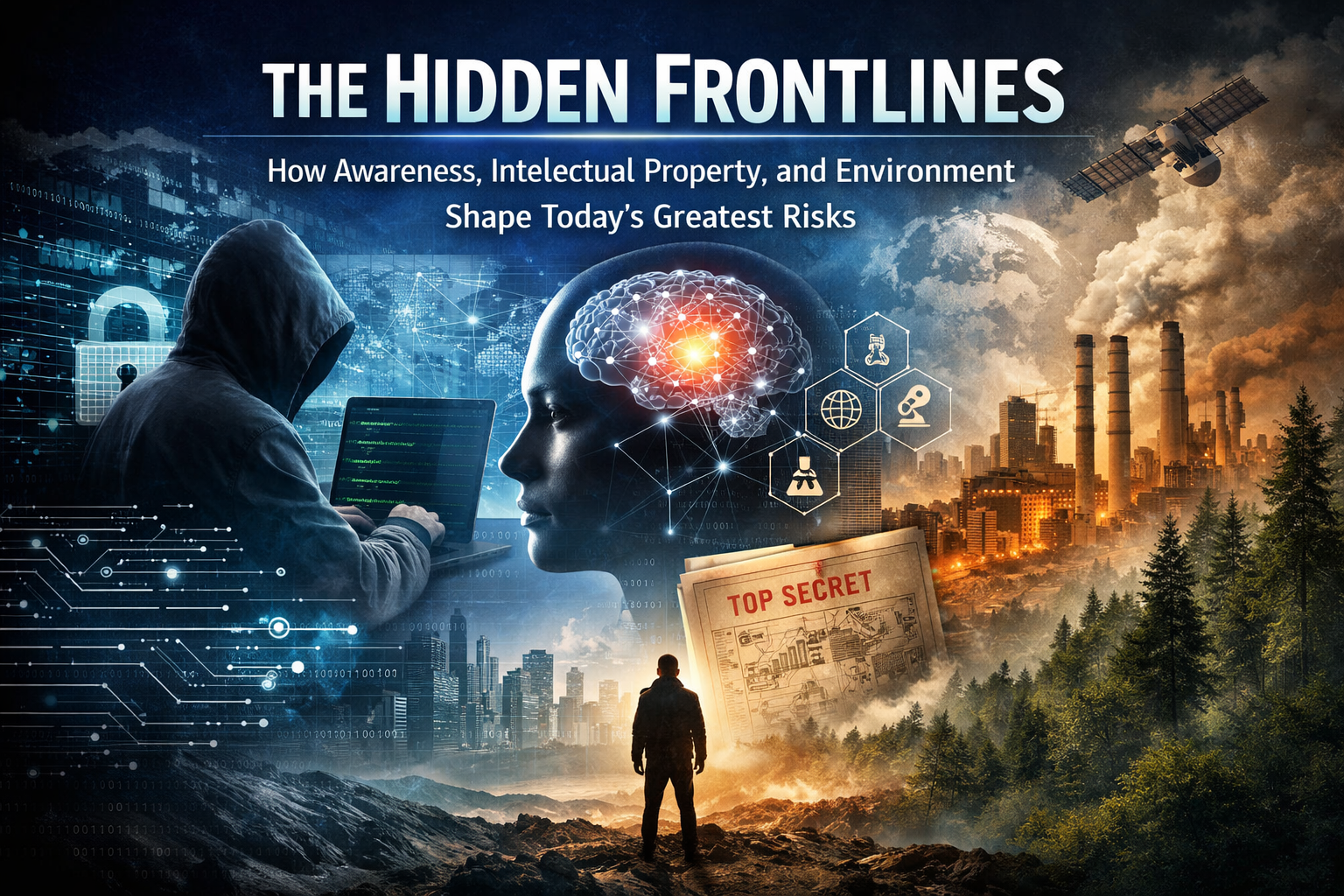
Today’s most serious risks are no longer loud or obvious. Whether you are protecting an organization, leading people, or building resilience in your own life, the real threats — and opportunities — increasingly exist below the surface, hidden in systems, environments, and assumptions we rarely question.
Leadership, cybersecurity, and performance are being reshaped quietly. The rules aren’t changing overnight; they’re shifting gradually, often unnoticed, until the impact becomes unavoidable. Staying ahead now requires understanding these subtle shifts before they turn into crises. Everything begins with awareness. Not just awareness of cyber threats, but of the deeper drivers of vulnerability and strength. Intellectual property, environmental influence, and decision-making systems are emerging as critical factors that determine long-term success or failure.
This shift demands a move away from late-stage reaction. Instead of responding after alarms go off, leaders must understand the battlefield in advance — identifying where value truly lives and how it can be exposed without obvious warning signs. Intellectual property has become one of the most valuable — and most targeted — assets in the modern threat landscape. As traditional perimeter defenses weaken, attackers are no longer just chasing systems and data; they are pursuing ideas, research, trade secrets, and innovation itself.
IP protection is no longer a legal checkbox or an afterthought. Nation-states, competitors, and sophisticated actors are exploiting digital access to siphon knowledge and strategic advantage. Defending intellectual capital now requires executive attention, governance, and security alignment.
Cybersecurity is also deeply personal. Our environments — digital and physical — quietly shape how we think, decide, perform, and recover. Factors like constant digital noise, poor system design, and unhealthy surroundings compound over time, leading to fatigue, errors, and burnout.
This perspective challenges leaders to design not only secure systems, but sustainable lives. Clear thinking, sound judgment, and consistent performance depend on mastering the environment around us as much as mastering technology or strategy. When change happens quietly, awareness becomes the strongest form of defense. Whether protecting intellectual property, navigating uncertainty, or strengthening personal resilience, the greatest risks — and advantages — are often the ones we fail to see at first glance.
Opinion
In my view, this shift marks a critical evolution in how we think about risk and leadership. The organizations and individuals who win won’t be those with the loudest tools, but those with the deepest awareness. Seeing beneath the surface — of systems, environments, and value — is no longer optional; it’s the defining capability of modern resilience and strategic advantage.
InfoSec services | InfoSec books | Follow our blog | DISC llc is listed on The vCISO Directory | ISO 27k Chat bot | Comprehensive vCISO Services | ISMS Services | AIMS Services | Security Risk Assessment Services | Mergers and Acquisition Security
At DISC InfoSec, we help organizations navigate this landscape by aligning AI risk management, governance, security, and compliance into a single, practical roadmap. Whether you are experimenting with AI or deploying it at scale, we help you choose and operationalize the right frameworks to reduce risk and build trust. Learn more at DISC InfoSec.
- MITRE ATT&CK: Turning Blind Spots into Real-World Cyber Defense
- When AI Hacks Faster Than Humans: The Coming Collapse of Traditional Cybersecurity Value
- SOC 2 Isn’t Enough: Moving Beyond Compliance Theater to Real Risk Management
- When AI Becomes the Attack Surface: Lessons from the McKinsey Lilli Incident
- Why Every Company Needs a CISO (or at Least vCISO-Level Leadership)
![Reblog this post [with Zemanta]](https://img.zemanta.com/reblog_e.png?x-id=6ccd3b7c-e7f3-4bb6-bd66-6c81a2930cba)