
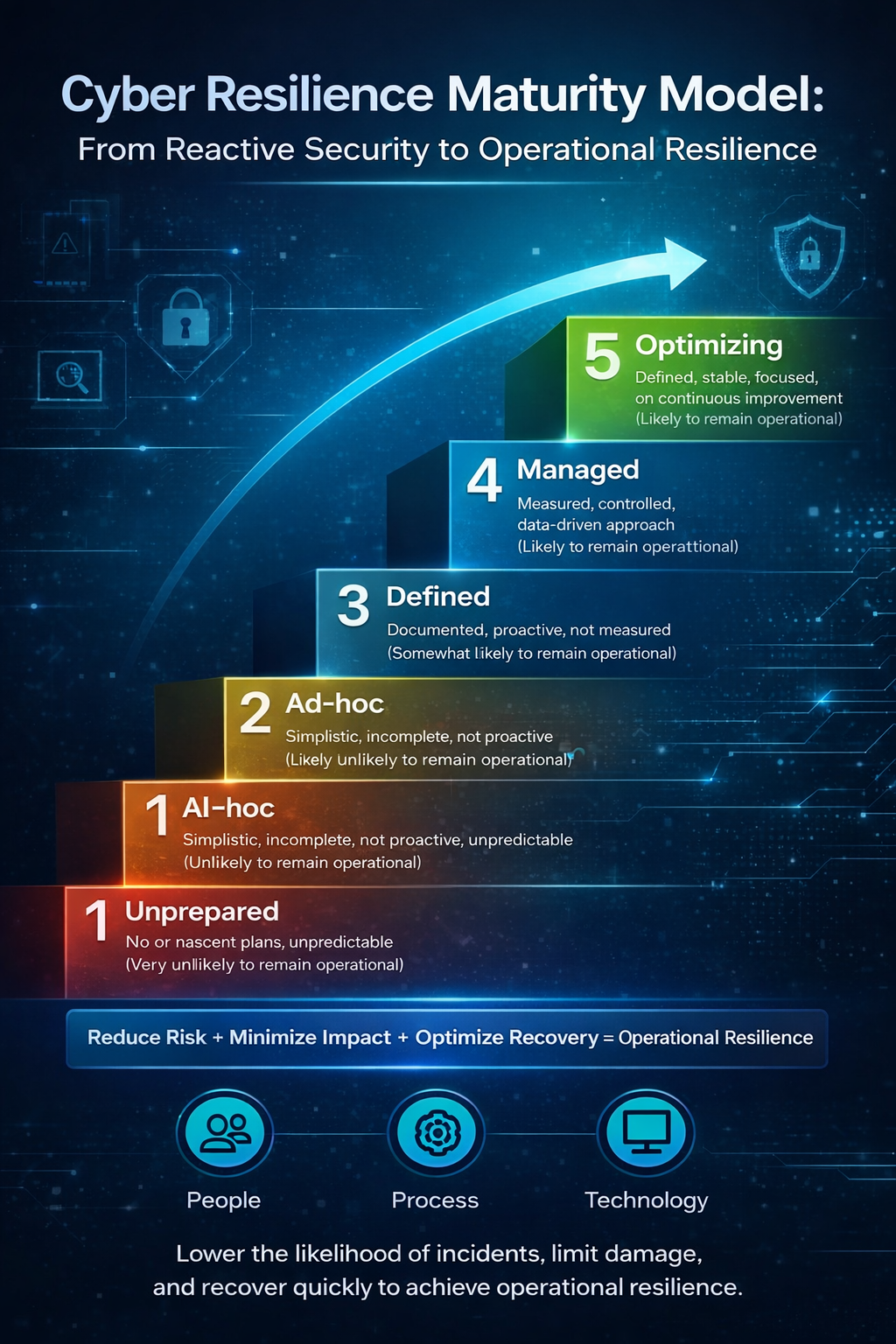
What is a Cyber Resilience Maturity Framework?
A Cyber Resilience Maturity Framework is a structured model used to assess how well an organization can prevent, withstand, respond to, and recover from cyber incidents. It evaluates capabilities across people, process, and technology, and helps organizations move from reactive security to predictable, adaptive resilience.
Maturity Levels (1–5) with Guidance
1. Unprepared
Definition:
No formal plans or controls. Security is reactive, inconsistent, and highly unpredictable. Survival during a major incident is unlikely.
How to prepare for next stage:
- Establish basic security policies (access control, backups)
- Identify critical assets and risks
- Implement foundational controls (antivirus, MFA, patching)
- Assign ownership (even if informal)
2. Ad-hoc
Definition:
Some controls exist but are inconsistent, incomplete, and not standardized. Efforts are reactive and siloed.
How to prepare for next stage:
- Standardize processes (incident response, vulnerability management)
- Document procedures
- Begin basic security awareness training
- Introduce simple monitoring/logging
3. Defined
Definition:
Policies and processes are documented and proactive, but not consistently measured or enforced.
How to prepare for next stage:
- Implement metrics and KPIs (MTTR, incident frequency)
- Conduct regular risk assessments
- Formalize governance (e.g., align with ISO 27001 / ISO 42001)
- Run tabletop exercises for incident response
4. Managed
Definition:
Security is measured, controlled, and data-driven. Decisions are based on analytics and risk insights.
How to prepare for next stage:
- Automate detection and response (SOAR, AI-driven monitoring)
- Integrate security into business processes (DevSecOps, AI governance)
- Continuously monitor third-party risks
- Benchmark against industry standards
5. Optimizing
Definition:
A mature, adaptive, and continuously improving security posture. The organization is resilient and can maintain operations even during disruptions.
How to sustain/advance:
- Continuously improve through threat intelligence and lessons learned
- Invest in predictive analytics and AI risk modeling
- Embed resilience into business strategy
- Regularly test crisis scenarios (chaos engineering, red teaming)
Reduce Risk + Minimize Impact + Optimize Recovery = Uber Mature Cyber Resilience
Rephrased:
Cyber resilience maturity is achieved when an organization can lower the likelihood of incidents, limit damage when they occur, and recover quickly and effectively.
Simple Breakdown:
- Reduce Risk: Prevent attacks (controls, governance, awareness)
- Minimize Impact: Contain damage (segmentation, detection, response)
- Optimize Recovery: Restore operations fast (backups, DR, resilience planning)
👉 Together, these shift security from defensive posture → operational continuity capability
Perspective
Most organizations over-invest in risk reduction (prevention) and under-invest in impact minimization and recovery—which is where true resilience lives. In today’s environment (especially with AI-driven threats), failure is inevitable, but collapse is optional.
A strong maturity model isn’t about being “secure”—it’s about being operational under stress.
The real differentiator at higher maturity levels is:
- Visibility (what’s happening)
- Speed (how fast you respond)
- Adaptability (how quickly you improve)
Organizations that embrace this model move from compliance-driven security → resilience-driven business strategy, which is exactly where the market (and regulators) are heading.
Cyber Resilience Act (CRA): A Practical Pocket Guide
InfoSec services | InfoSec books | Follow our blog | DISC llc is listed on The vCISO Directory | ISO 27k Chat bot | Comprehensive vCISO Services | ISMS Services | AIMS Services | Security Risk Assessment Services | Mergers and Acquisition Security
Is your AI strategy truly audit-ready today?
AI governance is no longer optional. Frameworks like ISO/IEC 42001 AI Management System Standard and regulations such as the EU AI Act are rapidly reshaping compliance expectations for organizations using AI.
DISC InfoSec brings deep expertise across AI, cybersecurity, and regulatory compliance to help you build trust, reduce risk, and stay ahead of evolving mandates—with a proven track record of success.
Ready to lead with confidence? Let’s start the conversation.
At DISC InfoSec, we help organizations navigate this landscape by aligning AI risk management, governance, security, and compliance into a single, practical roadmap. Whether you are experimenting with AI or deploying it at scale, we help you choose and operationalize the right frameworks to reduce risk and build trust. Learn more at DISC InfoSec.
- Cyber Resilience Maturity Model: From Reactive Security to Operational Resilience
- From Risk to Resilience: A 5-Step Playbook for Securing AI in the Modern Threat Era
- Which AI Governance Framework Should You Adopt First? A Practical Guide for U.S., EU, and Global Organizations
- MITRE ATT&CK: Turning Blind Spots into Real-World Cyber Defense
- When AI Hacks Faster Than Humans: The Coming Collapse of Traditional Cybersecurity Value





