Feb 14 2026

Understanding Blockchain: A Visual Walkthrough of the Technology

Category: Crypto,Information Securitydisc7 @ 9:22 am

Blockchain 101: Understanding the Basics Through a Visual

Think of cryptocurrency as a new kind of digital money that exists only on the internet and doesn’t rely on banks or governments to run it.

A good way to understand it is by starting with the most famous example: Bitcoin.


What is cryptocurrency?

Cryptocurrency is digital money secured by cryptography (advanced math used to protect information). Instead of a bank keeping track of who owns what, transactions are recorded on a public digital ledger called a blockchain.

You can imagine blockchain as a shared Google Sheet that thousands of computers around the world constantly verify and update. No single company controls it.

Key features:

  • 💻 Digital only – no physical coins or bills
  • 🌍 Decentralized – not controlled by one government or bank
  • 🔒 Secure – protected by cryptography
  • 📜 Transparent – transactions are recorded publicly

How does cryptocurrency work?

Most cryptocurrencies run on a blockchain network.

Here’s a simplified flow:

  1. You create a wallet
    A crypto wallet is like a digital bank account. It has:
    • a public address (like your email you can share)
    • a private key (like your password — keep it secret)
  2. You send a transaction
    When you send crypto, your wallet signs the transaction with your private key.
  3. The network verifies it
    Thousands of computers (called nodes or miners/validators) check that:
    • you actually own the funds
    • you aren’t spending the same money twice
  4. The transaction is added to the blockchain
    Once verified, it’s grouped with others into a “block” and permanently recorded.

After that, the transaction can’t easily be changed.


Benefits of cryptocurrency

1. Faster global payments

You can send money anywhere in the world in minutes, often cheaper than banks.

2. No middleman required

You don’t need a bank or payment company to approve transactions.

3. Financial access

Anyone with internet access can use crypto — helpful in places with weak banking systems.

4. Transparency and security

Transactions are public and hard to tamper with.

5. Programmable money

Some cryptocurrencies (like Ethereum) allow smart contracts — programs that automatically execute agreements.


Example: A simple crypto transaction

Let’s walk through a real-world style example.

Scenario:
Alice wants to send $20 worth of Bitcoin to Bob for helping with a project.

Step-by-step:

  1. Alice opens her wallet app and enters Bob’s public address.
  2. She types in the amount and presses Send.
  3. Her wallet signs the transaction with her private key.
  4. The Bitcoin network checks that Alice has enough funds.
  5. The transaction is added to the blockchain.
  6. Bob sees the payment appear in his wallet.

Time: ~10 minutes (depending on network traffic)
No bank involved.

It’s similar to handing someone cash — but done digitally and verified by a global network.


Simple analogy

Think of cryptocurrency like:

Email for money

Before email, sending letters took days and required postal systems.
Crypto lets you send money across the internet as easily as sending an email.


Important things to know (balanced view)

While crypto has benefits, it also has challenges:

  • ⚠️ Prices can be very volatile
  • 🔐 If you lose your private key, you may lose your funds
  • 🧾 Regulations are still evolving
  • 🧠 It has a learning curve

let’s walk through the diagram step by step in plain language, like you would in a classroom.
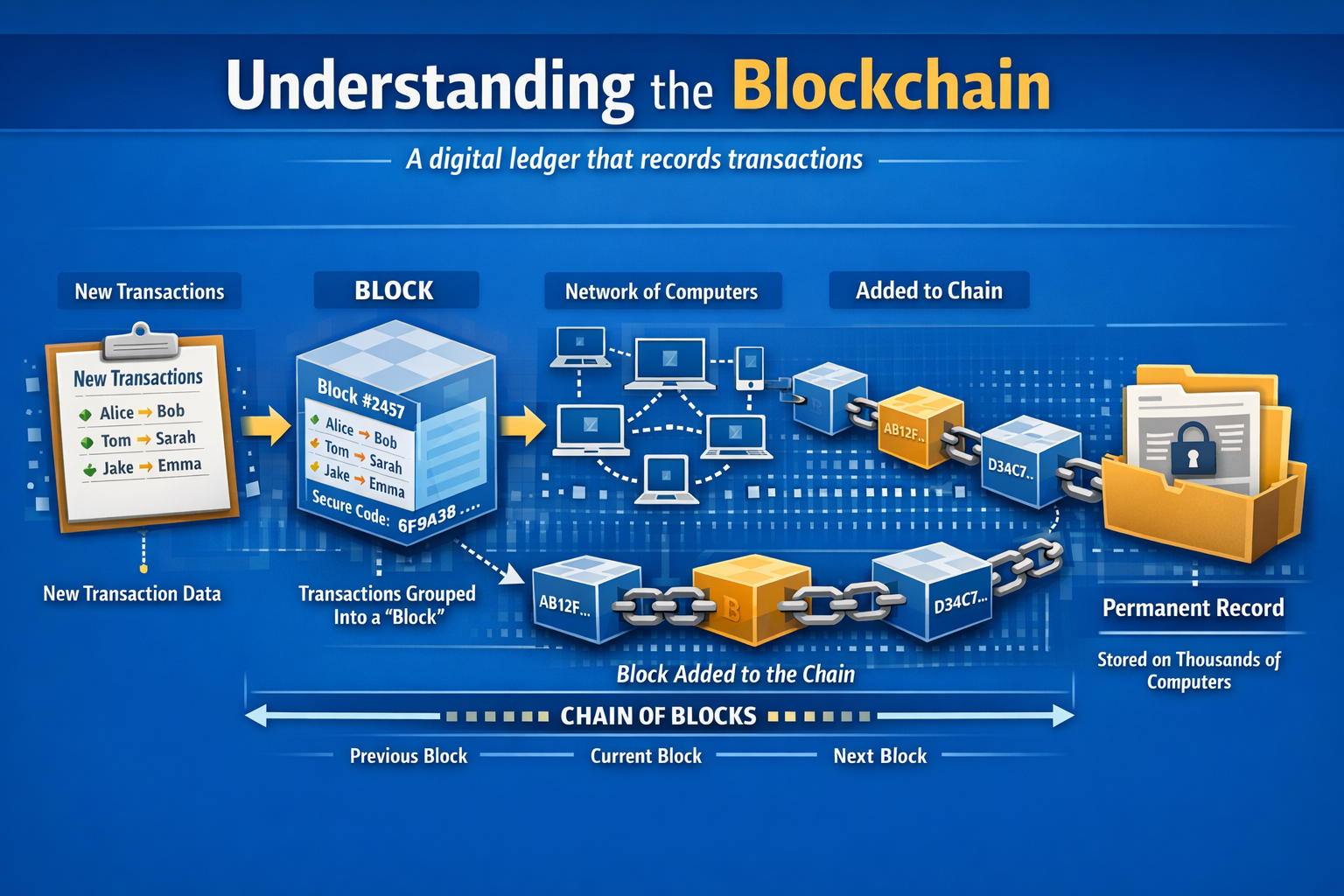
This diagram is showing how a blockchain records a transaction (like sending money using Bitcoin).


Step 1: New transactions are created

On the left side, you see a list of new transactions (for example: Alice sends money to Bob).

Think of this as:

👉 People requesting to send digital money to each other.

At this stage, the transactions are waiting to be verified.


Step 2: Transactions are grouped into a block

In the next section, those transactions are packed into a block.

A block is like a container or page in a notebook that stores:

  • A list of transactions
  • A timestamp (when it happened)
  • A unique security code (called a hash)

This security code links the block to the previous block — like a chain link.


Step 3: The network of computers verifies the block

In the middle of the diagram, you see many connected computers.

These computers form a global network that checks:

  • Are the transactions valid?
  • Does the sender actually have the funds?
  • Is anyone trying to cheat?

If most computers agree the transactions are valid, the block is approved.

Think of it like a group of students checking each other’s math homework to make sure it’s correct.


Step 4: The block is added to the chain

Once approved, the block is attached to previous blocks, forming a chain of blocks — this is the blockchain.

Each new block connects to the one before it using cryptographic links.

This makes it very hard to change past records, because you would have to change every block after it.


Step 5: Permanent record stored everywhere

On the far right, the diagram shows a secure folder.

This represents the permanent record:

  • The transaction is now finalized
  • It’s copied and stored across thousands of computers
  • It cannot easily be altered

This is what makes blockchain secure and transparent.


Big picture summary

The diagram shows this simple flow:

👉 Transaction → Block → Verification → Chain → Permanent record

In other words:

Someone sends crypto → it gets verified by many computers → it becomes a permanent part of a shared digital ledger.


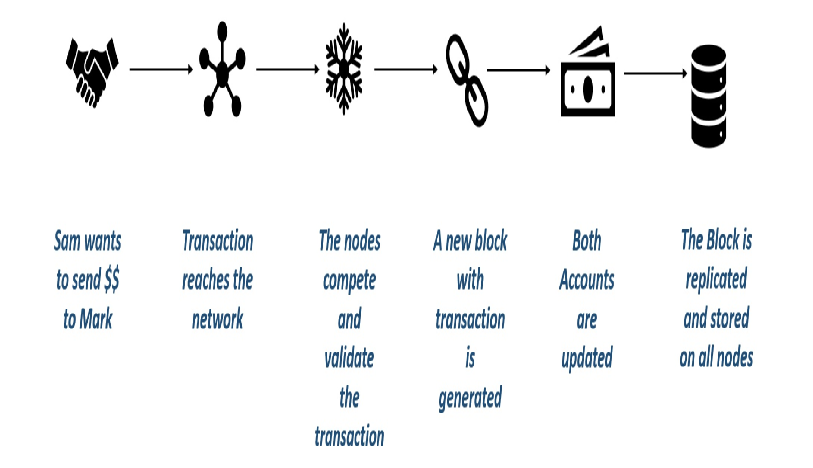
Here is another digital transaction exmple: in this example Sam want to send digital asset ($$) to Mark

InfoSec services | InfoSec books | Follow our blog | DISC llc is listed on The vCISO Directory | ISO 27k Chat bot | Comprehensive vCISO Services | ISMS Services | AIMS Services | Security Risk Assessment Services | Mergers and Acquisition Security

At DISC InfoSec, we help organizations navigate this landscape by aligning AI risk management, governance, security, and compliance into a single, practical roadmap. Whether you are experimenting with AI or deploying it at scale, we help you choose and operationalize the right frameworks to reduce risk and build trust. Learn more at DISC InfoSec.

Tags: blockchain, cryptocurrency


Jul 20 2023

How do you solve privacy issues with AI? It’s all about the blockchain

Category: AI,Blockchain,Information Privacydisc7 @ 9:18 am

How do you solve privacy issues with AI? It’s all about the blockchain

Data is the lifeblood of artificial intelligence (AI), and the power that AI brings to the business world — to unearth fresh insights, increase speed and efficiency, and multiply effectiveness — flows from its ability to analyze and learn from data. The more data AI has to work with, the more reliable its results will be.

Feeding AI’s need for data means collecting it from a wide variety of sources, which has raised concerns about AI gathering, processing, and storing personal data. The fear is that the ocean of data flowing into AI engines is not properly safeguarded.

Are you donating your personal data to generative AI platforms?

While protecting the data that AI tools like ChatGPT is collecting against breaches is a valid concern, it is actually only the tip of the iceberg when it comes to AI-related privacy issues. A more poignant issue is data ownership. Once you share information with a generative AI tool like Bard, who owns it?

Those who are simply using generative AI platforms to help craft better social posts may not understand the connection between the services they offer and personal data security. But consider the person who is using an AI-driven chatbot to explore treatment for a medical condition, learn about remedies for a financial crisis, or find a lawyer. In the course of the exchange, those users will most likely share some personal and sensitive information.

Every query posed to an AI platform becomes part of that platform’s data set without regard to whether or not it is personal or sensitive. ChatGPT’s privacy policy makes it clear: “When you use our Services, we collect Personal Information that is included in the input, file uploads, or feedback that you provide to our Services.” It also says: “In certain circumstances we may provide your Personal Information to third parties without further notice to you, unless required by the law…”

Looking to blockchain for data privacy solutions

While the US government has called for an “AI Bill of Rights” designed to protect sensitive data, it has yet to provide the type of regulations that protect its ownership. Consequently, Google and Microsoft have full ownership over the data that their users provide as they comb the web with generative AI platforms. That data empowers them to train their AI models, but also to get to understand you better.

Those looking for a way to gain control of their data in the age of AI can find a solution in blockchain technology. Commonly known as the foundation of cryptocurrency, blockchain can also be used to allow users to keep their personal data safe. By empowering a new type of digital identity management — known as a universal identity layer — blockchain allows you to decide how and when your personal data is shared.

Blockchain technology brings a number of factors into play that boost the security of personal data. First, it is decentralized, meaning that data is not stored in a centralized database and is not subject to its vulnerabilities with blockchain.

Blockchain also supports smart contracts, which are self-executing contracts that have the terms of an agreement written into their code. If the terms aren’t met, the contract does not execute, allowing for data stored on the blockchain to be utilized only in the way in which the owner stipulates.

Enhanced security is another factor that blockchain brings to data security efforts. The cryptographic techniques it utilizes allow users to authenticate their identity without revealing sensitive data.

Leveraging these factors to create a new type of identification framework gives users full control of who can use and view their information, for what purposes, and for how long. Once in place, this type of identity system could even be used to allow users to monetize their data, charging large language models (LLMs) like OpenAI and Google Bard to benefit from the use of personal data.

Ultimately, AI’s ongoing needs may lead to the creation of platforms where users offer their data to LLMs for a fee. A blockchain-based universal identity layer would allow the user to choose who gets to use it, toggling access on and off at will. If you decide you don’t like the business practices Google has been employing over the past two months, you can cut them off at the source.

That type of AI model illustrates the power that comes from securing data on a decentralized network. It also reveals the killer use case of blockchain that is on the horizon.

Image credittampatra@hotmail.com/depositphotos.com

Aaron Rafferty is the CEO of Standard DAO and Co-Founder of BattlePACs, a subsidiary of Standard DAO. BattlePACs is a technology platform that transforms how citizens engage in politics and civil discourse. BattlePACs believes participation and conversations are critical to moving America toward a future that works for everyone.

Blockchain and Web3: Building the Cryptocurrency, Privacy, and Security Foundations of the Metaverse

InfoSec books | InfoSec tools | InfoSec services

Tags: AI privacy, blockchain, Blockchain and Web3


Apr 16 2023

We are no longer securing computers, we’re securing Society

Category: Blockchain,Information SecurityDISC @ 10:12 am

Blockchain: Understanding Its Uses and Implications


InfoSec Threats
 | InfoSec books | InfoSec tools | InfoSec services

Tags: blockchain, securing Society


Jul 17 2020

Twitter stepped up search to fill top security job ahead of hack

Search for a chief information security officer

Twitter Inc had stepped up its search for a chief information security officer in recent weeks, two people familiar with the effort told Reuters, before the breach of high-profile accounts on Wednesday raised alarms about the platform’s security. Twitter said hackers had targeted employees with access to its internal systems and “used this access to take control of many highly-visible (including verified) accounts.”

The second and third rounds of hijacked accounts tweeted out messages telling users to send bitcoin to a given address in order to get more back. Publicly available blockchain records show the apparent scammers received more than $100,000 worth of cryptocurrency.

The U.S. House Intelligence Committee was in touch with Twitter regarding the hack, according to a committee official who did not wish to be named.

Source: Twitter stepped up search to fill top security job ahead of hack


Twitter says 130 accounts were targeted in hack

httpv://www.youtube.com/watch?v=4pquwx-doYg

Explore latest CISO Titles at DISC InfoSec

Download a Security Risk Assessment Steps paper!

Subscribe to DISC InfoSec blog by Email

Take an awareness quiz to test your basic cybersecurity knowledge

DISC InfoSec 🔒 securing the business 🔒 via latest InfoSec titles


Tags: bitcoin, blockchain, Chief Information Security Officer, high-profile accounts, hijacked accounts, House Intelligence Committee, Twitter CISO, vCISO, verified accounts