
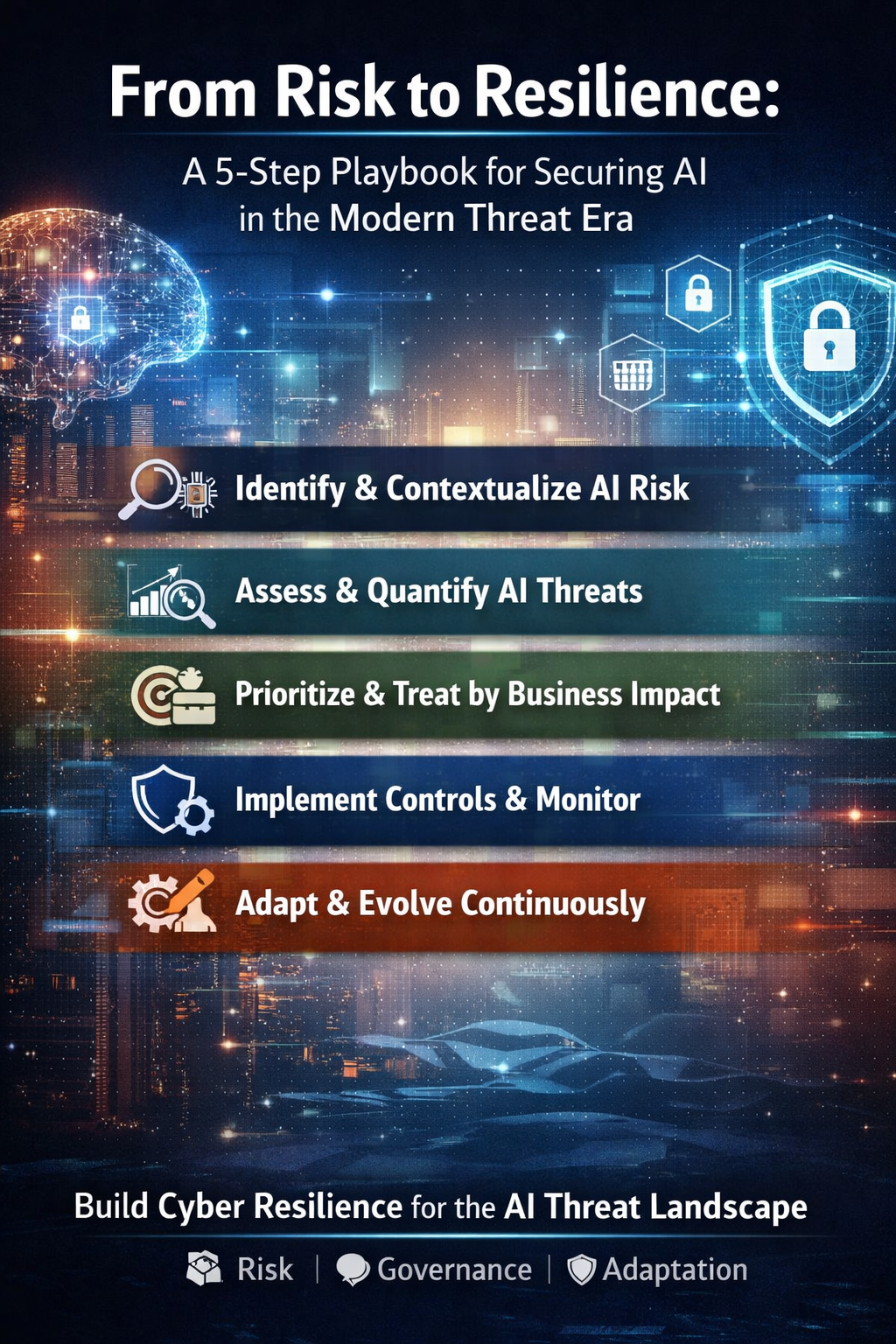
The AI cyber risk playbook outlines a structured, five-step approach to building cyber resilience in the face of rapidly evolving AI-driven threats. First, organizations must contextualize AI risk by identifying where and how AI is used—whether through shadow AI, third-party models, or internally developed systems—and understanding how each introduces new attack vectors. This step shifts security from a static inventory mindset to a dynamic view of AI exposure across the enterprise.
Second, organizations need to assess and quantify AI-driven risks, moving beyond traditional qualitative methods. AI amplifies both the speed and scale of attacks, so risk must be modeled in terms of likelihood, impact, and business loss scenarios. This aligns with modern cyber risk thinking where AI introduces compounding and adaptive threat patterns, making traditional linear risk models insufficient.
Third, the playbook emphasizes prioritizing and treating risks based on business impact, not just technical severity. This means aligning mitigation strategies—such as controls, monitoring, and governance—with high-value assets and critical AI use cases. Organizations must integrate AI risk into enterprise risk management and governance structures, ensuring leadership visibility and accountability rather than treating it as a siloed security issue.
Fourth, organizations must operationalize resilience through controls, monitoring, and response capabilities tailored to AI threats. This includes embedding security into the AI lifecycle, implementing zero-trust principles, and enabling real-time detection and response. Given that AI-powered attacks are more automated and adaptive, resilience depends on continuous monitoring, rapid response, and the ability to maintain operations under attack—not just prevent breaches.
Finally, the fifth step is to continuously improve and adapt, recognizing that AI-driven threats evolve faster than traditional security programs. Organizations must measure outcomes, refine controls, and build feedback loops that allow systems to learn from incidents. This aligns with the emerging shift from static resilience to adaptive or even “antifragile” security, where defenses improve over time as threats evolve.
Perspective:
Most organizations are still applying ISO 27001-style thinking to an AI problem—and that’s a gap. AI resilience is not just about protecting data; it’s about governing systems that act, decide, and impact the outside world. This is where frameworks like ISO/IEC 42001 become critical. The real opportunity is to unify these five steps into an AI governance program that combines risk quantification, lifecycle controls, and societal impact awareness. Organizations that do this well won’t just reduce risk—they’ll gain trust, move faster with AI adoption, and turn governance into a competitive advantage.
SOURCE: the Cyber Risk for the AI threat era

InfoSec services | InfoSec books | Follow our blog | DISC llc is listed on The vCISO Directory | ISO 27k Chat bot | Comprehensive vCISO Services | ISMS Services | AIMS Services | Security Risk Assessment Services | Mergers and Acquisition Security
At DISC InfoSec, we help organizations navigate this landscape by aligning AI risk management, governance, security, and compliance into a single, practical roadmap. Whether you are experimenting with AI or deploying it at scale, we help you choose and operationalize the right frameworks to reduce risk and build trust. Learn more at DISC InfoSec.
- From Risk to Resilience: A 5-Step Playbook for Securing AI in the Modern Threat Era
- Which AI Governance Framework Should You Adopt First? A Practical Guide for U.S., EU, and Global Organizations
- MITRE ATT&CK: Turning Blind Spots into Real-World Cyber Defense
- When AI Hacks Faster Than Humans: The Coming Collapse of Traditional Cybersecurity Value
- SOC 2 Isn’t Enough: Moving Beyond Compliance Theater to Real Risk Management





