Managing AI Risks Through Strong Governance, Compliance, and Internal Audit Oversight
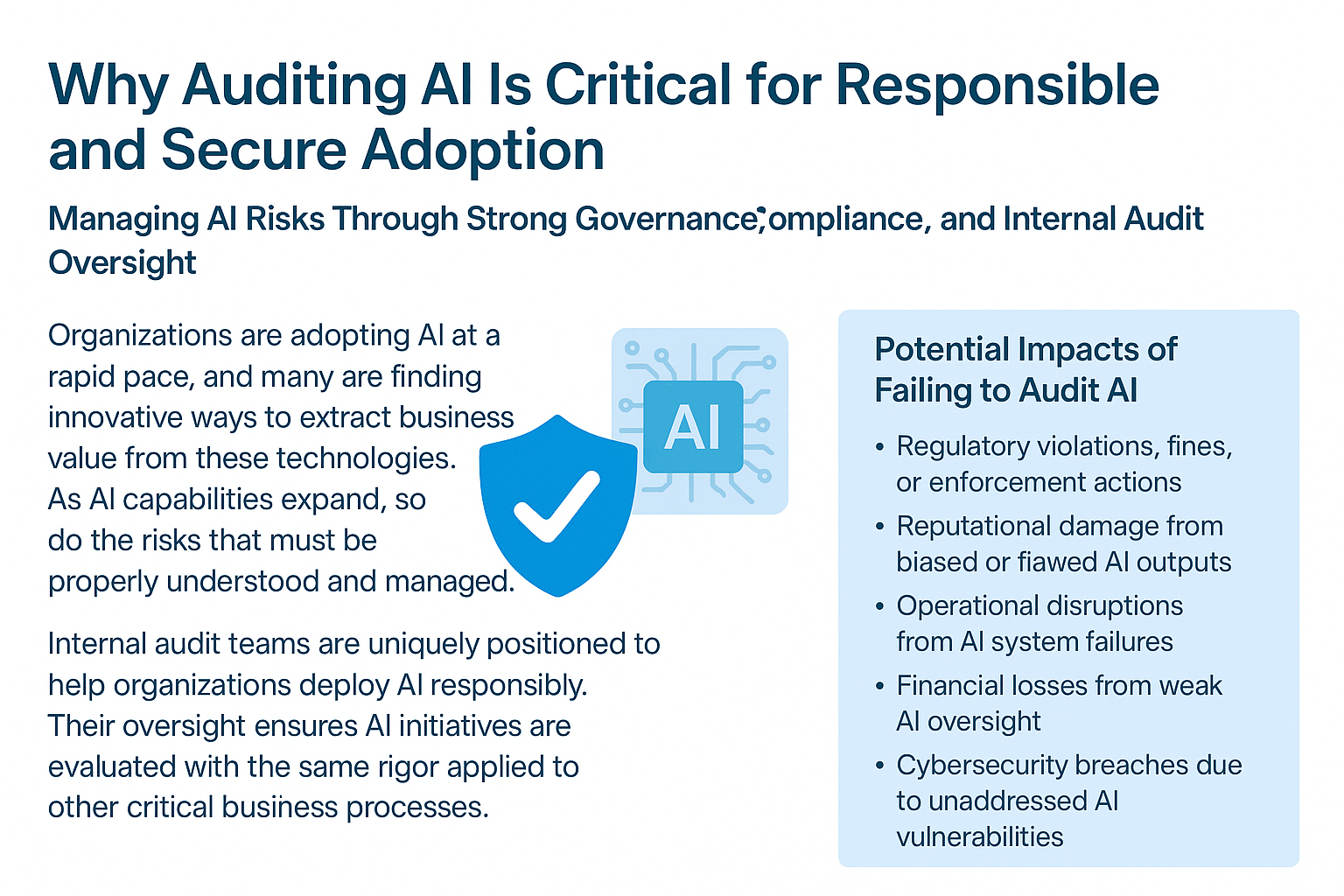
- Organizations are adopting AI at a rapid pace, and many are finding innovative ways to extract business value from these technologies. As AI capabilities expand, so do the risks that must be properly understood and managed.
- Internal audit teams are uniquely positioned to help organizations deploy AI responsibly. Their oversight ensures AI initiatives are evaluated with the same rigor applied to other critical business processes.
- By participating in AI governance committees, internal audit can help set standards, align stakeholders, and bring clarity to how AI is adopted across the enterprise.
- A key responsibility is identifying the specific risks associated with AI systems—whether ethical, technical, regulatory, or operational—and determining whether proper controls are in place to address them.
- Internal audit also plays a role in interpreting and monitoring evolving regulations. As governments introduce new AI-specific rules, companies must demonstrate compliance, and auditors help ensure they are prepared.
- Several indicators signal growing AI risk within an organization. One major warning sign is the absence of a formal AI risk management framework or any consistent evaluation of AI initiatives through a risk lens.
- Another risk indicator arises when new regulations create uncertainty about whether the company’s AI practices are compliant—raising concerns about gaps in oversight or readiness.
- Organizations without a clear AI strategy, or those operating multiple isolated AI projects, may fail to realize the intended benefits. Fragmentation often leads to inefficiencies and unmanaged risks.
- If AI initiatives continue without centralized governance, the organization may lose visibility into how AI is used, making it difficult to maintain accountability, consistency, and compliance.
Potential Impacts of Failing to Audit AI (Summary)
- The organization may face regulatory violations, fines, or enforcement actions.
- Biased or flawed AI outputs could damage the company’s reputation.
- Operational disruptions may occur if AI systems fail or behave unpredictably.
- Weak AI oversight can result in financial losses.
- Unaddressed vulnerabilities in AI systems could lead to cybersecurity incidents.
My Opinion
Auditing AI is no longer optional—it is becoming a foundational part of digital governance. Without structured oversight, AI can expose organizations to reputational damage, operational failures, regulatory penalties, and security weaknesses. A strong AI audit function ensures transparency, accountability, and resilience. In my view, organizations that build mature AI auditing capabilities early will not only avoid risk but also gain a competitive edge by deploying trustworthy, well-governed AI at scale.
InfoSec services | ISMS Services | AIMS Services | InfoSec books | Follow our blog | DISC llc is listed on The vCISO Directory | ISO 27k Chat bot | Comprehensive vCISO Services | Security Risk Assessment Services | Mergers and Acquisition Security
Governance in The Age of Gen AI: A Director’s Handbook on Gen AI
- Securing LLM-Powered Enterprises: From Invisible Threats to Operational Resilience
- Cyber Resilience Maturity Model: From Reactive Security to Operational Resilience
- From Risk to Resilience: A 5-Step Playbook for Securing AI in the Modern Threat Era
- Which AI Governance Framework Should You Adopt First? A Practical Guide for U.S., EU, and Global Organizations
- MITRE ATT&CK: Turning Blind Spots into Real-World Cyber Defense