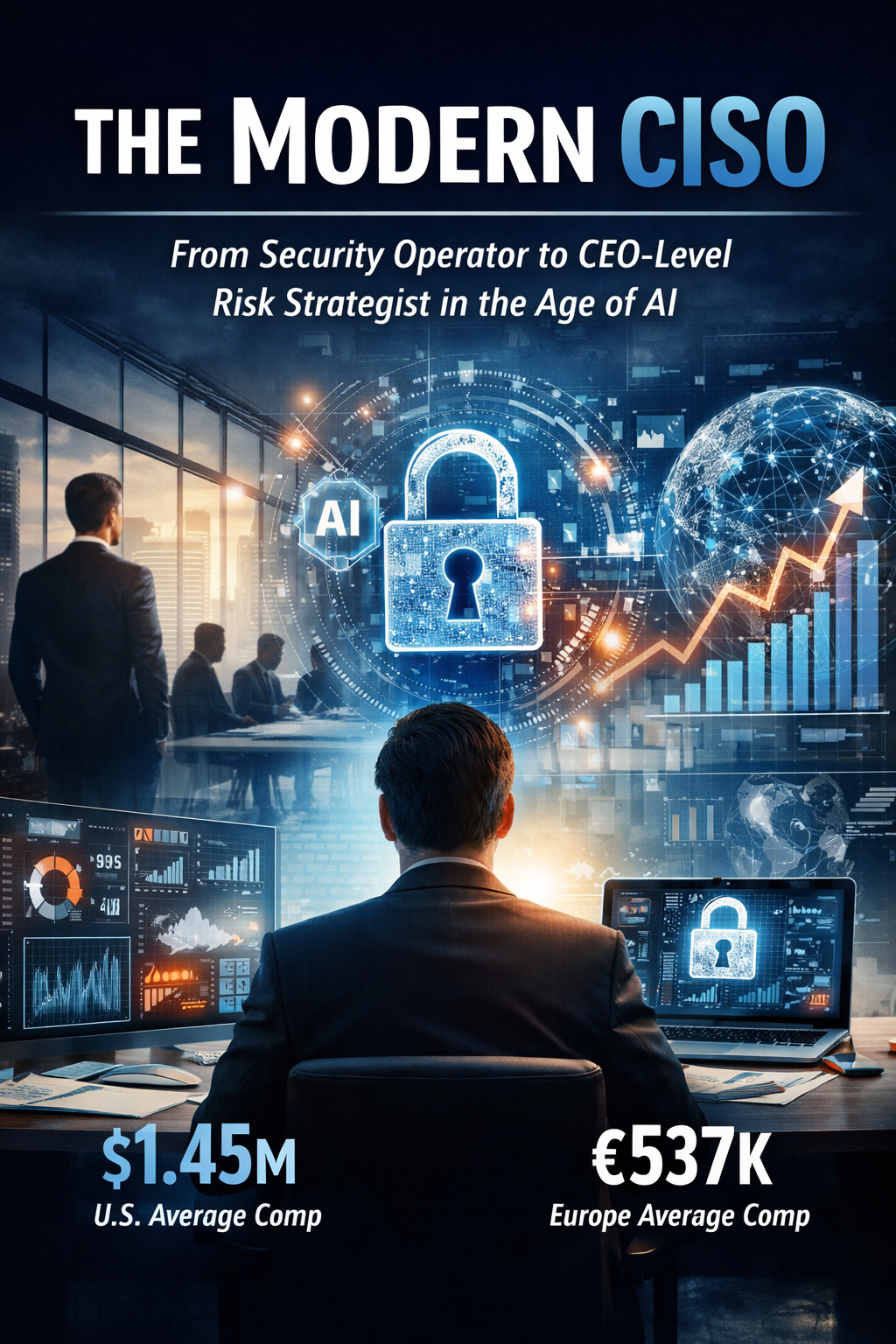
The latest Global CISO Organization & Compensation Survey highlights a decisive shift in how organizations position and reward cybersecurity leadership. Today, 42% of CISOs report directly to the CEO across both public and private companies. Nearly all (96%) are already integrating AI into their security programs. Compensation continues to climb sharply in the United States, where average total pay has reached $1.45M, while Europe averages €537K, with Germany and the UK leading the region. The message is clear: cybersecurity leadership has become a CEO-level mandate tied directly to enterprise performance.
- 42% of CISOs now report to the CEO (across private & public companies)
- 96% are already using AI in their security programs
- U.S. average total comp: $1.45M, with top-end cash continuing to rise
- Europe average total comp: €537K, led by Germany and the UK
The reporting structure data is particularly telling. With nearly half of CISOs now reporting to the CEO, security is no longer buried under IT or operations. This shift reflects recognition that cyber risk is business risk — affecting revenue, brand equity, regulatory exposure, and shareholder value.
In organizations where the CISO reports to the CEO, the role tends to be broader and more strategic. These leaders are involved in risk appetite discussions, digital transformation initiatives, and enterprise resilience planning rather than focusing solely on technical controls and incident response.
The survey also confirms that AI adoption within security programs is nearly universal. With 96% of CISOs leveraging AI, security teams are using automation for threat detection, anomaly analysis, vulnerability management, and response orchestration. AI is no longer experimental — it is operational.
At the same time, AI introduces new governance and oversight responsibilities. CISOs are now expected to evaluate AI model risks, third-party AI exposure, data integrity issues, and regulatory compliance implications. This expands their mandate well beyond traditional cybersecurity domains.
Compensation trends underscore the elevation of the role. In the United States, total average compensation of $1.45M reflects increasing equity awards and performance-based incentives. Top-end cash compensation continues to rise, especially in high-growth and technology-driven sectors.
European compensation, averaging €537K, remains lower than U.S. levels but shows strong leadership in Germany and the UK. The regional difference likely reflects variations in market size, risk exposure, regulatory complexity, and equity-based compensation culture.
The survey also suggests that compensation increasingly differentiates operational security leaders from enterprise risk executives. CISOs who influence corporate strategy, communicate effectively with boards, and align cybersecurity with business growth tend to command higher pay.
Another key takeaway is the broadening expectation set. Modern CISOs are not only defenders of infrastructure but stewards of digital trust, AI governance, third-party risk, and business continuity. The role now intersects with legal, compliance, product, and innovation functions.
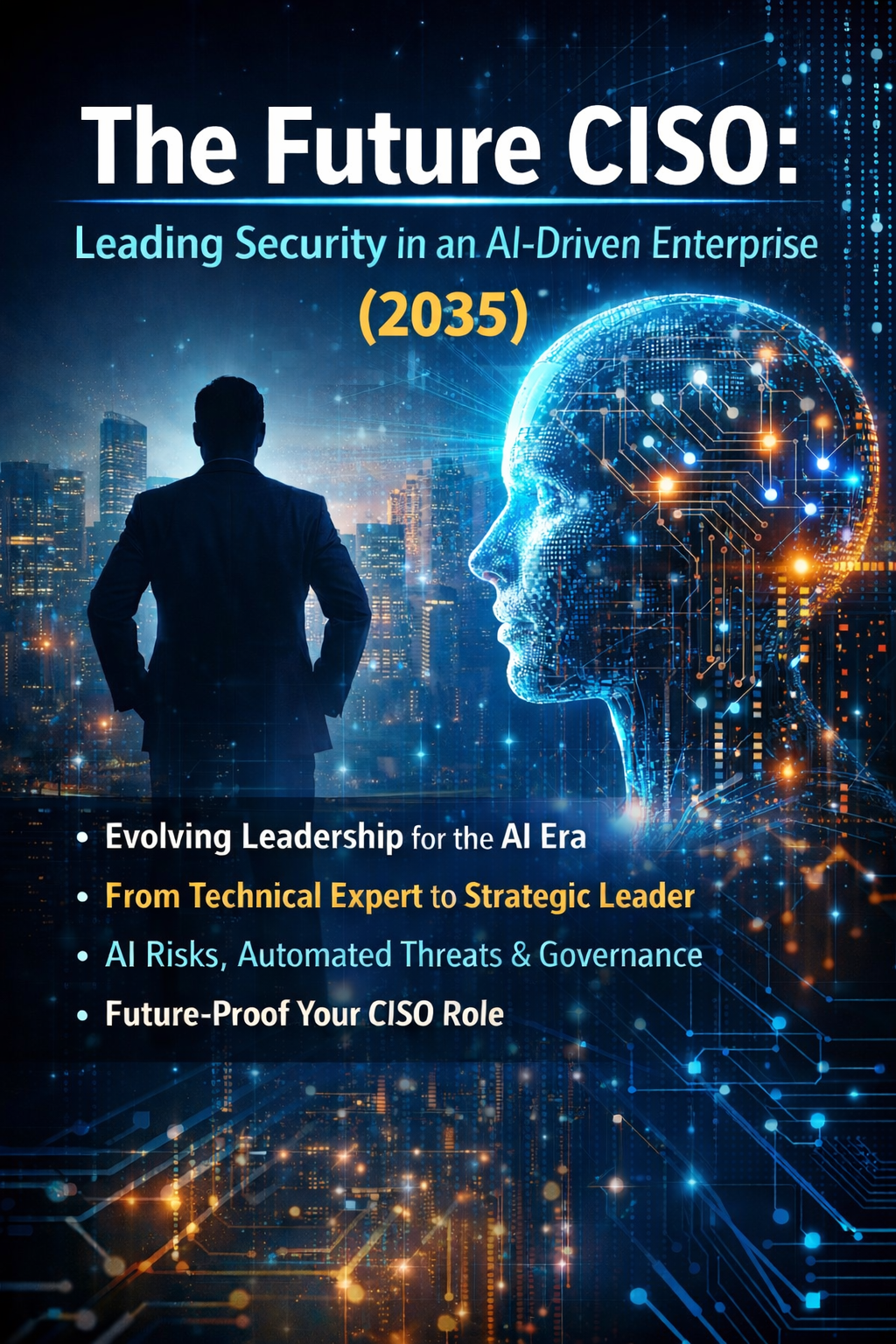
My perspective: The data confirms what many of us have observed in practice — cybersecurity has become a proxy for enterprise decision quality. As AI scales decision-making across organizations, risk scales with it. The CISO who thrives in this environment is not merely technical but strategic, commercially aware, and governance-focused. Compensation is rising because the consequences of failure are existential. In today’s environment, AI risk is business decision risk at scale — and the CISO sits at the center of that equation.
Source: https://www.heidrick.com/-/media/heidrickcom/publications-and-reports/2025-global-chief-information-security-officer-ciso-comp-survey.pdf

InfoSec services | InfoSec books | Follow our blog | DISC llc is listed on The vCISO Directory | ISO 27k Chat bot | Comprehensive vCISO Services | ISMS Services | AIMS Services | Security Risk Assessment Services | Mergers and Acquisition Security
At DISC InfoSec, we help organizations navigate this landscape by aligning AI risk management, governance, security, and compliance into a single, practical roadmap. Whether you are experimenting with AI or deploying it at scale, we help you choose and operationalize the right frameworks to reduce risk and build trust. Learn more at DISC InfoSec.
- Measure What Matters: Security & AI Readiness Scorecard
- Security Is a People Problem: Culture, Behavior, and Decisions Drive Cyber Resilience
- Security Driven by Business Value: Focus, Prioritize, Protect What Matters Most
- Claude Mythos and the Future of Cybersecurity: Powerful—and Potentially Dangerous
- Hackers at Machine Speed: The AI Cybersecurity Reality