Why ISMS Matters Even More in the Age of AI
In the AI-driven era, organizations are no longer just protecting traditional IT assets—they are safeguarding data pipelines, training datasets, models, prompts, decision logic, and automated actions. AI systems amplify risk because they operate at scale, learn dynamically, and often rely on opaque third-party components.
An Information Security Management System (ISMS) provides the governance backbone needed to:
- Control how sensitive data is collected, used, and retained by AI systems
- Manage emerging risks such as model leakage, data poisoning, hallucinations, and automated misuse
- Align AI innovation with regulatory, ethical, and security expectations
- Shift security from reactive controls to continuous, risk-based decision-making
ISO 27001, especially the 2022 revision, is highly relevant because it integrates modern risk concepts that naturally extend into AI governance and AI security management.
1. Core Philosophy: The CIA Triad
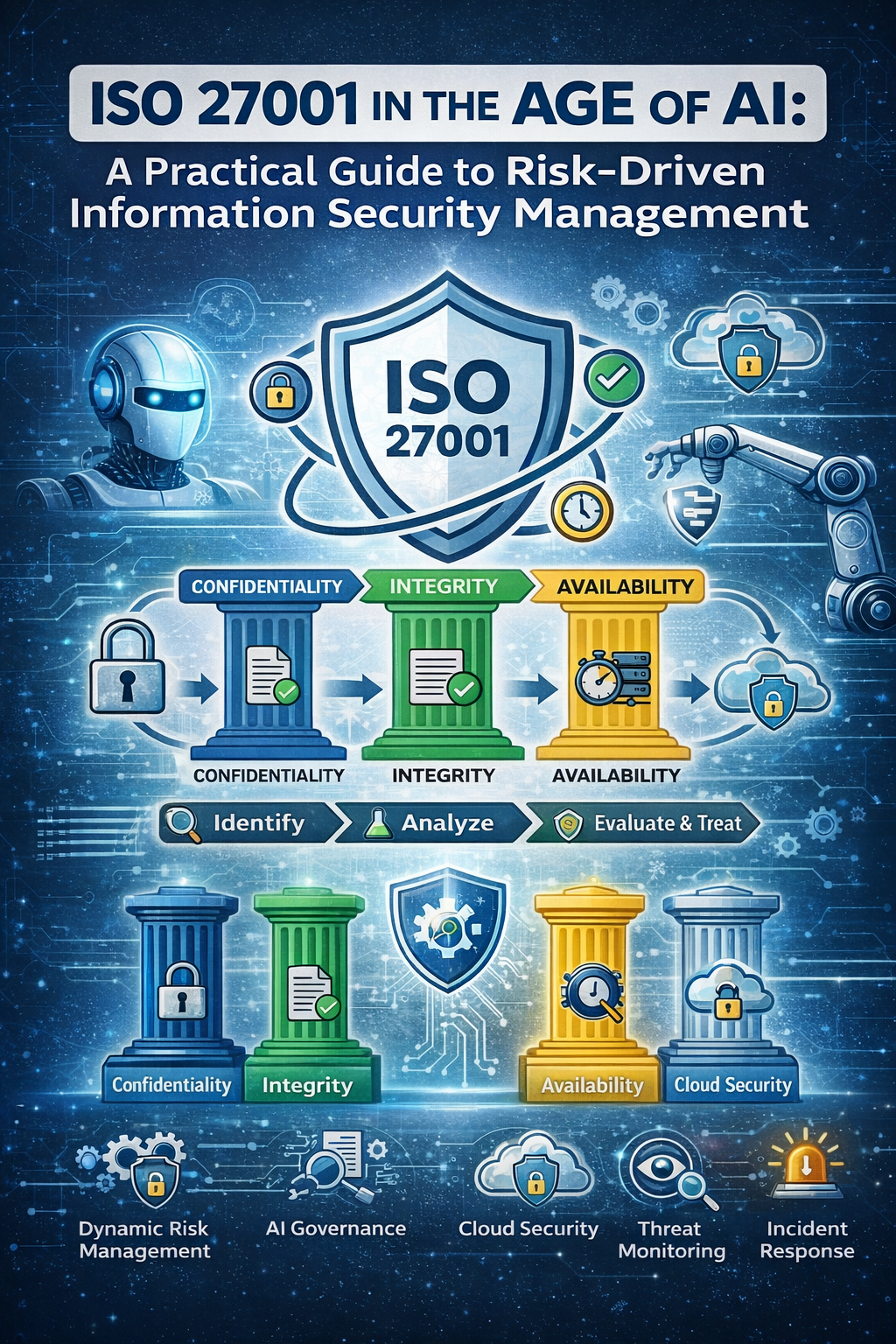
At the foundation of ISO 27001 lies the CIA Triad, which defines what information security is meant to protect:
- Confidentiality
Ensures that information is accessed only by authorized users and systems. This includes encryption, access controls, identity management, and data classification—critical for protecting sensitive training data, prompts, and model outputs in AI environments. - Integrity
Guarantees that information remains accurate, complete, and unaltered unless properly authorized. Controls such as version control, checksums, logging, and change management protect against data poisoning, model tampering, and unauthorized changes. - Availability
Ensures systems and data are accessible when needed. This includes redundancy, backups, disaster recovery, and resilience planning—vital for AI-driven services that often support business-critical or real-time decision-making.
Together, the CIA Triad ensures trust, reliability, and operational continuity.
2. Evolution of ISO 27001: 2013 vs. 2022
ISO 27001 has evolved to reflect modern technology and risk realities:
- 2013 Version (Legacy)
- 114 controls spread across 14 domains
- Primarily compliance-focused
- Limited emphasis on cloud, threat intelligence, and emerging technologies
- 2022 Version (Modern)
- Streamlined to 93 controls grouped into 4 themes: People, Organization, Technology, Physical
- Strong emphasis on dynamic risk management
- Explicit coverage of cloud security, data leakage prevention (DLP), and threat intelligence
- Better alignment with agile, DevOps, and AI-driven environments
This shift makes ISO 27001:2022 far more adaptable to AI, SaaS, and continuously evolving threat landscapes.
3. ISMS Implementation Lifecycle
ISO 27001 follows a structured lifecycle that embeds security into daily operations:
- Define Scope – Identify what systems, data, AI workloads, and business units fall under the ISMS
- Risk Assessment – Identify and analyze risks affecting information assets
- Statement of Applicability (SoA) – Justify which controls are selected and why
- Implement Controls – Deploy technical, organizational, and procedural safeguards
- Employee Controls & Awareness – Ensure roles, responsibilities, and training are in place
- Internal Audit – Validate control effectiveness and compliance
- Certification Audit – Independent verification of ISMS maturity
This lifecycle reinforces continuous improvement rather than one-time compliance.
4. Risk Assessment: The Heart of ISO 27001
Risk assessment is the core engine of the ISMS:
- Step 1: Identify Risks
Identify assets, threats, vulnerabilities, and AI-specific risks (e.g., data misuse, model bias, shadow AI tools). - Step 2: Analyze Risks
Evaluate likelihood and impact, considering technical, legal, and reputational consequences. - Step 3: Evaluate & Treat Risks
Decide how to handle risks using one of four strategies:- Avoid – Eliminate the risky activity
- Mitigate – Reduce risk through controls
- Transfer – Shift risk via contracts or insurance
- Accept – Formally accept residual risk
This risk-based approach ensures security investments are proportionate and justified.
5. Mandatory Clauses (Clauses 4–10)
ISO 27001 mandates seven core governance clauses:
- Context – Understand internal and external factors, including stakeholders and AI dependencies
- Leadership – Demonstrate top management commitment and accountability
- Planning – Define security objectives and risk treatment plans
- Support – Allocate resources, training, and documentation
- Operation – Execute controls and security processes
- Performance Evaluation – Monitor, measure, audit, and review ISMS effectiveness
- Improvement – Address nonconformities and continuously enhance controls
These clauses ensure security is embedded at the organizational level—not just within IT.
6. Incident Management & Common Pitfalls
Incident Response Flow
A structured response minimizes damage and recovery time:
- Assess – Detect and analyze the incident
- Contain – Limit spread and impact
- Restore – Recover systems and data
- Notify – Inform stakeholders and regulators as required
Common Pitfalls
Organizations often fail due to:
- Weak or inconsistent access controls
- Lack of audit-ready evidence
- Unpatched or outdated systems
- Stale risk registers that ignore evolving threats like AI misuse
These gaps undermine both security and compliance.
My Perspective on the ISO 27001 Methodology
ISO 27001 is best understood not as a compliance checklist, but as a governance-driven risk management methodology. Its real strength lies in:
- Flexibility across industries and technologies
- Strong alignment with AI governance frameworks (e.g., ISO 42001, NIST AI RMF)
- Emphasis on leadership accountability and continuous improvement
In the age of AI, ISO 27001 should be used as the foundational control layer, with AI-specific risk frameworks layered on top. Organizations that treat it as a living system—rather than a certification project—will be far better positioned to innovate securely, responsibly, and at scale.
InfoSec services | InfoSec books | Follow our blog | DISC llc is listed on The vCISO Directory | ISO 27k Chat bot | Comprehensive vCISO Services | ISMS Services | AIMS Services | Security Risk Assessment Services | Mergers and Acquisition Security
At DISC InfoSec, we help organizations navigate this landscape by aligning AI risk management, governance, security, and compliance into a single, practical roadmap. Whether you are experimenting with AI or deploying it at scale, we help you choose and operationalize the right frameworks to reduce risk and build trust. Learn more at DISC InfoSec.
- AI-Accelerated Offense: Why Security Programs Must Move Now, Not Later
- AI Governance Explained: Accountability, Trust, and Control in the Age of AI
- Measure What Matters: Security & AI Readiness Scorecard
- Security Is a People Problem: Culture, Behavior, and Decisions Drive Cyber Resilience
- Security Driven by Business Value: Focus, Prioritize, Protect What Matters Most