
1. Defining AI boundaries clarifies purpose and limits
Clear AI boundaries answer the most basic question: what is this AI meant to do—and what is it not meant to do? By explicitly defining purpose, scope, and constraints, organizations prevent unintended use, scope creep, and over-reliance on the system. Boundaries ensure the AI is applied only within approved business and user contexts, reducing the risk of misuse or decision-making outside its design assumptions.
2. Boundaries anchor AI to real-world business context
AI does not operate in a vacuum. Understanding where an AI system is used—by which business function, user group, or operational environment—connects technical capability to real-world impact. Contextual boundaries help identify downstream effects, regulatory exposure, and operational dependencies that may not be obvious during development but become critical after deployment.
3. Accountability establishes clear ownership
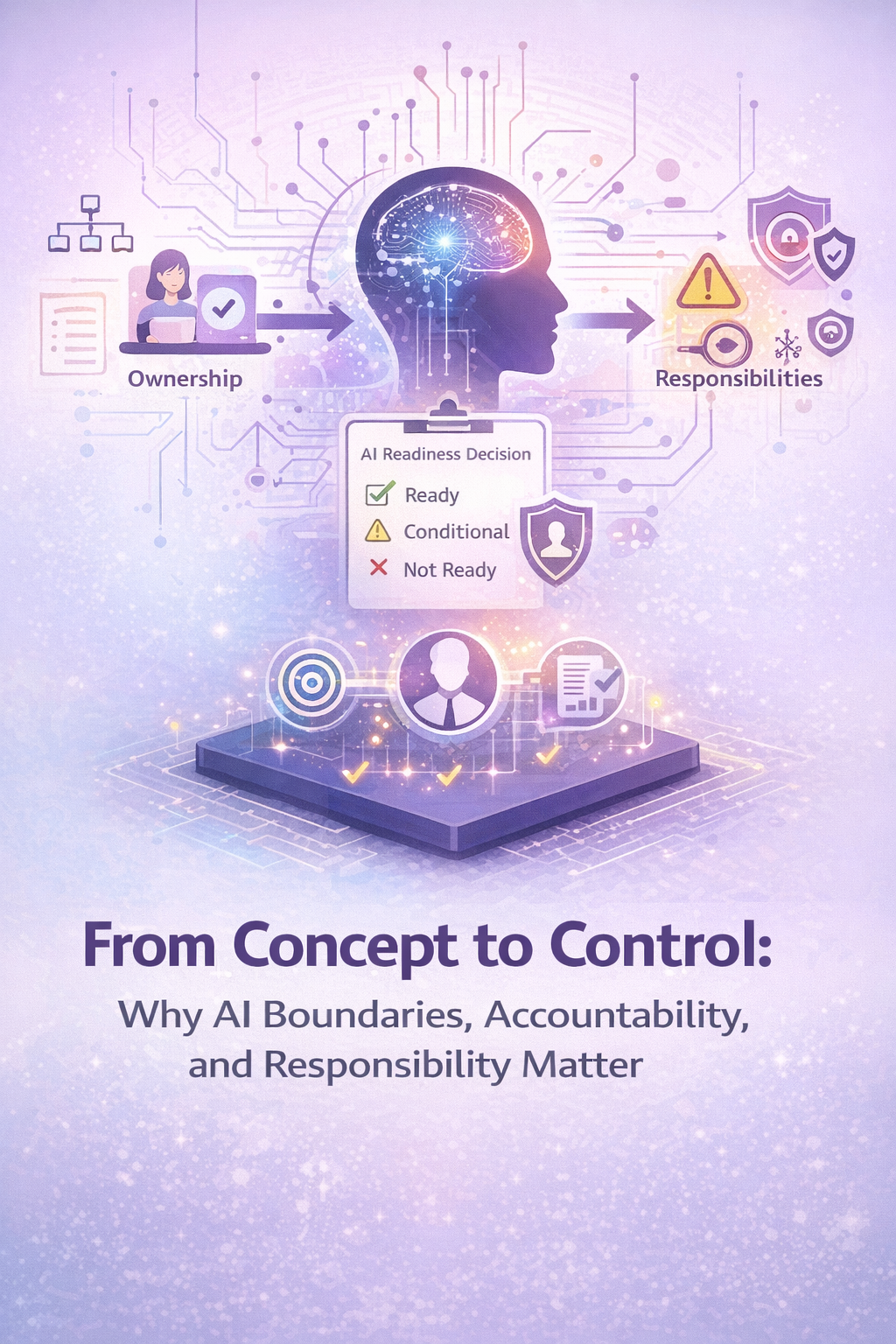
Accountability answers the question: who owns this AI system? Without a clearly accountable owner, AI risks fall into organizational gaps. Assigning an accountable individual or function ensures there is someone responsible for approvals, risk acceptance, and corrective action when issues arise. This mirrors mature governance practices seen in security, privacy, and compliance programs.
4. Ownership enables informed risk decisions
When accountability is explicit, risk discussions become practical rather than theoretical. The accountable owner is best positioned to balance safety, bias, privacy, security, and business risks against business value. This enables informed decisions about whether risks are acceptable, need mitigation, or require stopping deployment altogether.
5. Responsibilities translate risk into safeguards
Defined responsibilities ensure that identified risks lead to concrete action. This includes implementing safeguards and controls, establishing monitoring and evidence collection, and defining escalation paths for incidents. Responsibilities ensure that risk management does not end at design time but continues throughout the AI lifecycle.
6. Post–go-live responsibilities protect long-term trust
AI risks evolve after deployment due to model drift, data changes, or new usage patterns. Clearly defined responsibilities ensure continuous monitoring, incident response, and timely escalation. This “after go-live” ownership is critical to maintaining trust with users, regulators, and stakeholders as real-world behavior diverges from initial assumptions.
7. Governance enables confident AI readiness decisions
When boundaries, accountability, and responsibilities are well defined, organizations can make credible AI readiness decisions—ready, conditionally ready, or not ready. These decisions are based on evidence, controls, and ownership rather than optimism or pressure to deploy.
Opinion (with AI Governance and ISO/IEC 42001):
In my view, boundaries, accountability, and responsibilities are the difference between using AI and governing AI. This is precisely where a formal AI Governance function becomes critical. Governance ensures these elements are not ad hoc or project-specific, but consistently defined, enforced, and reviewed across the organization. Without governance, AI risk remains abstract and unmanaged; with it, risk becomes measurable, owned, and actionable.
Acquiring ISO/IEC 42001 certification strengthens this governance model by institutionalizing accountability, decision rights, and lifecycle controls for AI systems. ISO 42001 requires organizations to clearly define AI purpose and boundaries, assign accountable owners, manage risks such as bias, security, and privacy, and demonstrate ongoing monitoring and incident handling. In effect, it operationalizes responsible AI rather than leaving it as a policy statement.
Together, strong AI governance and ISO 42001 shift AI risk management from technical optimism to disciplined decision-making. Leaders gain the confidence to approve, constrain, or halt AI systems based on evidence, controls, and real-world impact—rather than hype, urgency, or unchecked innovation.

InfoSec services | InfoSec books | Follow our blog | DISC llc is listed on The vCISO Directory | ISO 27k Chat bot | Comprehensive vCISO Services | ISMS Services | AIMS Services | Security Risk Assessment Services | Mergers and Acquisition Security
At DISC InfoSec, we help organizations navigate this landscape by aligning AI risk management, governance, security, and compliance into a single, practical roadmap. Whether you are experimenting with AI or deploying it at scale, we help you choose and operationalize the right frameworks to reduce risk and build trust. Learn more at DISC InfoSec.
- From Risk to Resilience: A 5-Step Playbook for Securing AI in the Modern Threat Era
- Which AI Governance Framework Should You Adopt First? A Practical Guide for U.S., EU, and Global Organizations
- MITRE ATT&CK: Turning Blind Spots into Real-World Cyber Defense
- When AI Hacks Faster Than Humans: The Coming Collapse of Traditional Cybersecurity Value
- SOC 2 Isn’t Enough: Moving Beyond Compliance Theater to Real Risk Management





