
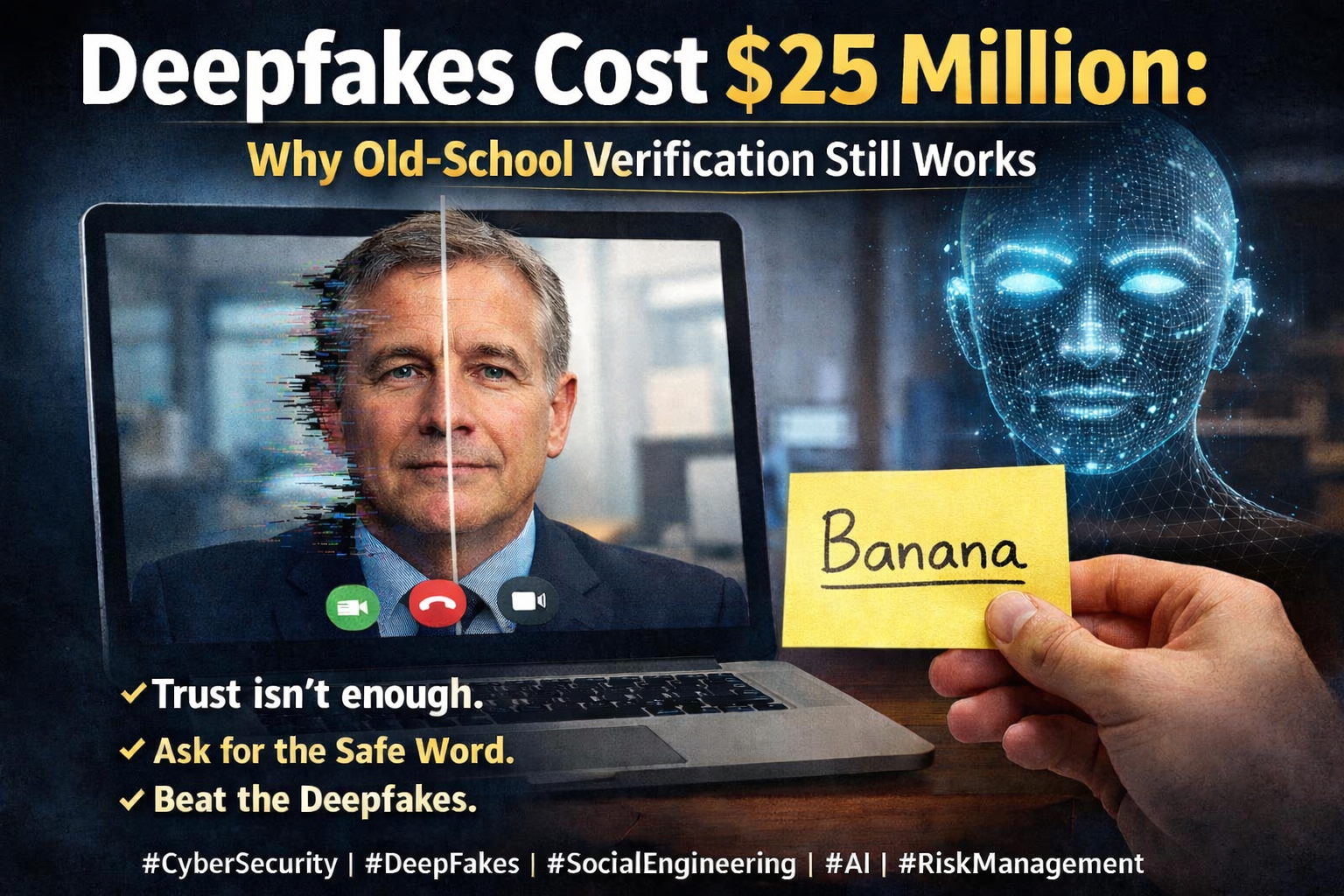
A British engineering firm reportedly lost $25 million after an employee joined a video call that appeared to include their CFO. The voice, the face, and the mannerisms all checked out—but it wasn’t actually him. The incident highlights how convincing deepfake technology has become and how easily trust can be exploited.
This case shows that visual and audio cues alone are no longer reliable for verification. AI can now replicate voices and faces with alarming accuracy, making traditional “it looks and sounds right” judgment calls dangerously insufficient, especially under pressure.
Ironically, the most effective countermeasure to advanced AI attacks isn’t more technology—it’s simpler, human-centered controls. When digital signals can be forged, analog verification methods regain their value.
One such method is establishing a “safe word.” This is a randomly chosen word known only to a small, trusted group and never shared via email, chat, or documents. It lives only in human memory.
If an urgent request comes in—whether from a “CEO,” “CFO,” or even a family member—especially involving money or sensitive actions, the response should be to pause and ask for the safe word. An AI can mimic a voice, but it cannot reliably guess a secret it was never trained on.
My opinion: Safe words may sound old-fashioned, but they are practical, low-cost, and highly effective in a world of deepfakes and social engineering. Every finance team—and even families—should treat this as a basic risk control, not a gimmick. In high-risk moments, simple friction can be the difference between trust and a multimillion-dollar loss.
#CyberSecurity #DeepFakes #SocialEngineering #AI #RiskManagement
InfoSec services | InfoSec books | Follow our blog | DISC llc is listed on The vCISO Directory | ISO 27k Chat bot | Comprehensive vCISO Services | ISMS Services | AIMS Services | Security Risk Assessment Services | Mergers and Acquisition Security
At DISC InfoSec, we help organizations navigate this landscape by aligning AI risk management, governance, security, and compliance into a single, practical roadmap. Whether you are experimenting with AI or deploying it at scale, we help you choose and operationalize the right frameworks to reduce risk and build trust. Learn more at DISC InfoSec.
- When AI Hacks Faster Than Humans: The Coming Collapse of Traditional Cybersecurity Value
- SOC 2 Isn’t Enough: Moving Beyond Compliance Theater to Real Risk Management
- When AI Becomes the Attack Surface: Lessons from the McKinsey Lilli Incident
- Why Every Company Needs a CISO (or at Least vCISO-Level Leadership)
- How ISO 27001 Lead Auditors Should Evaluate AI Risks in an ISMS





