
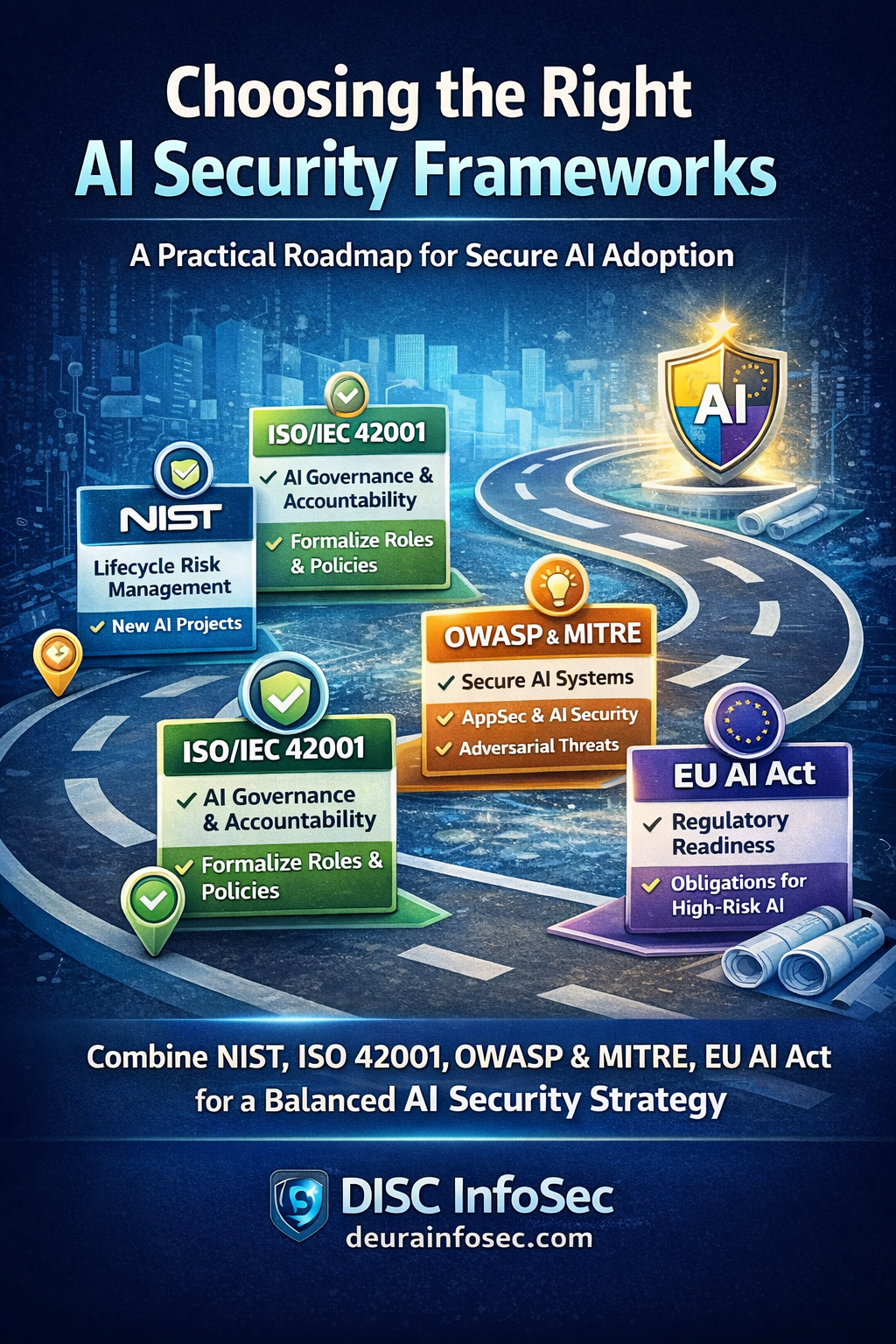
Choosing the right AI security framework is becoming a critical decision as organizations adopt AI at scale. No single framework solves every problem. Each one addresses a different aspect of AI risk, governance, security, or compliance, and understanding their strengths helps organizations apply them effectively.
The NIST AI Risk Management Framework (AI RMF) is best suited for managing AI risks across the entire lifecycle—from design and development to deployment and ongoing use. It emphasizes trustworthy AI by addressing security, privacy, safety, reliability, and bias. This framework is especially valuable for organizations that are building or rapidly scaling AI capabilities and need a structured way to identify and manage AI-related risks.
ISO/IEC 42001, the AI Management System (AIMS) standard, focuses on governance rather than technical controls. It helps organizations establish policies, accountability, oversight, and continuous improvement for AI systems. This framework is ideal for enterprises deploying AI across multiple teams or business units and looking to formalize AI governance in a consistent, auditable way.
For teams building AI-enabled applications, the OWASP Top 10 for LLMs and Generative AI provides practical, hands-on security guidance. It highlights common and emerging risks such as prompt injection, data leakage, insecure output handling, and model abuse. This framework is particularly useful for AppSec and DevSecOps teams securing AI interfaces, APIs, and user-facing AI features.
MITRE ATLAS takes a threat-centric approach by mapping adversarial tactics and techniques that target AI systems. It is well suited for threat modeling, red-team exercises, and AI breach simulations. By helping security teams think like attackers, MITRE ATLAS strengthens defensive strategies against real-world AI threats.
From a regulatory perspective, the EU AI Act introduces a risk-based compliance framework for organizations operating in or offering AI services within the European Union. It defines obligations for high-risk AI systems and places strong emphasis on transparency, accountability, and risk controls. For global organizations, this regulation is becoming a key driver of AI compliance strategy.
The most effective approach is not choosing one framework, but combining them. Using NIST AI RMF for risk management, ISO/IEC 42001 for governance, OWASP and MITRE for technical security, and the EU AI Act for regulatory compliance creates a balanced and defensible AI security posture.
At DISC InfoSec, we help organizations navigate this landscape by aligning AI risk management, governance, security, and compliance into a single, practical roadmap. Whether you are experimenting with AI or deploying it at scale, we help you choose and operationalize the right frameworks to reduce risk and build trust. Learn more at https://deurainfosec.com.
InfoSec services | InfoSec books | Follow our blog | DISC llc is listed on The vCISO Directory | ISO 27k Chat bot | Comprehensive vCISO Services | ISMS Services | AIMS Services | Security Risk Assessment Services | Mergers and Acquisition Security
- Securing LLM-Powered Enterprises: From Invisible Threats to Operational Resilience
- Cyber Resilience Maturity Model: From Reactive Security to Operational Resilience
- From Risk to Resilience: A 5-Step Playbook for Securing AI in the Modern Threat Era
- Which AI Governance Framework Should You Adopt First? A Practical Guide for U.S., EU, and Global Organizations
- MITRE ATT&CK: Turning Blind Spots into Real-World Cyber Defense





