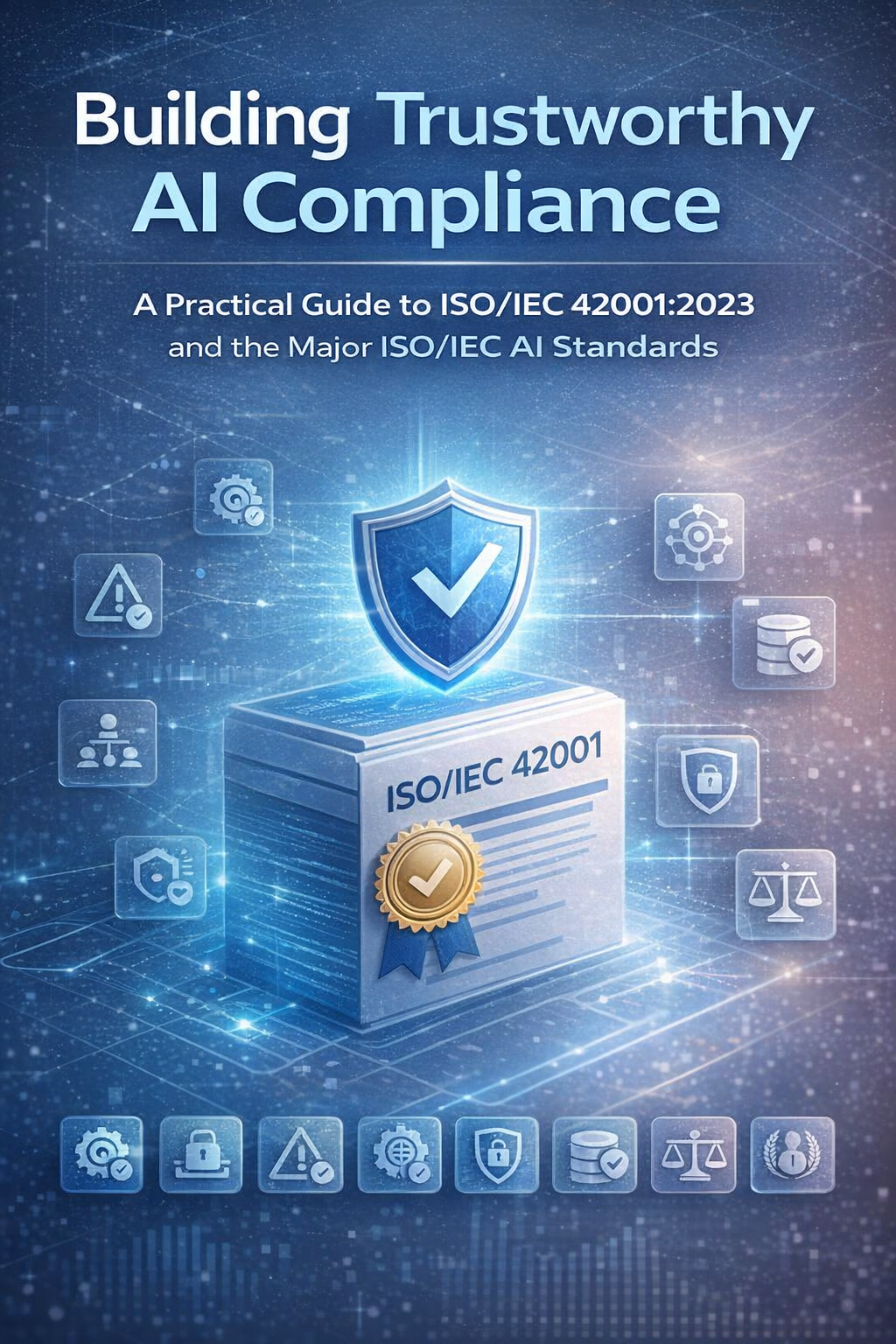
Major ISO/IEC Standards in AI Compliance — Summary & Significance
1. ISO/IEC 42001:2023 — AI Management System (AIMS)
This standard defines the requirements for establishing, implementing, maintaining, and continually improving an Artificial Intelligence Management System. It focuses on organizational governance, accountability, and structured oversight of AI lifecycle activities. Its significance lies in providing a formal management framework that embeds responsible AI practices into daily operations, enabling organizations to systematically manage risks, document decisions, and demonstrate compliance to regulators and stakeholders.
2. ISO/IEC 23894:2023 — AI Risk Management
This standard offers guidance for identifying, assessing, and monitoring risks associated with AI systems across their lifecycle. It promotes a risk-based approach aligned with enterprise risk management. Its importance in AI compliance is that it helps organizations proactively detect technical, operational, and ethical risks, ensuring structured mitigation strategies that reduce unexpected failures and compliance gaps.
3. ISO/IEC 38507:2022 — Governance of AI
This framework provides principles for boards and executive leadership to oversee AI responsibly. It emphasizes strategic alignment, accountability, and ethical decision-making. Its compliance value comes from strengthening executive oversight, ensuring AI initiatives align with organizational values, regulatory expectations, and long-term strategy.
4. ISO/IEC 22989:2022 — AI Concepts & Architecture
This standard establishes shared terminology and reference architectures for AI systems. It ensures stakeholders use consistent language and system classifications. Its significance lies in reducing ambiguity in policy, governance, and compliance discussions, which improves collaboration between legal, technical, and business teams.
5. ISO/IEC 23053:2022 — Machine Learning System Framework
This framework describes the structure and lifecycle of ML-based AI systems, including system components and data-model interactions. It is significant because it guides organizations in designing AI systems with traceability and control, supporting auditability and lifecycle governance required for compliance.
6. ISO/IEC 5259 — Data Quality for AI
This series focuses on dataset governance, quality metrics, and bias-aware controls. It emphasizes the integrity and reliability of training and operational data. Its compliance relevance is critical, as poor data quality directly affects fairness, performance, and legal defensibility of AI outcomes.
7. ISO/IEC TR 24027:2021 — Bias in AI
This technical report explains sources of bias in AI systems and outlines mitigation and measurement techniques. It is significant for compliance because it supports fairness and non-discrimination objectives, helping organizations implement defensible controls against biased outcomes.
8. ISO/IEC TR 24028:2020 — Trustworthiness in AI
This report defines key attributes of trustworthy AI, including robustness, transparency, and reliability. Its role in compliance is to provide practical benchmarks for evaluating system dependability and stakeholder trust.
9. ISO/IEC TR 24368:2022 — Ethical & Societal Concerns
This guidance examines the broader human and societal impacts of AI deployment. It encourages responsible implementation that considers social risk and ethical implications. Its significance is in aligning AI programs with public expectations and emerging regulatory ethics requirements.
Overview: How ISO Standards Build AIMS and Reduce AI Risk
Major ISO/IEC standards form an integrated ecosystem that supports organizations in building a robust Artificial Intelligence Management System (AIMS) and achieving effective AI compliance. ISO/IEC 42001 serves as the structural backbone by defining management system requirements that embed governance, accountability, and continuous improvement into AI operations. ISO/IEC 23894 complements this by providing a structured risk management methodology tailored to AI, ensuring risks are systematically identified and mitigated.
Supporting standards strengthen specific pillars of AI governance. ISO/IEC 27001 and ISO/IEC 27701 reinforce data security and privacy protection, safeguarding sensitive information used in AI systems. ISO/IEC 22989 establishes shared terminology that reduces ambiguity across teams, while ISO/IEC 23053 and the ISO/IEC 5259 series enhance lifecycle management and data quality controls. Technical reports addressing bias, trustworthiness, and ethical concerns further ensure that AI systems operate responsibly and transparently.
Together, these standards create a comprehensive compliance architecture that improves accountability, supports regulatory readiness, and minimizes operational and ethical risks. By integrating governance, risk management, security, and quality assurance into a unified framework, organizations can deploy AI with greater confidence and resilience.
My Perspective
ISO’s AI standards represent a shift from ad-hoc AI experimentation toward disciplined, auditable AI governance. What makes this ecosystem powerful is not any single standard, but how they interlock: management systems provide structure, risk frameworks guide decision-making, and ethical and technical standards shape implementation. Organizations that adopt this integrated approach are better positioned to scale AI responsibly while maintaining stakeholder trust. In practice, the biggest value comes when these standards are operationalized — embedded into workflows, metrics, and leadership oversight — rather than treated as checkbox compliance.

InfoSec services | InfoSec books | Follow our blog | DISC llc is listed on The vCISO Directory | ISO 27k Chat bot | Comprehensive vCISO Services | ISMS Services | AIMS Services | Security Risk Assessment Services | Mergers and Acquisition Security
At DISC InfoSec, we help organizations navigate this landscape by aligning AI risk management, governance, security, and compliance into a single, practical roadmap. Whether you are experimenting with AI or deploying it at scale, we help you choose and operationalize the right frameworks to reduce risk and build trust. Learn more at DISC InfoSec.
- AI Attack Surface ScoreCard
- AI-Accelerated Offense: Why Security Programs Must Move Now, Not Later
- AI Governance Explained: Accountability, Trust, and Control in the Age of AI
- Measure What Matters: Security & AI Readiness Scorecard
- Security Is a People Problem: Culture, Behavior, and Decisions Drive Cyber Resilience