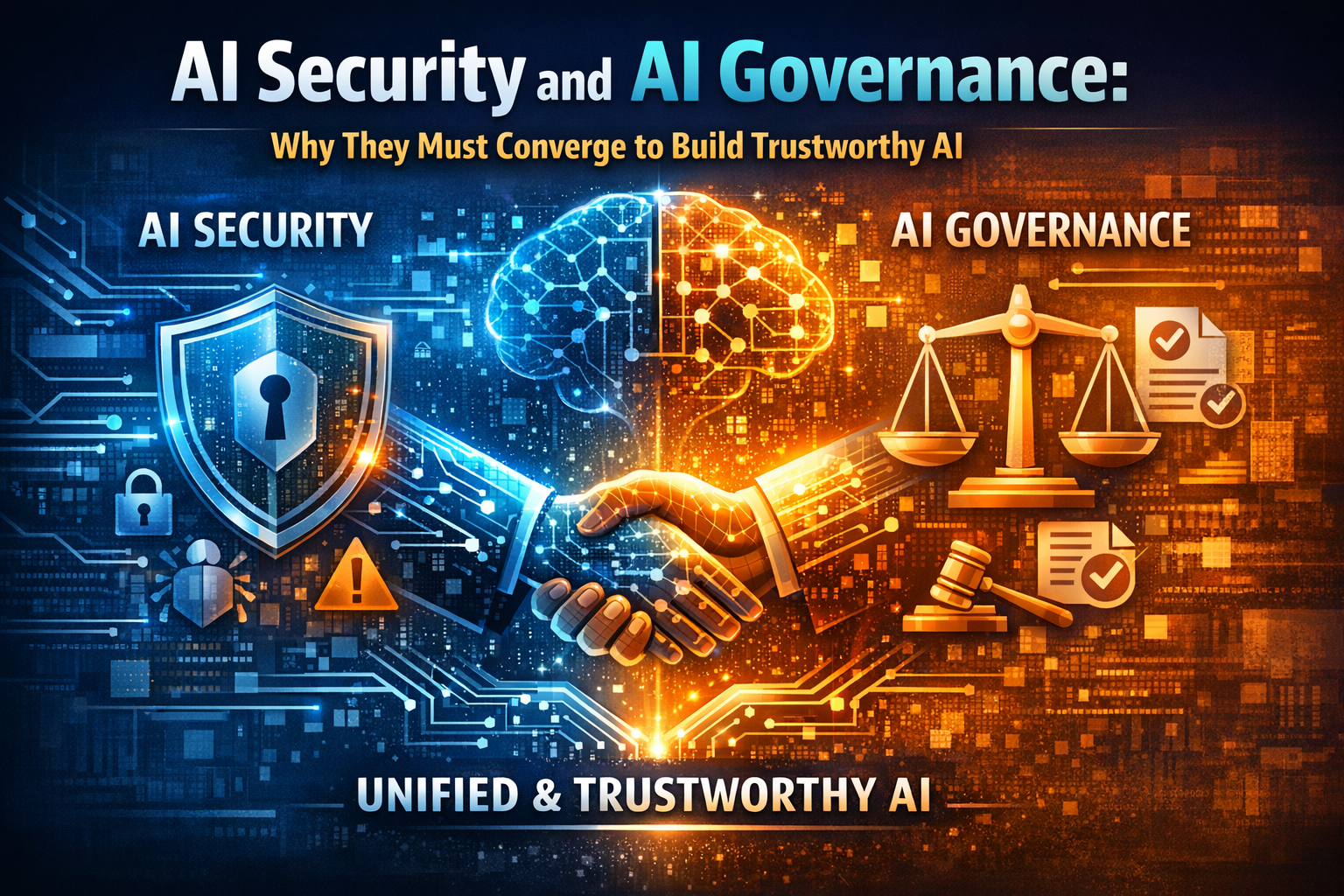
AI Security and AI Governance are often discussed as separate disciplines, but the industry is realizing they are inseparable. Over the past year, conversations have revolved around AI governance—whether AI should be used and under what principles—and AI security—how AI systems are protected from threats. This separation is no longer sustainable as AI adoption accelerates.
The core reality is simple: governance without security is ineffective, and security without governance is incomplete. If an organization cannot secure its AI systems, it has no real control over them. Likewise, securing systems without clear governance leaves unanswered questions about legality, ethics, and accountability.
This divide exists largely because governance and security evolved in different organizational domains. Governance typically sits with legal, risk, and compliance teams, focusing on fairness, transparency, and ethical use. Security, on the other hand, is owned by technical teams and SOCs, concentrating on attacks such as prompt injection, model manipulation, and data leakage.
When these functions operate in silos, organizations unintentionally create “Shadow AI” risks. Governance teams may publish policies that lack technical enforcement, while security teams may harden systems without understanding whether the AI itself is compliant or trustworthy.
The governance gap appears when policies exist only on paper. Without security controls to enforce them, rules become optional guidance rather than operational reality, leaving organizations exposed to regulatory and reputational risk.
The security gap emerges when protection is applied without context. Systems may be technically secure, yet still rely on biased, non-compliant, or poorly governed models, creating hidden risks that security tooling alone cannot detect.
To move forward, AI risk must be treated as a unified discipline. A combined “Governance-Security” mindset requires shared inventories of models and data pipelines, continuous monitoring of both technical vulnerabilities and ethical drift, and automated enforcement that connects policy directly to controls.
Organizations already adopting this integrated approach are gaining a competitive advantage. Their objective goes beyond compliance checklists; they are building AI systems that are trustworthy, resilient by design, and compliant by default—earning confidence from regulators, customers, and partners alike.
My opinion: AI governance and AI security should no longer be separate conversations or teams. Treating them as one integrated function is not just best practice—it is inevitable. Organizations that fail to unify these disciplines will struggle with unmanaged risk, while those that align them early will define the standard for trustworthy and resilient AI.

InfoSec services | InfoSec books | Follow our blog | DISC llc is listed on The vCISO Directory | ISO 27k Chat bot | Comprehensive vCISO Services | ISMS Services | AIMS Services | Security Risk Assessment Services | Mergers and Acquisition Security
At DISC InfoSec, we help organizations navigate this landscape by aligning AI risk management, governance, security, and compliance into a single, practical roadmap. Whether you are experimenting with AI or deploying it at scale, we help you choose and operationalize the right frameworks to reduce risk and build trust. Learn more at DISC InfoSec.
- When AI Hacks Faster Than Humans: The Coming Collapse of Traditional Cybersecurity Value
- SOC 2 Isn’t Enough: Moving Beyond Compliance Theater to Real Risk Management
- When AI Becomes the Attack Surface: Lessons from the McKinsey Lilli Incident
- Why Every Company Needs a CISO (or at Least vCISO-Level Leadership)
- How ISO 27001 Lead Auditors Should Evaluate AI Risks in an ISMS