
The recent announcement by Atlassian to reduce its workforce by about 1,600 employees—roughly 10% of its global staff—has become one of the latest examples of how the technology sector is responding to the rise of artificial intelligence. According to CEO Mike Cannon-Brookes, the decision is part of a broader restructuring aimed at preparing the company for the next phase of software development in the AI era. Like many technology firms, Atlassian is attempting to realign its strategy, investments, and workforce to better compete in a market increasingly shaped by AI capabilities.
The company explained that the layoffs are not simply about replacing people with machines. Instead, leadership argues that artificial intelligence is changing the type of skills organizations need and the structure of teams that build and maintain modern software products. As AI becomes embedded in development tools, productivity platforms, and collaboration systems, companies believe they must reconfigure roles and responsibilities to match the new technological landscape.
Part of the restructuring also reflects economic pressure and competitive shifts in the software industry. Atlassian has seen its market value decline significantly amid investor concerns that generative AI could disrupt traditional software business models. The company therefore plans to redirect resources toward AI innovation and enterprise growth, effectively using cost reductions to fund the next generation of products and services.
The layoffs will affect employees across multiple regions, including North America, Australia, and India. Although the job losses are significant, the company stated that it would provide severance packages, healthcare support, and other benefits to those affected. Leadership acknowledged the emotional impact of the decision and emphasized that the restructuring was intended to position the company for long-term sustainability in a rapidly evolving technological environment.
This development also reflects a broader trend across the technology sector. Companies are increasingly framing layoffs as part of a shift toward AI-driven operations. As automation improves coding, testing, customer support, and data analysis, organizations are reassessing how many employees they need in certain functions. Yet many executives also emphasize that AI does not eliminate the need for people—it changes how people contribute.
At the same time, the debate around “AI-driven layoffs” is becoming more complex. Critics argue that some companies may be using AI as a justification for broader cost-cutting or restructuring decisions. Others point out that technological revolutions have historically transformed work rather than eliminating it entirely, often creating new roles that require different skills and expertise.
Source: Atlassian to Reduce 1,600 jobs in the latest AI-Linked cuts
Perspective:
The AI revolution should not be interpreted as a signal that people are no longer needed. In reality, the opposite is true. Artificial intelligence is a powerful tool, but tools still require human judgment, governance, creativity, and accountability. The organizations that succeed in the AI era will not be those that remove people from the equation, but those that enable people to work alongside intelligent systems. AI can accelerate productivity, automate repetitive tasks, and generate insights—but humans remain essential to guide strategy, validate outcomes, and ensure ethical use. The future of work is not AI replacing people; it is people who understand AI replacing those who do not.

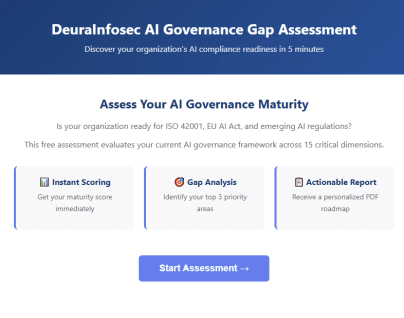
Get Your Free AI Governance Readiness Assessment – Is your organization ready for ISO 42001, EU AI Act, and emerging AI regulations?
AI Governance Gap Assessment tool
- 15 questions
- Instant maturity score
- Detailed PDF report
- Top 3 priority gaps
Click below to open an AI Governance Gap Assessment in your browser or click the image to start assessment.
ai_governance_assessment-v1.5Download
Built by AI governance experts. Used by compliance leaders.

InfoSec services | InfoSec books | Follow our blog | DISC llc is listed on The vCISO Directory | ISO 27k Chat bot | Comprehensive vCISO Services | ISMS Services | AIMS Services | Security Risk Assessment Services | Mergers and Acquisition Security
At DISC InfoSec, we help organizations navigate this landscape by aligning AI risk management, governance, security, and compliance into a single, practical roadmap. Whether you are experimenting with AI or deploying it at scale, we help you choose and operationalize the right frameworks to reduce risk and build trust. Learn more at DISC InfoSec.
- Securing LLM-Powered Enterprises: From Invisible Threats to Operational Resilience
- Cyber Resilience Maturity Model: From Reactive Security to Operational Resilience
- From Risk to Resilience: A 5-Step Playbook for Securing AI in the Modern Threat Era
- Which AI Governance Framework Should You Adopt First? A Practical Guide for U.S., EU, and Global Organizations
- MITRE ATT&CK: Turning Blind Spots into Real-World Cyber Defense





