1. Defining Risk in AI-Native Systems
AI-native systems introduce a new class of risk driven by autonomy, scale, and complexity. Unlike traditional applications, these systems rely on dynamic decision-making, continuous learning, and interconnected services. As a result, risks are no longer confined to static vulnerabilities—they emerge from unpredictable behaviors, opaque logic, and rapidly evolving interactions across systems.
2. Why AI Security Is Still an API Security Problem
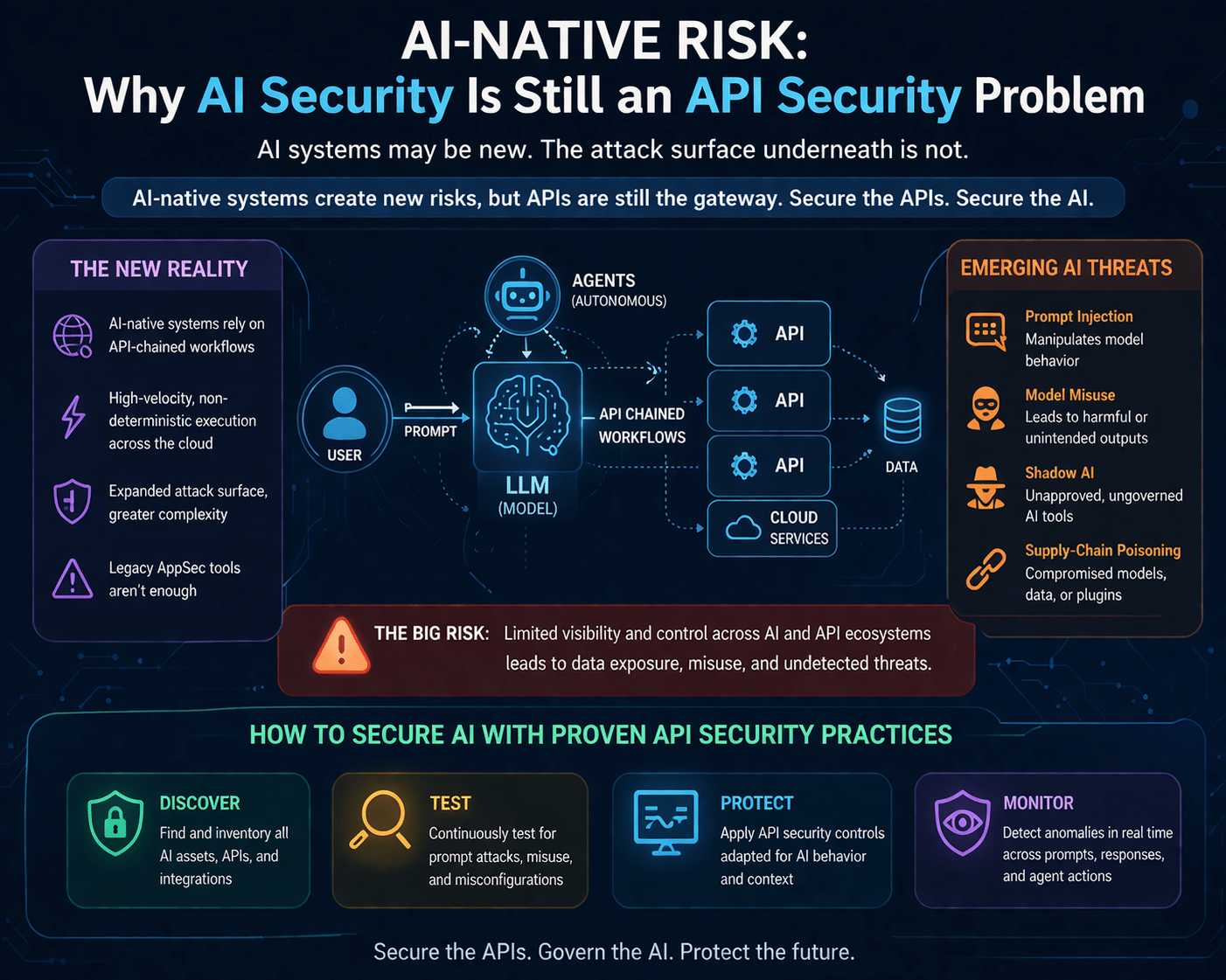
At its core, AI security remains an API security challenge. Modern AI systems—especially those powered by large language models (LLMs) and autonomous agents—operate through API-driven architectures. Every prompt, response, and action is mediated through APIs, making them the primary attack surface. The difference is that AI introduces non-deterministic behavior, increasing the difficulty of predicting and controlling how these APIs are used.
3. Expansion of the Attack Surface
The shift to AI-native design significantly expands the enterprise attack surface. AI workflows often involve chained APIs, third-party integrations, and cloud-based services operating at high speed. This creates complex execution paths that are harder to monitor and secure, exposing organizations to a broader range of potential entry points and attack vectors.
4. Emerging AI-Specific Threats
AI-native environments face unique threats that go beyond traditional API risks. Prompt injection can manipulate model behavior, model misuse can lead to unintended outputs, shadow AI introduces ungoverned tools, and supply-chain poisoning compromises upstream data or models. These threats exploit both the AI logic and the APIs that deliver it, creating layered security challenges.
5. Visibility and Control Gaps
A major risk factor is the lack of visibility and control across AI and API ecosystems. Security teams often struggle to track how data flows between models, agents, and services. Without clear insight into these interactions, it becomes difficult to enforce policies, detect anomalies, or prevent sensitive data exposure.
6. Applying API Security Best Practices
Organizations can reduce AI risk by extending proven API security practices into AI environments. This includes strong authentication, rate limiting, schema validation, and continuous monitoring. However, these controls must be adapted to account for AI-specific behaviors such as context handling, prompt variability, and dynamic execution paths.
7. Strengthening AI Discovery, Testing, and Protection
To secure AI-native systems effectively, organizations must improve discovery, testing, and runtime protection. This involves identifying all AI assets, continuously testing for adversarial inputs, and deploying real-time safeguards against misuse and anomalies. A layered approach—combining API security fundamentals with AI-aware controls—is essential to building resilient and trustworthy AI systems.
This post lands on the right core insight: AI security isn’t a brand-new discipline—it’s an evolution of API security under far more dynamic and unpredictable conditions. That framing is powerful because it grounds the conversation in something security teams already understand, while still acknowledging the real shift in risk introduced by AI-native architectures.
Where I strongly agree is the emphasis on API-chained workflows and non-deterministic behavior. In practice, this is exactly where most organizations underestimate risk. Traditional API security assumes predictable inputs and outputs, but LLM-driven systems break that assumption. The same API can behave differently based on subtle prompt variations, context memory, or agent decision paths. That unpredictability is the real multiplier of risk—not just the APIs themselves.
I also think the callout on identity and agent behavior is critical and often overlooked. In AI systems, identity is no longer just “user or service”—it becomes “agent acting on behalf of a user with partial autonomy.” That creates a blurred accountability model. Who is responsible when an agent chains five APIs and exposes sensitive data? This is where most current security models fall short.
On threats like prompt injection, shadow AI, and supply-chain poisoning, we’re highlighting the right categories, but the deeper issue is that these attacks bypass traditional controls entirely. They don’t exploit code—they exploit logic and trust boundaries. That’s why legacy AppSec tools (SAST, DAST, even WAFs) struggle—they’re not designed to understand intent or context.
The point about visibility gaps is probably the most urgent operational problem. Most teams simply don’t know:
- Which AI models are in use
- What data is being sent to them
- What downstream actions agents are taking
Without that, governance becomes theoretical. You can’t secure what you can’t see—especially when execution paths are being created in real time.
Where I’d push the perspective further is this:
AI security is not just API security with “extra controls”—it requires runtime governance.
Static controls and pre-deployment testing are not enough. You need continuous AI Governance enforcement at execution time—monitoring prompts, responses, and agent actions as they happen.
Finally, your recommendation to extend API security practices is absolutely right—but success depends on how deeply organizations adapt them. Basic controls like authentication and rate limiting are table stakes. The real maturity comes from:
- Context-aware inspection (prompt + response)
- Behavioral baselining for agents
- Policy enforcement tied to business risk (not just endpoints)
If you’re serious about moving from **AI governance theory → real enforcement**,
DISC InfoSec can help you build the control layer your AI systems need.
Schedule a free consultation or drop a comment below: info@deurainfosec.com
- Is Your AI Governance Strategy Audit-Ready—or Just Documented?
- AI-Native Risk: Why AI Security Is Still an API Security Problem
- AI Governance Enforcement: The Foundation for Scaling AI Governance Effectively
- Securing LLM-Powered Enterprises: From Invisible Threats to Operational Resilience
- Cyber Resilience Maturity Model: From Reactive Security to Operational Resilience