
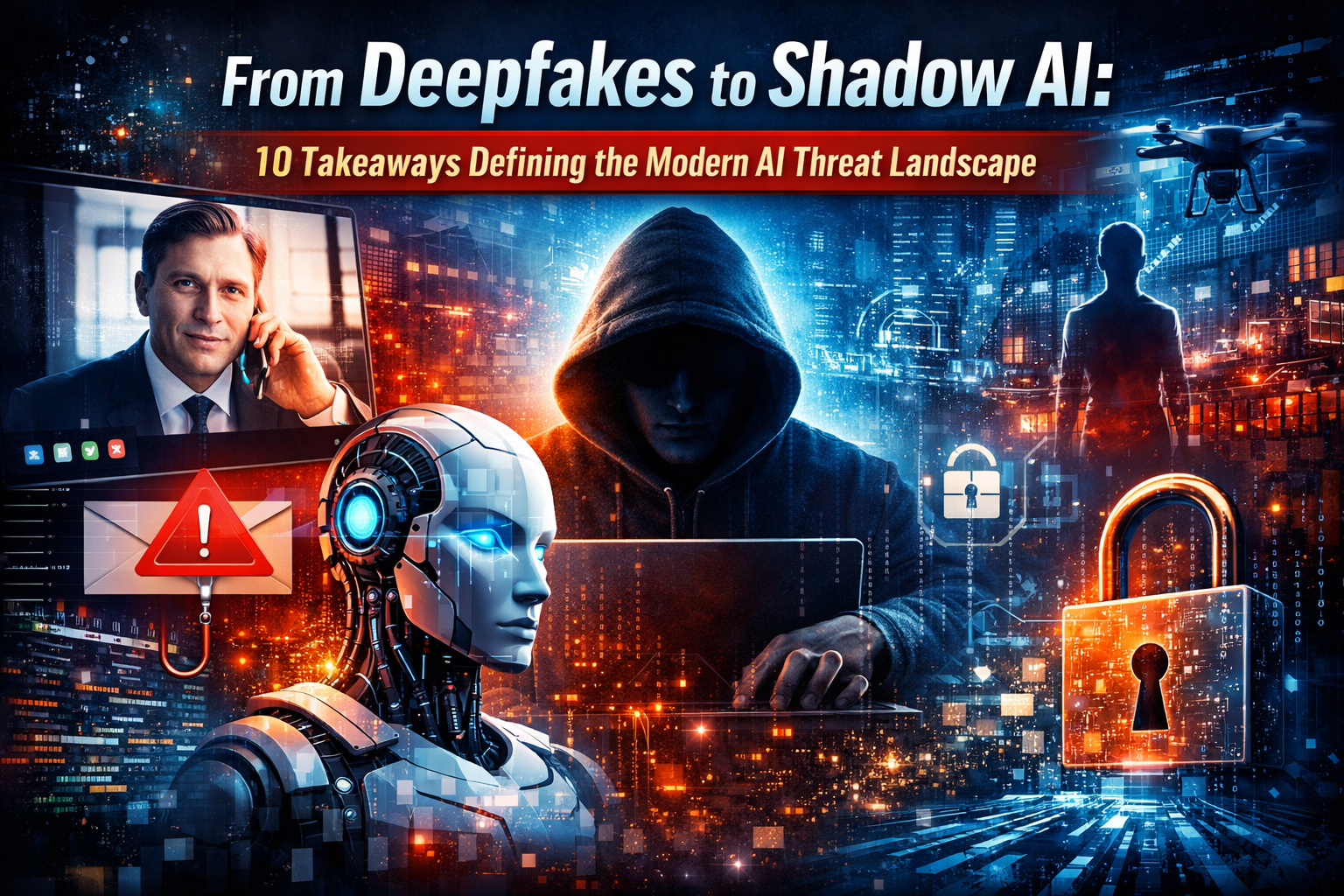
AI & Cyber Threat Landscape
1. Growing AI Risks in Cybersecurity
Artificial intelligence has rapidly become a central factor in cybersecurity, acting as both a powerful defense and a serious threat vector. Attackers have quickly adopted AI tools to amplify their capabilities, and many executives now consider AI-related cyber risks among their top organizational concerns.
2. AI’s Dual Role
While AI helps defenders detect threats faster, it also enables cybercriminals to automate attacks at scale. This rapid adoption by attackers is reshaping the overall cyber threat landscape going into 2026.
3. Deepfakes and Impersonation Techniques
One of the most alarming developments is the use of deepfakes and voice cloning. These tools create highly convincing impersonations of executives or trusted individuals, fooling employees and even automated systems.
4. Enhanced Phishing and Messaging
AI has made phishing attacks more sophisticated. Instead of generic scam messages, attackers use generative AI to craft highly personalized and convincing messages that leverage data collected from public sources.
5. Automated Reconnaissance
AI now automates what used to be manual reconnaissance. Malicious scripts scout corporate websites and social profiles to build detailed target lists much faster than human attackers ever could.
6. Adaptive Malware
AI-driven malware is emerging that can modify its code and behavior in real time to evade detection. Unlike traditional threats, this adaptive malware learns from failed attempts and evolves to be more effective.
7. Shadow AI and Data Exposure
“Shadow AI” refers to employees using third-party AI tools without permission. These tools can inadvertently capture sensitive information, which might be stored, shared, or even reused by AI providers, posing significant data leakage risks.
8. Long-Term Access and Silent Attacks
Modern AI-enabled attacks often aim for persistence—maintaining covert access for weeks or months to gather credentials and monitor systems before striking, rather than causing immediate disruption.
9. Evolving Defense Needs
Traditional security systems are increasingly inadequate against these dynamic, AI-driven threats. Organizations must embrace adaptive defenses, real-time monitoring, and identity-centric controls to keep pace.
10. Human Awareness Remains Critical
Technology alone won’t stop these threats. A strong “human firewall” — knowledgeable employees and ongoing awareness training — is crucial to recognize and prevent emerging AI-enabled attacks.
My Opinion
AI’s influence on the cyber threat landscape is both inevitable and transformative. On one hand, AI empowers defenders with unprecedented speed and analytical depth. On the other, it’s lowering the barrier to entry for attackers, enabling highly automated, convincing attacks that traditional defenses struggle to catch. This duality makes cybersecurity a fundamentally different game than it was even a few years ago.
Organizations can’t afford to treat AI simply as a defensive tool or a checkbox in their security stack. They must build AI-aware risk management strategies, integrate continuous monitoring and identity-centric defenses, and invest in employee education. Most importantly, cybersecurity leaders need to assume that attackers will adopt AI faster than defenders — so resilience and adaptive defense are not optional, they’re mandatory.
The key takeaway? Cybersecurity in 2026 and beyond won’t just be about technology. It will be a strategic balance between innovation, human awareness, and proactive risk governance.

InfoSec services | InfoSec books | Follow our blog | DISC llc is listed on The vCISO Directory | ISO 27k Chat bot | Comprehensive vCISO Services | ISMS Services | AIMS Services | Security Risk Assessment Services | Mergers and Acquisition Security
At DISC InfoSec, we help organizations navigate this landscape by aligning AI risk management, governance, security, and compliance into a single, practical roadmap. Whether you are experimenting with AI or deploying it at scale, we help you choose and operationalize the right frameworks to reduce risk and build trust. Learn more at DISC InfoSec.
- When AI Hacks Faster Than Humans: The Coming Collapse of Traditional Cybersecurity Value
- SOC 2 Isn’t Enough: Moving Beyond Compliance Theater to Real Risk Management
- When AI Becomes the Attack Surface: Lessons from the McKinsey Lilli Incident
- Why Every Company Needs a CISO (or at Least vCISO-Level Leadership)
- How ISO 27001 Lead Auditors Should Evaluate AI Risks in an ISMS





