
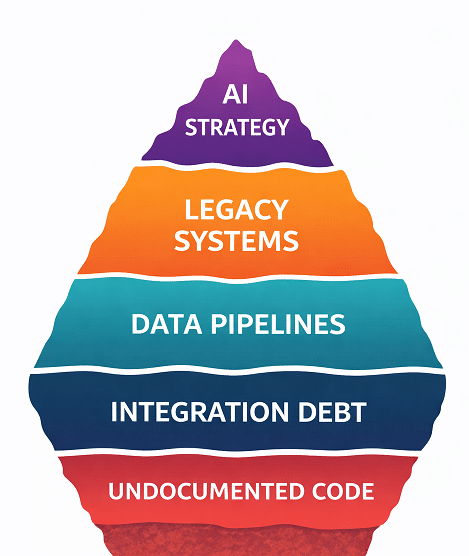
The iceberg captures the reality of AI transformation.
At the very top of the iceberg sits “AI Strategy.” This is the visible, exciting part—the headlines about GenAI, AI agents, copilots, and transformation. On the surface, leaders are saying, “AI will transform us,” and teams are eager to “move fast.” This is where ambition lives.
Just below the waterline, however, are the layers most organizations prefer not to talk about.
First come legacy systems—applications stitched together over decades through acquisitions, quick fixes, and short-term decisions. These systems were never designed to support real-time AI workflows, yet they hold critical business data.
Beneath that are data pipelines—fragile processes moving data between systems. Many break silently, rely on manual intervention, or produce inconsistent outputs. AI models don’t fail dramatically at first; they fail subtly when fed inconsistent or delayed data.
Below that lies integration debt—APIs, batch jobs, and custom connectors built years ago, often without clear ownership. When no one truly understands how systems talk to each other, scaling AI becomes risky and slow.
Even deeper is undocumented code—business logic embedded in scripts and services that only a few long-tenured employees understand. This is the most dangerous layer. When AI systems depend on logic no one can confidently explain, trust erodes quickly.
This is where the real problems live—beneath the surface. Organizations are trying to place advanced AI strategies on top of foundations that are unstable. It’s like installing smart automation in a building with unreliable wiring.
We’ve seen what happens when the foundation isn’t ready:
- AI systems trained on “clean” lab data struggle in messy real-world environments.
- Models inherit bias from historical datasets and amplify it.
- Enterprise AI pilots stall—not because the algorithms are weak, but because data quality, workflows, and integrations can’t support them.
If AI is to work at scale, the invisible layers must become the priority.
Clean Data
Clean data means consistent definitions, deduplicated records, validated inputs, and reconciled sources of truth. It means knowing which dataset is authoritative. AI systems amplify whatever they are given—if the data is flawed, the intelligence will be flawed. Clean data is the difference between automation and chaos.
Strong Pipelines
Strong pipelines ensure data flows reliably, securely, and in near real time. They include monitoring, error handling, lineage tracking, and version control. AI cannot depend on pipelines that break quietly or require manual fixes. Reliability builds trust.
Disciplined Integration
Disciplined integration means structured APIs, documented interfaces, clear ownership, and controlled change management. AI agents must interact with systems in predictable ways. Without integration discipline, AI becomes brittle and risky.
Governance
Governance defines accountability—who owns the data, who approves models, who monitors bias, who audits outcomes. It aligns AI usage with regulatory, ethical, and operational standards. Without governance, AI becomes experimentation without guardrails.
Documentation
Documentation captures business logic, data definitions, workflows, and architectural decisions. It reduces dependency on tribal knowledge. In AI governance, documentation is not bureaucracy—it is institutional memory and operational resilience.
The Bigger Picture
GenAI is powerful. But it is not magic. It does not repair fragmented data landscapes or reconcile conflicting system logic. It accelerates whatever foundation already exists.
The organizations that succeed with AI won’t be the ones that move fastest at the top of the iceberg. They will be the ones willing to strengthen what lies beneath the waterline.
AI is the headline.
Data infrastructure is the foundation.
AI Governance is the discipline that makes transformation real.
My perspective: AI Governance is not about controlling innovation—it’s about preparing the enterprise so innovation doesn’t collapse under its own ambition. The “boring” work—data quality, integration discipline, documentation, and oversight—is not a delay to transformation. It is the transformation.

InfoSec services | InfoSec books | Follow our blog | DISC llc is listed on The vCISO Directory | ISO 27k Chat bot | Comprehensive vCISO Services | ISMS Services | AIMS Services | Security Risk Assessment Services | Mergers and Acquisition Security
At DISC InfoSec, we help organizations navigate this landscape by aligning AI risk management, governance, security, and compliance into a single, practical roadmap. Whether you are experimenting with AI or deploying it at scale, we help you choose and operationalize the right frameworks to reduce risk and build trust. Learn more at DISC InfoSec.
- Stop asking what your agent can do
- You can’t put a human in the loop of a system that kills its agents every 3 minutes
- Human Oversight vs Human Control: Where the Human Sits in AI Execution
- A signed two-page policy beats a fifty-page draft. Every time…
- We have guardrails for that is not a control – Here’s the difference




February 13th, 2026 8:51 am
[…] Below the Waterline: Why AI Strategy Fails Without Data Foundations […]