What is ISO/IEC 42001 in today’s AI-infested apps?
ISO/IEC 42001 is the first international standard for establishing, implementing, maintaining, and continually improving an Artificial Intelligence Management System (AIMS). In an era where AI is deeply embedded into everyday applications—recommendation engines, copilots, fraud detection, decision automation, and generative systems—ISO 42001 provides a governance backbone. It helps organizations ensure that AI systems are trustworthy, transparent, accountable, risk-aware, and aligned with business and societal expectations, rather than being ad-hoc experiments running in production.
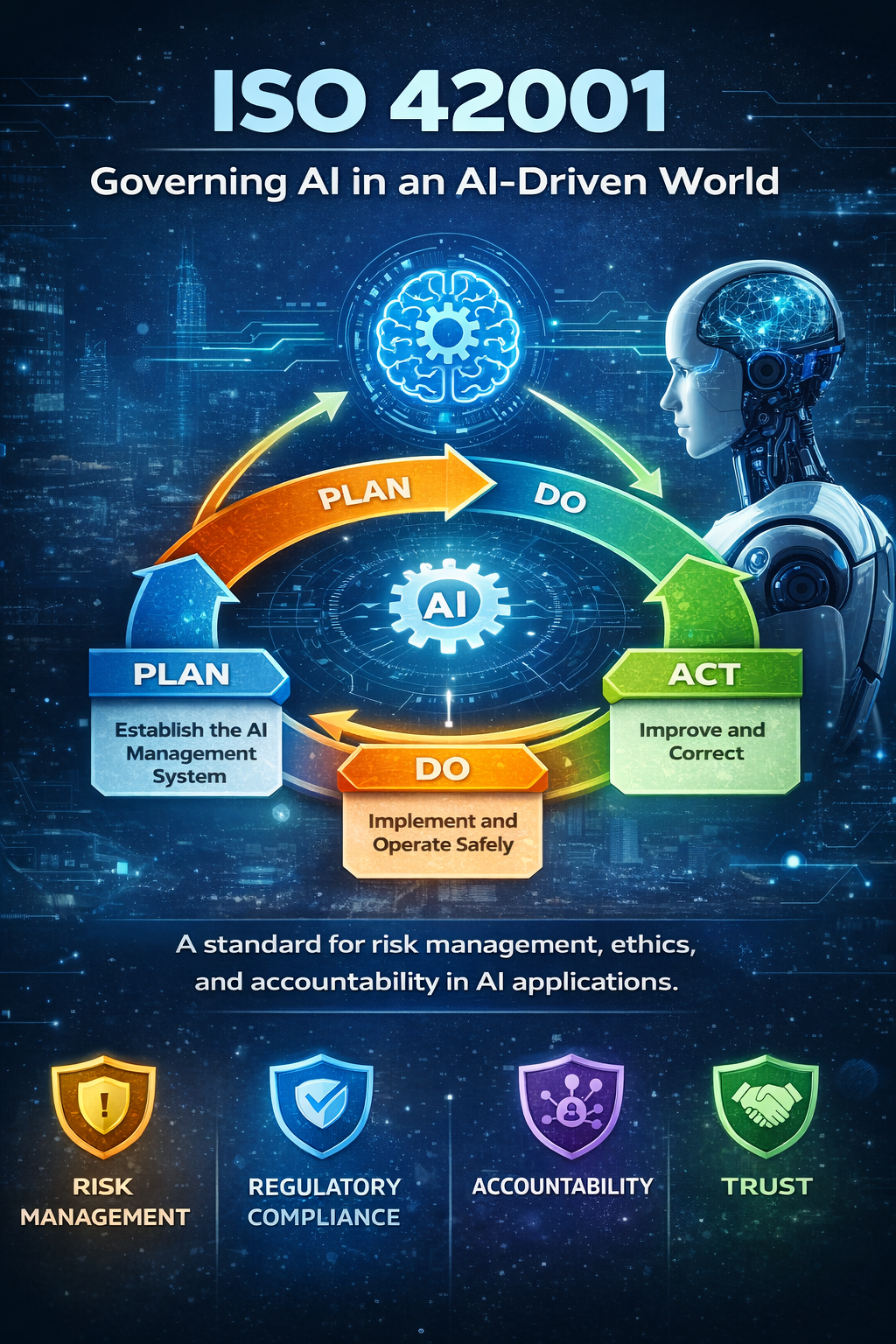
At its core, ISO 42001 adapts the familiar Plan–Do–Check–Act (PDCA) lifecycle to AI, recognizing that AI risk is dynamic, context-dependent, and continuously evolving.
PLAN – Establish the AIMS
The Plan phase focuses on setting the foundation for responsible AI. Organizations define the context, identify stakeholders and their expectations, determine the scope of AI usage, and establish leadership commitment. This phase includes defining AI policies, assigning roles and responsibilities, performing AI risk and impact assessments, and setting measurable AI objectives. Planning is critical because AI risks—bias, hallucinations, misuse, privacy violations, and regulatory exposure—cannot be mitigated after deployment if they were never understood upfront.
Why it matters: Without structured planning, AI governance becomes reactive. Plan turns AI risk from an abstract concern into deliberate, documented decisions aligned with business goals and compliance needs.
DO – Implement the AIMS
The Do phase is where AI governance moves from paper to practice. Organizations implement controls through operational planning, resource allocation, competence and training, awareness programs, documentation, and communication. AI systems are built, deployed, and operated with defined safeguards, including risk treatment measures and impact mitigation controls embedded directly into AI lifecycles.
Why it matters: This phase ensures AI governance is not theoretical. It operationalizes ethics, risk management, and accountability into day-to-day AI development and operations.
CHECK – Maintain and Evaluate the AIMS
The Check phase emphasizes continuous oversight. Organizations monitor and measure AI performance, reassess risks, conduct internal audits, and perform management reviews. This is especially important in AI, where models drift, data changes, and new risks emerge long after deployment.
Why it matters: AI systems degrade silently. Check ensures organizations detect bias, failures, misuse, or compliance gaps early—before they become regulatory, legal, or reputational crises.
ACT – Improve the AIMS
The Act phase focuses on continuous improvement. Based on evaluation results, organizations address nonconformities, apply corrective actions, and refine controls. Lessons learned feed back into planning, ensuring AI governance evolves alongside technology, regulation, and organizational maturity.
Why it matters: AI governance is not a one-time effort. Act ensures resilience and adaptability in a fast-changing AI landscape.
Opinion: How ISO 42001 strengthens AI Governance
In my view, ISO 42001 transforms AI governance from intent into execution. Many organizations talk about “responsible AI,” but without a management system, accountability is fragmented and risk ownership is unclear. ISO 42001 provides a repeatable, auditable, and scalable framework that integrates AI risk into enterprise governance—similar to how ISO 27001 did for information security.
More importantly, ISO 42001 helps organizations shift from using AI to governing AI. It creates clarity around who is responsible, how risks are assessed and treated, and how trust is maintained over time. For organizations deploying AI at scale, ISO 42001 is not just a compliance exercise—it is a strategic enabler for safe innovation, regulatory readiness, and long-term trust.
InfoSec services | InfoSec books | Follow our blog | DISC llc is listed on The vCISO Directory | ISO 27k Chat bot | Comprehensive vCISO Services | ISMS Services | AIMS Services | Security Risk Assessment Services | Mergers and Acquisition Security
At DISC InfoSec, we help organizations navigate this landscape by aligning AI risk management, governance, security, and compliance into a single, practical roadmap. Whether you are experimenting with AI or deploying it at scale, we help you choose and operationalize the right frameworks to reduce risk and build trust. Learn more at DISC InfoSec.
- The cheapest security control you’ll ever implement is the component you decided not to build
- AI Handoffs: How Uncertainty Propagates—and How to Fix It
- The Security Risks Hiding in AI Agent Memory
- AI Log Retention: Why Every AI Log Doesn’t Deserve the Same Shelf Life
- The AI Agent Harness Is the New Security Boundary