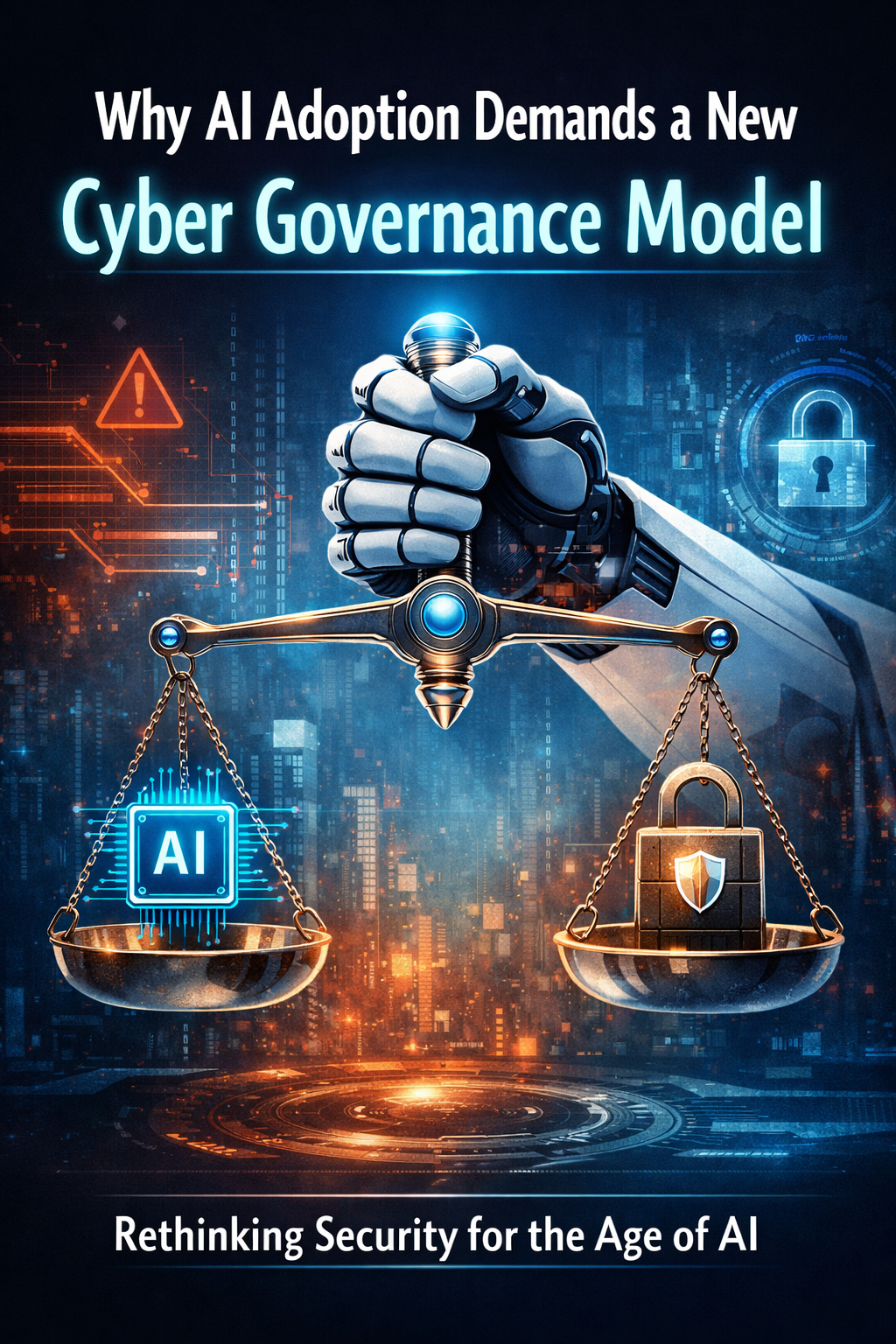
“Why AI adoption requires a dedicated approach to cyber governance”
1. Rapid AI Adoption and Rising Risks
AI tools are being adopted at an extraordinary pace across businesses, offering clear benefits like efficiency, reduced errors, and increased revenue. However, this rapid uptake also dramatically expands the enterprise attack surface. Each AI model, prompt, plugin, API connection, training dataset, or dependency introduces new vulnerability points, requiring stronger and continuous security measures than traditional SaaS governance frameworks were designed to handle.
2. Traditional Governance Falls Short for AI
Many security teams simply repurpose existing governance approaches designed for SaaS vendors when evaluating AI tools. This is problematic because data fed into AI systems can be exposed far more widely and may even be retained permanently by the AI provider—something that most conventional governance models don’t account for.
3. Explainability and Trust Issues
AI outputs can be opaque due to black-box models and phenomena like “hallucinations,” where the system generates confident but incorrect information. These characteristics make verification difficult and can introduce false data into important business decisions—another challenge existing governance frameworks weren’t built to manage.
4. Pressure to Move Fast
Business units are pushing for rapid AI adoption to stay competitive, which puts security teams in a bind. Existing third-party risk processes are slow, manual, and rigid, creating bottlenecks that force organizations to choose between agility and safety. Modern governance must be agile and scalable to match the pace of AI integration.
5. Gaps in Current Cyber Governance
Governance and Risk Compliance (GRC) programs commonly monitor direct vendors but often fail to extend visibility far enough into fourth or Nth-party risks. Even when organizations are compliant with regulations like DORA or NIS2, they may still face significant vulnerabilities because compliance checks only provide snapshots in time, missing dynamic risks across complex supply chains.
6. Limited Tool Effectiveness and Emerging Solutions
Most organizations acknowledge that current GRC tools are inadequate for managing AI risks. In response, many CISOs are turning to AI-based vendor risk assessment solutions that can monitor dependencies and interactions continuously rather than relying solely on point-in-time assessments. However, these tools must themselves be trustworthy and validated to avoid generating misleading results.
7. Practical Risk-Reduction Strategies
Effective governance requires proactive strategies like mapping data flows to uncover blind spots, enforcing output traceability, keeping humans in the oversight loop, and replacing one-off questionnaires with continuous monitoring. These measures help identify and mitigate risks earlier and more reliably.
8. Safe AI Management Is Possible
Deploying AI securely is achievable, but only with robust, AI-adapted governance—dynamic vendor onboarding, automated monitoring, continuous risk evaluation, and policies tailored to the unique nature of AI tools. Security teams must evolve their practices and frameworks to ensure AI is both adopted responsibly and aligned with business goals.
My Opinion
The article makes a compelling case that treating AI like traditional software or SaaS tools is a governance mistake. AI’s dynamic nature—its opaque decision processes, broad data exposure, and rapid proliferation via APIs and plugins—demands purpose-built governance mechanisms that are continuous, adaptive, and integrated with how organizations actually operate, not just how they report. This aligns with broader industry observations that shadow AI and decentralized AI use (e.g., “bring your own AI”) create blind spots that static governance models can’t handle.
In short, cybersecurity leaders should move beyond check-the-box compliance and toward risk-based, real-time oversight that embraces human-AI collaboration, leverages AI for risk monitoring, and embeds governance throughout the AI lifecycle. Done well, this strengthens security and unlocks AI’s value; done poorly, it exposes organizations to unnecessary harm.

InfoSec services | InfoSec books | Follow our blog | DISC llc is listed on The vCISO Directory | ISO 27k Chat bot | Comprehensive vCISO Services | ISMS Services | AIMS Services | Security Risk Assessment Services | Mergers and Acquisition Security
At DISC InfoSec, we help organizations navigate this landscape by aligning AI risk management, governance, security, and compliance into a single, practical roadmap. Whether you are experimenting with AI or deploying it at scale, we help you choose and operationalize the right frameworks to reduce risk and build trust. Learn more at DISC InfoSec.
- AI Log Retention: Why Every AI Log Doesn’t Deserve the Same Shelf Life
- The AI Agent Harness Is the New Security Boundary
- Stop asking what your agent can do
- You can’t put a human in the loop of a system that kills its agents every 3 minutes
- Human Oversight vs Human Control: Where the Human Sits in AI Execution