In developing organizational risk documentation—such as enterprise risk registers, cyber risk assessments, and business continuity plans—it is increasingly important to consider the World Economic Forum’s Global Risks Report. The report provides a forward-looking view of global threats and helps leaders balance immediate pressures with longer-term strategic risks.
The analysis is based on the Global Risks Perception Survey (GRPS), which gathered insights from more than 1,300 experts across government, business, academia, and civil society. These perspectives allow the report to examine risks across three time horizons: the immediate term (2026), the short-to-medium term (up to 2028), and the long term (to 2036).
One of the most pressing short-term threats identified is geopolitical instability. Rising geopolitical tensions, regional conflicts, and fragmentation of global cooperation are increasing uncertainty for businesses. These risks can disrupt supply chains, trigger sanctions, and increase regulatory and operational complexity across borders.
Economic risks remain central across all timeframes. Inflation volatility, debt distress, slow economic growth, and potential financial system shocks pose ongoing threats to organizational stability. In the medium term, widening inequality and reduced economic opportunity could further amplify social and political instability.
Cyber and technological risks continue to grow in scale and impact. Cybercrime, ransomware, data breaches, and misuse of emerging technologies—particularly artificial intelligence—are seen as major short- and long-term risks. As digital dependency increases, failures in technology governance or third-party ecosystems can cascade quickly across industries.
The report also highlights misinformation and disinformation as a critical threat. The erosion of trust in institutions, fueled by false or manipulated information, can destabilize societies, influence elections, and undermine crisis response efforts. This risk is amplified by AI-driven content generation and social media scale.
Climate and environmental risks dominate the long-term outlook but are already having immediate effects. Extreme weather events, resource scarcity, and biodiversity loss threaten infrastructure, supply chains, and food security. Organizations face increasing exposure to physical risks as well as regulatory and reputational pressures related to sustainability.
Public health risks remain relevant, even as the world moves beyond recent pandemics. Future outbreaks, combined with strained healthcare systems and global inequities in access to care, could create significant economic and operational disruptions, particularly in densely connected global markets.
Another growing concern is social fragmentation, including polarization, declining social cohesion, and erosion of trust. These factors can lead to civil unrest, labor disruptions, and increased pressure on organizations to navigate complex social and ethical expectations.
Overall, the report emphasizes that global risks are deeply interconnected. Cyber incidents can amplify economic instability, climate events can worsen geopolitical tensions, and misinformation can undermine responses to every other risk category. For organizations, the key takeaway is clear: risk management must be integrated, forward-looking, and resilience-focused—not siloed or purely compliance-driven.
Source: The report can be downloaded here: https://reports.weforum.org/docs/WEF_Global_Risks_Report_2026.pdf
Below is a clear, practitioner-level mapping of the World Economic Forum (WEF) global threats to ISO/IEC 27001, written for CISOs, vCISOs, risk owners, and auditors. I’ve mapped each threat to key ISO 27001 clauses and Annex A control themes (aligned to ISO/IEC 27001:2022).
WEF Global Threats → ISO/IEC 27001 Mapping
1. Geopolitical Instability & Conflict
Risk impact: Sanctions, supply-chain disruption, regulatory uncertainty, cross-border data issues
ISO 27001 Mapping
- Clause 4.1 – Understanding the organization and its context
- Clause 6.1 – Actions to address risks and opportunities
- Annex A
- A.5.31 – Legal, statutory, regulatory, and contractual requirements
- A.5.19 / A.5.20 – Supplier relationships & security within supplier agreements
- A.5.30 – ICT readiness for business continuity
2. Economic Instability & Financial Stress
Risk impact: Budget cuts, control degradation, insolvency of vendors
ISO 27001 Mapping
- Clause 5.1 – Leadership and commitment
- Clause 6.1.2 – Information security risk assessment
- Annex A
- A.5.4 – Management responsibilities
- A.5.23 – Information security for use of cloud services
- A.5.29 – Information security during disruption
3. Cybercrime & Ransomware
Risk impact: Operational disruption, data loss, extortion
ISO 27001 Mapping
- Clause 6.1.3 – Risk treatment
- Clause 8.1 – Operational planning and control
- Annex A
- A.5.7 – Threat intelligence
- A.5.25 – Secure development lifecycle
- A.8.7 – Protection against malware
- A.8.15 – Logging
- A.8.16 – Monitoring activities
- A.5.29 / A.5.30 – Incident & continuity readiness
4. AI Misuse & Emerging Technology Risk
Risk impact: Data leakage, model abuse, regulatory exposure
ISO 27001 Mapping
- Clause 4.1 – Internal and external issues
- Clause 6.1 – Risk-based planning
- Annex A
- A.5.10 – Acceptable use of information and assets
- A.5.11 – Return of assets
- A.5.12 – Classification of information
- A.5.23 – Cloud and shared technology governance
- A.5.25 – Secure system engineering principles
5. Misinformation & Disinformation
Risk impact: Reputational damage, decision errors, social instability
ISO 27001 Mapping
- Clause 7.4 – Communication
- Clause 8.2 – Information security risk assessment (operational risks)
- Annex A
- A.5.2 – Information security roles and responsibilities
- A.6.8 – Information security event reporting
- A.5.33 – Protection of records
- A.5.35 – Independent review of information security
6. Climate Change & Environmental Disruption
Risk impact: Facility outages, infrastructure damage, workforce disruption
ISO 27001 Mapping
- Clause 4.1 – Context of the organization
- Clause 8.1 – Operational planning and control
- Annex A
- A.5.29 – Information security during disruption
- A.5.30 – ICT readiness for business continuity
- A.7.5 – Protecting equipment
- A.7.13 – Secure disposal or re-use of equipment
7. Supply Chain & Third-Party Risk
Risk impact: Vendor outages, cascading failures, data exposure
ISO 27001 Mapping
- Clause 6.1.3 – Risk treatment planning
- Clause 8.1 – Operational controls
- Annex A
- A.5.19 – Information security in supplier relationships
- A.5.20 – Addressing security within supplier agreements
- A.5.21 – Managing changes in supplier services
- A.5.22 – Monitoring, review, and change management
8. Public Health Crises
Risk impact: Workforce unavailability, operational shutdowns
ISO 27001 Mapping
- Clause 8.1 – Operational planning and control
- Clause 6.1 – Risk assessment and treatment
- Annex A
- A.5.29 – Information security during disruption
- A.5.30 – ICT readiness for business continuity
- A.6.3 – Information security awareness, education, and training
9. Social Polarization & Workforce Risk
Risk impact: Insider threats, reduced morale, policy non-compliance
ISO 27001 Mapping
- Clause 7.2 – Competence
- Clause 7.3 – Awareness
- Annex A
- A.6.1 – Screening
- A.6.2 – Terms and conditions of employment
- A.6.4 – Disciplinary process
- A.6.7 – Remote working
10. Interconnected & Cascading Risks
Risk impact: Compound failures across cyber, economic, and operational domains
ISO 27001 Mapping
- Clause 6.1 – Risk-based thinking
- Clause 9.1 – Monitoring, measurement, analysis, and evaluation
- Clause 10.1 – Continual improvement
- Annex A
- A.5.7 – Threat intelligence
- A.5.35 – Independent review of information security
- A.8.16 – Continuous monitoring
Key Takeaway (vCISO / Board-Level)
ISO 27001 is not just a cybersecurity standard — it is a resilience framework.
When properly implemented, it directly addresses the systemic, interconnected risks highlighted by the World Economic Forum, provided organizations treat it as a living risk management system, not a compliance checkbox.
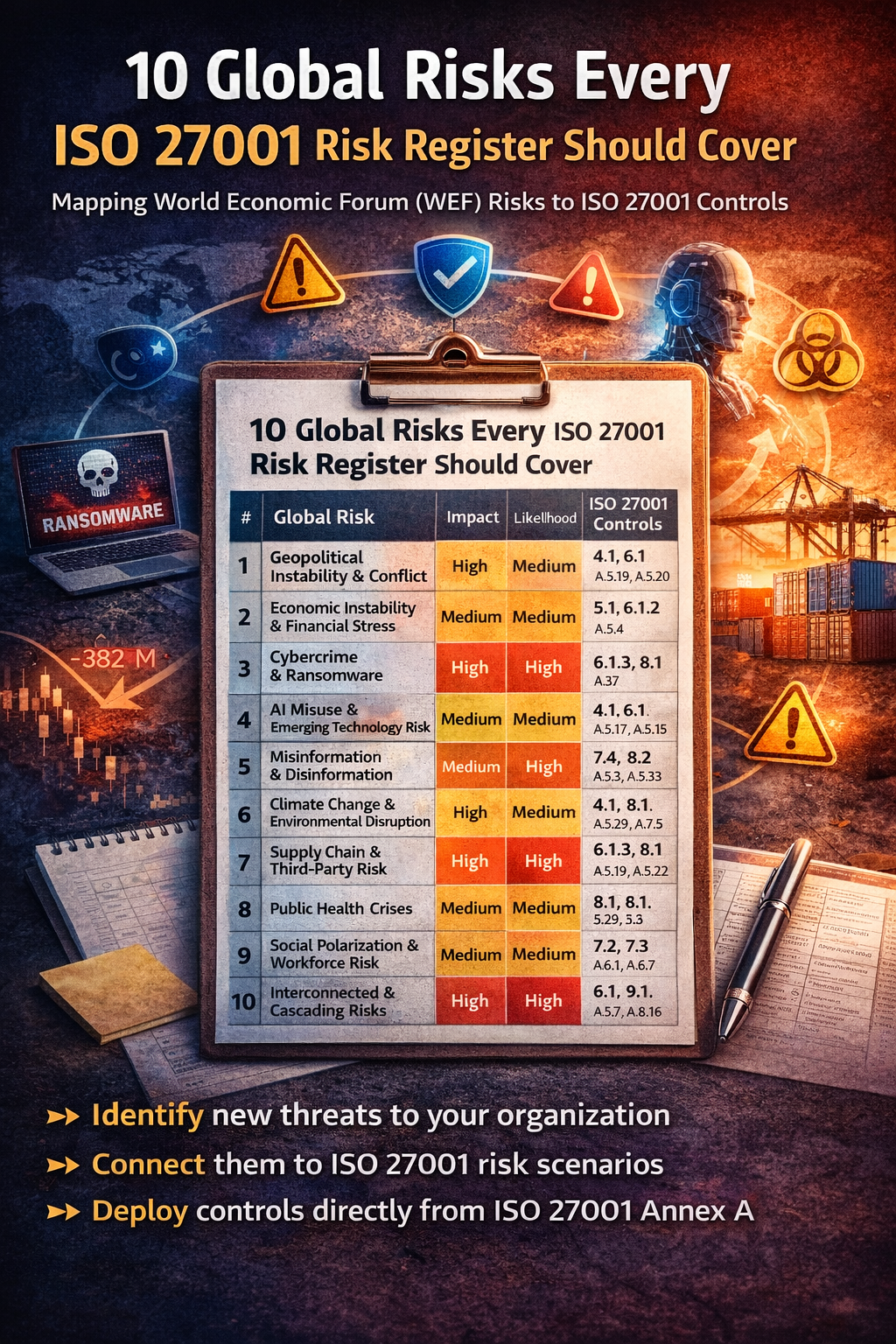
Here’s a practical mapping of WEF global risks to ISO 27001 risk register entries, designed for use by vCISOs, risk managers, or security teams. I’ve structured it in a way that you could directly drop into a risk register template.
WEF Risks → ISO 27001 Risk Register Mapping
| # | WEF Risk | ISO 27001 Clause / Annex A | Risk Description | Impact | Likelihood | Controls / Treatment |
|---|---|---|---|---|---|---|
| 1 | Geopolitical Instability & Conflict | 4.1, 6.1, A.5.19, A.5.20, A.5.30 | Supplier disruptions, sanctions, cross-border compliance issues | High | Medium | Vendor risk management, geopolitical monitoring, business continuity plans |
| 2 | Economic Instability & Financial Stress | 5.1, 6.1.2, A.5.4, A.5.23, A.5.29 | Budget cuts, financial insolvency of vendors, delayed projects | Medium | Medium | Financial risk reviews, budget contingency planning, third-party assessments |
| 3 | Cybercrime & Ransomware | 6.1.3, 8.1, A.5.7, A.5.25, A.8.7, A.8.15, A.8.16, A.5.29 | Data breaches, operational disruption, ransomware payments | High | High | Endpoint protection, monitoring, incident response, secure development, backup & recovery |
| 4 | AI Misuse & Emerging Technology Risk | 4.1, 6.1, A.5.10, A.5.12, A.5.23, A.5.25 | Model/data misuse, regulatory non-compliance, bias or errors | Medium | Medium | Secure AI lifecycle, model testing, governance framework, access controls |
| 5 | Misinformation & Disinformation | 7.4, 8.2, A.5.2, A.6.8, A.5.33, A.5.35 | Reputational damage, poor decisions, erosion of trust | Medium | High | Communication policies, monitoring media/social, staff awareness training, incident reporting |
| 6 | Climate Change & Environmental Disruption | 4.1, 8.1, A.5.29, A.5.30, A.7.5, A.7.13 | Physical damage to facilities, infrastructure outages, supply chain delays | High | Medium | Business continuity plans, backup sites, environmental risk monitoring, asset protection |
| 7 | Supply Chain & Third-Party Risk | 6.1.3, 8.1, A.5.19, A.5.20, A.5.21, A.5.22 | Vendor failures, data leaks, cascading disruptions | High | High | Vendor risk assessments, SLAs, liability/indemnity clauses, continuous monitoring |
| 8 | Public Health Crises | 8.1, 6.1, A.5.29, A.5.30, A.6.3 | Workforce unavailability, operational shutdowns | Medium | Medium | Continuity planning, remote work policies, health monitoring, staff training |
| 9 | Social Polarization & Workforce Risk | 7.2, 7.3, A.6.1, A.6.2, A.6.4, A.6.7 | Insider threats, reduced compliance, morale issues | Medium | Medium | HR screening, employee awareness, remote work controls, disciplinary policies |
| 10 | Interconnected & Cascading Risks | 6.1, 9.1, 10.1, A.5.7, A.5.35, A.8.16 | Compound failures across cyber, economic, operational domains | High | High | Enterprise risk management, monitoring, continual improvement, scenario testing, incident response |
Notes for Implementation
- Impact & Likelihood are example placeholders — adjust based on your organizational context.
- Controls / Treatment align with ISO 27001 Annex A but can be supplemented by NIST CSF, COBIT, or internal policies.
- Treat this as a living document: WEF risk landscape evolves annually, so review at least yearly.
- This mapping can feed risk heatmaps, board reports, and executive dashboards.
InfoSec services | InfoSec books | Follow our blog | DISC llc is listed on The vCISO Directory | ISO 27k Chat bot | Comprehensive vCISO Services | ISMS Services | AIMS Services | Security Risk Assessment Services | Mergers and Acquisition Security
At DISC InfoSec, we help organizations navigate this landscape by aligning AI risk management, governance, security, and compliance into a single, practical roadmap. Whether you are experimenting with AI or deploying it at scale, we help you choose and operationalize the right frameworks to reduce risk and build trust. Learn more at DISC InfoSec.
- Human Oversight vs Human Control: Where the Human Sits in AI Execution
- A signed two-page policy beats a fifty-page draft. Every time…
- We have guardrails for that is not a control – Here’s the difference
- Point-in-time remediation is dead against a persistent adversary
- Your Security Stack Isn’t Obsolete. Your Operating Model Is