
The Road to Enterprise AGI: Why Reliability Matters More Than Intelligence
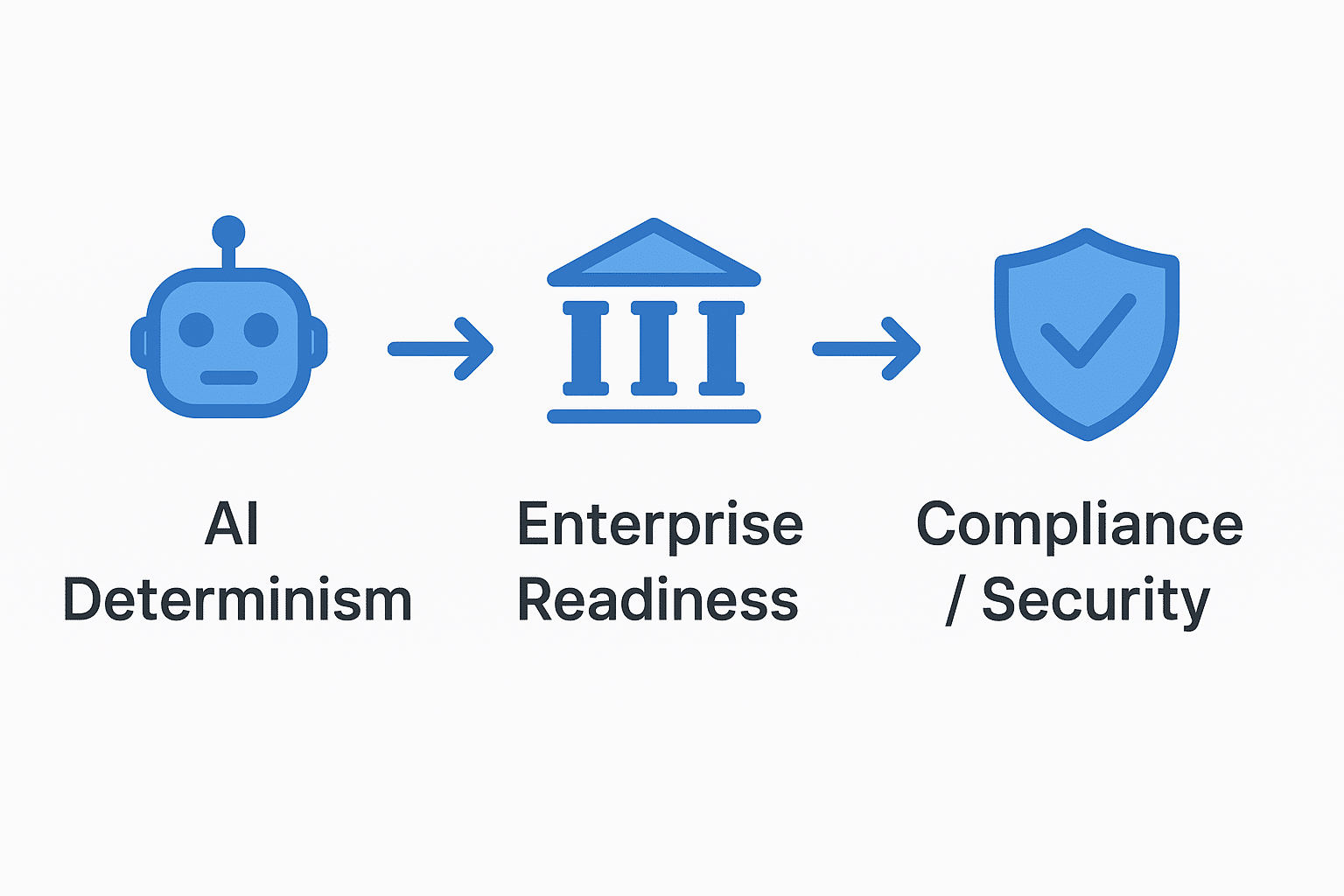
1️⃣ Why Practical Reliability Matters
- Many current AI systems — especially large language models (LLMs) and multimodal models — are non-deterministic: the same prompt can produce different outputs at different times.
- For enterprises, non-determinism is a huge problem:
- Compliance & auditability: Industries like finance, healthcare, and regulated manufacturing require traceable, reproducible decisions. An AI that gives inconsistent advice is essentially unusable in these contexts.
- Risk management: If AI recommendations are unpredictable, companies can’t reliably integrate them into business-critical workflows.
- Integration with existing systems: ERP, CRM, legal review systems, and automation pipelines need predictable outputs to function smoothly.
Murati’s research at Thinking Machines Lab directly addresses this. By working on deterministic inference pipelines, the goal is to ensure AI outputs are reproducible, reducing operational risk for enterprises. This moves generative AI from “experimental assistant” to a trusted tool. (a tool called Tinker that automates the creation of custom frontier AI models)
2️⃣ Enterprise Readiness
- Security & Governance Integration: Enterprise adoption requires AI systems that comply with security policies, privacy standards, and governance rules. Murati emphasizes creating auditable, controllable AI.
- Customization & Human Alignment: Businesses need AI that can be configured for specific workflows, tone, or operational rules — not generic “off-the-shelf” outputs. Thinking Machines Lab is focusing on human-aligned AI, meaning the system can be tailored while maintaining predictable behavior.
- Operational Reliability: Enterprise-grade software demands high uptime, error handling, and predictable performance. Murati’s approach suggests that her AI systems are being designed with industrial-grade reliability, not just research demos.
3️⃣ The Competitive Edge
- By tackling reproducibility and reliability at the inference level, her startup is positioning itself to serve companies that cannot tolerate “creative AI outputs” that are inconsistent or untraceable.
- This is especially critical in sectors like:
- Healthcare: AI-assisted diagnoses need predictable outputs.
- Finance & Insurance: Risk modeling and automated compliance checks cannot fluctuate unpredictably.
- Regulated Manufacturing & Energy: Decision-making and operational automation must be deterministic to meet safety standards.
Murati isn’t just building AI that “works,” she’s building AI that can be safely deployed in regulated, risk-sensitive environments. This aligns strongly with InfoSec, vCISO, and compliance priorities, because it makes AI audit-ready, predictable, and controllable — moving it from a curiosity or productivity tool to a reliable enterprise asset. In Short Building Trustworthy AGI: Determinism, Governance, and Real-World Readiness…
Murati’s Thinking Machines in Talks for $50 Billion Valuation
InfoSec services | ISMS Services | AIMS Services | InfoSec books | Follow our blog | DISC llc is listed on The vCISO Directory | ISO 27k Chat bot | Comprehensive vCISO Services | Security Risk Assessment Services | Mergers and Acquisition Security
Governance in The Age of Gen AI: A Director’s Handbook on Gen AI
- Lawyers Can’t Delegate Accountability: The Coming AI Responsibility Reckoning
- ISO 42001 + ISO 27001: Unified Governance for Secure and Responsible AI
- ChatGPT CEO Warns of AI Risks: Balancing Innovation with Societal Safety
- Without AI Governance, AI Agents Become Your Biggest Liability
- Victim Language Is Killing Cybersecurity Accountability





