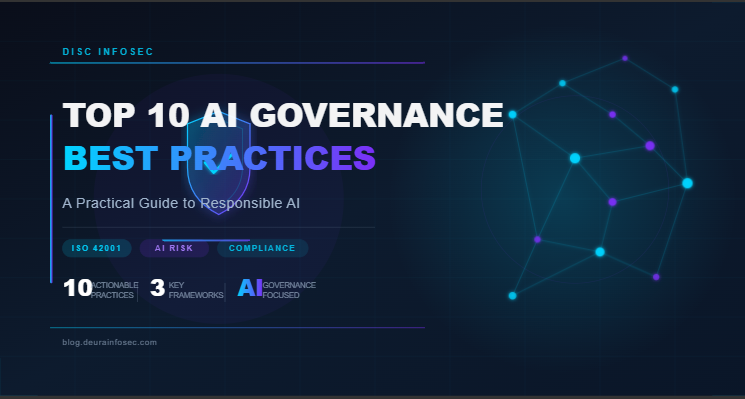
Overview of the Top 10 AI Governance Best Practices from the Lumenova AI article:
1. Build Cross-Functional AI Governance Committees
AI risk isn’t isolated to one department — it spans legal, security, data science, and business operations. Establishing a multi-disciplinary governance body ensures that decisions consider diverse perspectives and risks, rather than leaving oversight to only technology or compliance teams. This committee should have authority to review and, if needed, block AI deployments that don’t meet governance standards.
2. Standardize AI Use Case Approval and Risk Classification
Shadow AI — unvetted tools and projects — is one of the biggest governance threats. A structured intake and approval workflow helps organizations classify each AI use case by risk level (e.g., low, high) and routes them through appropriate oversight processes. This keeps innovation moving while preventing uncontrolled deployments.
3. Align Governance with Global Regulatory Standards
AI governance is no longer just internal policy; it must align with evolving laws like the EU AI Act and various U.S. state regulations. Mapping controls to the strictest standards creates a single compliance approach that covers multiple jurisdictions rather than maintaining separate regional frameworks.
4. Maintain a Centralized AI Inventory and Policy Repository
You can’t govern what you don’t see. A unified registry that tracks AI models, their datasets, lineage, versions, and associated policies becomes the “source of truth” for compliance and audit readiness. It also enables rapid impact analysis when governance needs change.
5. Embed Governance into Daily Workflows
Governance today isn’t about policies filed away in a binder — it must be integrated into how AI is developed, deployed, and monitored. Embedding controls into everyday workflows ensures oversight is continuous, not periodic, and matches the pace of how modern AI systems evolve.
6. Automate Compliance and Controls Where Possible
Relying on manual checks doesn’t scale. Automating policy enforcement, compliance validation, and risk monitoring helps organizations stay ahead of drift, bias, and other governance gaps — reducing both human error and operational bottlenecks.
7. Continuously Document Models and Decisions
Transparent documentation — covering training data sources, intended use cases, performance limits, and governance decisions — is key for audits, regulatory scrutiny, and internal accountability. It also supports explainability and trust with stakeholders.
8. Monitor AI Systems Post-Deployment
AI systems change over time — as input data shifts and usage patterns evolve — meaning ongoing monitoring is essential. This includes watching for bias, performance decay, security vulnerabilities, and other risks. Continuous oversight ensures systems stay aligned with standards and expectations.
9. Enforce Human Oversight Where Needed
For high-impact or high-risk AI, human oversight (e.g., human-in-the-loop checkpoints) ensures that critical decisions aren’t fully automated and that ethical judgment or context is retained. This practice balances automation with accountability.
10. Foster a Responsible AI Culture Through Training
Governance isn’t just about tools and policies — it’s also about people. Ongoing education and role-specific training help teams understand why governance matters, what their responsibilities are, and how to implement best practices effectively.
My Perspective
As AI adoption accelerates, governance is no longer optional — it’s foundational. Organizations that treat governance as a compliance checkbox inevitably fall behind; those that operationalize it — embedding controls into workflows, automating compliance, and building cross-functional oversight — gain real strategic advantage. Strong AI governance doesn’t slow innovation; it reduces risk, builds stakeholder trust, and enables AI to scale responsibly across the enterprise. By shifting from static policies to living governance practices, leaders protect their organizations while unlocking AI’s full value.
Source: https://lnkd.in/eJ9wfjZs

InfoSec services | InfoSec books | Follow our blog | DISC llc is listed on The vCISO Directory | ISO 27k Chat bot | Comprehensive vCISO Services | ISMS Services | AIMS Services | Security Risk Assessment Services | Mergers and Acquisition Security
At DISC InfoSec, we help organizations navigate this landscape by aligning AI risk management, governance, security, and compliance into a single, practical roadmap. Whether you are experimenting with AI or deploying it at scale, we help you choose and operationalize the right frameworks to reduce risk and build trust. Learn more at DISC InfoSec.
- Is Your AI Governance Strategy Audit-Ready—or Just Documented?
- AI-Native Risk: Why AI Security Is Still an API Security Problem
- AI Governance Enforcement: The Foundation for Scaling AI Governance Effectively
- Securing LLM-Powered Enterprises: From Invisible Threats to Operational Resilience
- Cyber Resilience Maturity Model: From Reactive Security to Operational Resilience