
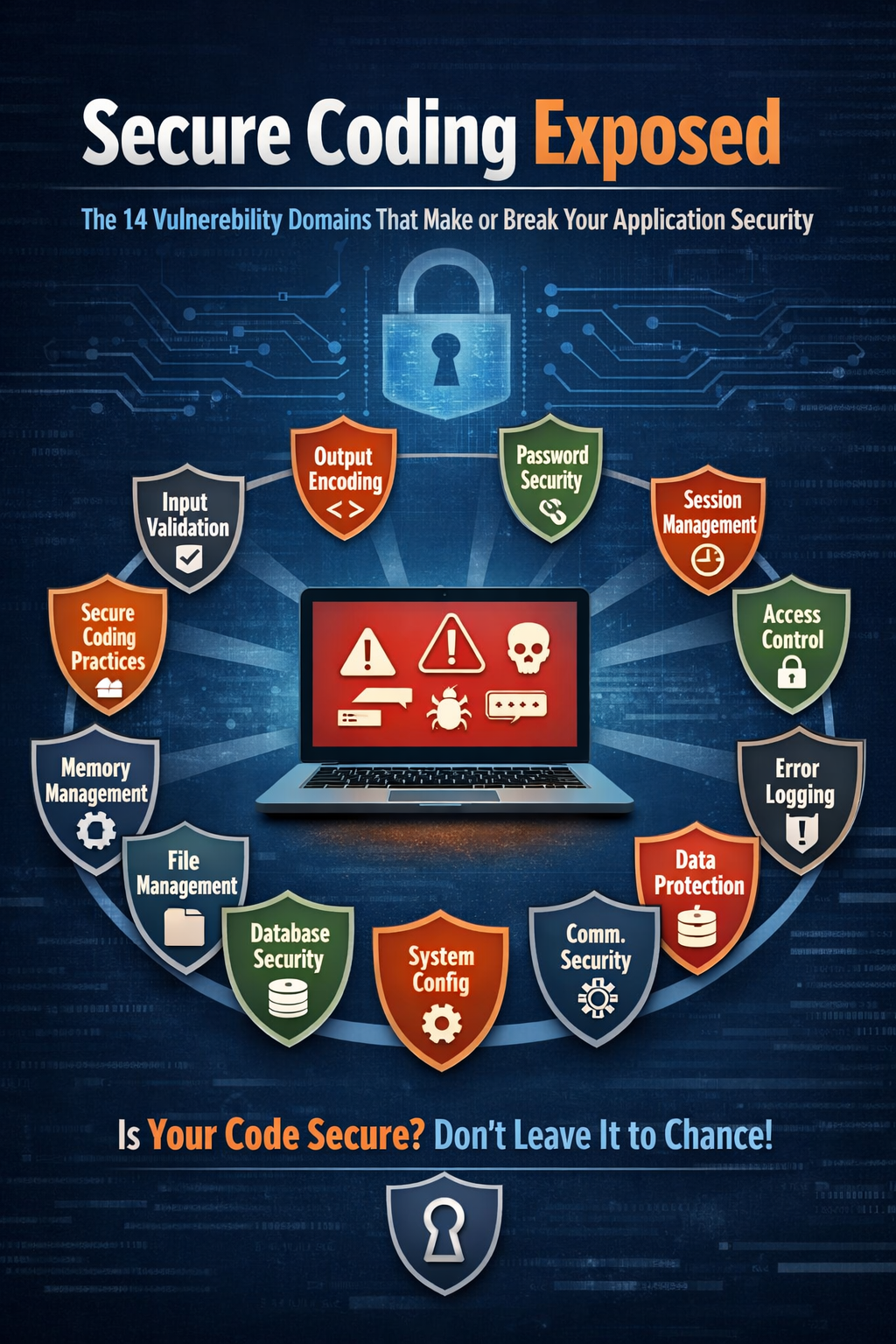
The fourteen vulnerability domains outlined in the OWASP Secure Coding Practices checklist collectively address the most common and dangerous weaknesses found in modern applications. They begin with Input Validation, which emphasizes rejecting malformed, unexpected, or malicious data before it enters the system by enforcing strict type, length, range, encoding, and whitelist controls. Closely related is Output Encoding, is a security technique that converts untrusted user input into a safe format before it is rendered by a browser, preventing malicious scripts from executing, which ensures that any data leaving the system—especially untrusted input—is properly encoded and sanitized based on context (HTML, SQL, OS commands, etc.) to prevent injection and cross-site scripting attacks. Authentication and Password Management focuses on enforcing strong identity verification, secure credential storage using salted hashes, robust password policies, secure reset mechanisms, protection against brute-force attacks, and the use of multi-factor authentication for sensitive accounts. Session Management strengthens how authenticated sessions are created, maintained, rotated, and terminated, ensuring secure cookie attributes, timeout controls, CSRF protections, and prevention of session hijacking or fixation.
Access Control ensures that authorization checks are consistently enforced across all requests, applying least privilege, segregating privileged logic, restricting direct object references, and documenting access policies to prevent horizontal and vertical privilege escalation. Cryptographic Practices govern how encryption and key management are implemented, requiring trusted execution environments, secure random number generation, protection of master secrets, compliance with standards, and defined key lifecycle processes. Error Handling and Logging prevents sensitive information leakage through verbose errors while ensuring centralized, tamper-resistant logging of security-relevant events such as authentication failures, access violations, and cryptographic errors to enable monitoring and incident response. Data Protection enforces encryption of sensitive data at rest, safeguards cached and temporary files, removes sensitive artifacts from production code, prevents insecure client-side storage, and supports secure data disposal when no longer required.
Communication Security protects data in transit by mandating TLS for all sensitive communications, validating certificates, preventing insecure fallback, enforcing consistent TLS configurations, and filtering sensitive data from headers. System Configuration reduces the attack surface by keeping components patched, disabling unnecessary services and HTTP methods, minimizing privileges, suppressing server information leakage, and ensuring secure default behavior. Database Security focuses on protecting data stores through secure queries, restricted privileges, parameterized statements, and protection against injection and unauthorized access. File Management addresses safe file uploads, storage, naming, permissions, and validation to prevent path traversal, malicious file execution, and unauthorized access. Memory Management emphasizes preventing buffer overflows, memory leaks, and improper memory handling that could lead to exploitation, especially in lower-level languages. Finally, General Coding Practices reinforce secure design principles such as defensive programming, code reviews, adherence to standards, minimizing complexity, and integrating security throughout the software development lifecycle.
My perspective:
What stands out is that these fourteen areas are not isolated technical controls—they form an interconnected security architecture. Most major breaches trace back to failures in just a few of these domains: weak input validation, broken access control, poor credential handling, or misconfiguration. Organizations often overinvest in perimeter defenses while underinvesting in secure coding discipline. In reality, secure coding is risk management at the source. If development teams operationalize these fourteen domains as mandatory engineering guardrails—not optional best practices—they dramatically reduce exploitability, compliance exposure, and incident response costs. Secure coding is no longer a developer concern alone; it is a governance and leadership responsibility.
The Secure Vibe Coding Handbook: A Practical Guide to Safe and Secure AI Programming

InfoSec services | InfoSec books | Follow our blog | DISC llc is listed on The vCISO Directory | ISO 27k Chat bot | Comprehensive vCISO Services | ISMS Services | AIMS Services | Security Risk Assessment Services | Mergers and Acquisition Security
At DISC InfoSec, we help organizations navigate this landscape by aligning AI risk management, governance, security, and compliance into a single, practical roadmap. Whether you are experimenting with AI or deploying it at scale, we help you choose and operationalize the right frameworks to reduce risk and build trust. Learn more at DISC InfoSec.
- Measure What Matters: Security & AI Readiness Scorecard
- Security Is a People Problem: Culture, Behavior, and Decisions Drive Cyber Resilience
- Security Driven by Business Value: Focus, Prioritize, Protect What Matters Most
- Claude Mythos and the Future of Cybersecurity: Powerful—and Potentially Dangerous
- Hackers at Machine Speed: The AI Cybersecurity Reality





