
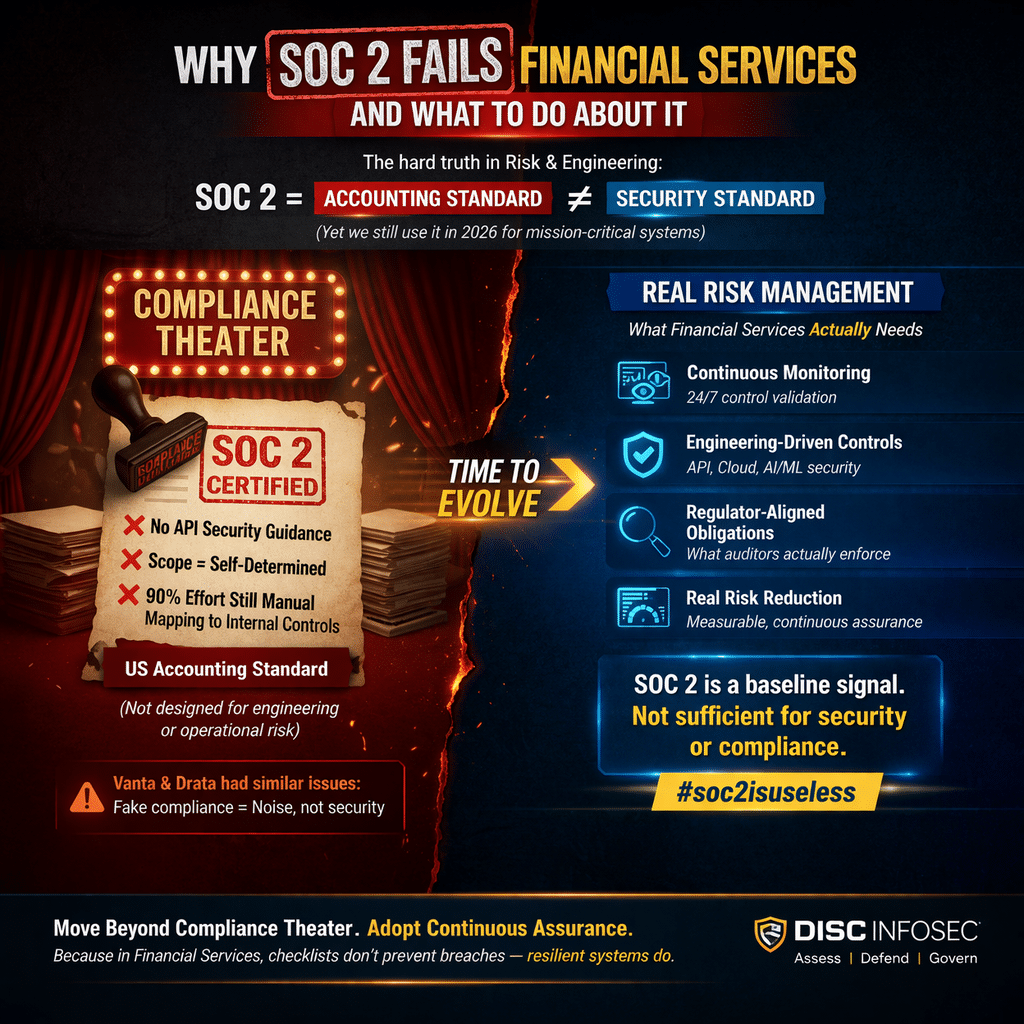
The recent criticism around “fake compliance” highlights a growing frustration in the industry: many organizations are mistaking certifications for actual security. Incidents involving platforms like Vanta and Drata have only amplified concerns that compliance can sometimes create more noise than real assurance.
At the center of this debate is SOC 2, which is widely adopted across industries. However, critics argue that SOC 2 is fundamentally misapplied—especially in high-risk sectors like financial services—where engineering rigor and operational resilience are far more critical than audit checklists.
One key issue is that SOC 2 originates from an accounting and auditing perspective, not an engineering or security-first mindset. This raises a valid question: why are organizations in 2026 still relying on a framework designed for financial reporting to evaluate complex, mission-critical systems?
Another concern is the lack of technical depth. SOC 2 does not provide meaningful guidance on modern security challenges such as API protection, cloud-native architectures, or AI-driven systems. As a result, it often fails to address the real risks organizations face today.
The flexibility of SOC 2 scope is also problematic. Companies define the boundaries of what gets audited, which means they can effectively “choose their own story.” This undermines the consistency and reliability that compliance frameworks are supposed to provide.
Even when a SOC 2 report is obtained, the burden doesn’t end there. Organizations must still map the report back to their own internal controls, policies, and regulatory obligations—often accounting for the majority of the actual work in vendor risk management.
This has led many professionals to describe SOC 2 as “compliance theater”—a process that looks good on paper but doesn’t necessarily translate into real security or risk reduction. The focus shifts from managing risk to passing audits.
The alternative being proposed is a move toward continuous assurance: ongoing testing, monitoring, and validation against internal standards and regulatory expectations. This approach emphasizes real-world resilience over periodic certification.
Perspective on the State of Compliance:
Compliance today is at an inflection point. Frameworks like SOC 2 still have value as baseline signals, but they are increasingly insufficient on their own—especially in regulated and high-risk environments. The future of compliance is not about more certifications; it’s about measurable, continuous risk validation. Organizations that continue to rely solely on audit-based assurance will fall behind, while those investing in engineering-driven security, real-time monitoring, and regulator-aligned controls will define the next generation of trust.
💡 Bottom line: SOC 2 can be a baseline signal, but it’s useless as your sole measure of security or compliance. Focus on measurable, continuous assurance aligned with regulatory expectations.
#soc2isuseless #CyberSecurity #RiskManagement #Compliance #FinancialServices #InfoSec #vCISO #ContinuousMonitoring #SecurityGovernance #DISCInfoSec
InfoSec services | InfoSec books | Follow our blog | DISC llc is listed on The vCISO Directory | ISO 27k Chat bot | Comprehensive vCISO Services | ISMS Services | AIMS Services | Security Risk Assessment Services | Mergers and Acquisition Security
At DISC InfoSec, we help organizations navigate this landscape by aligning AI risk management, governance, security, and compliance into a single, practical roadmap. Whether you are experimenting with AI or deploying it at scale, we help you choose and operationalize the right frameworks to reduce risk and build trust. Learn more at DISC InfoSec.
- AI Attack Surface ScoreCard
- AI-Accelerated Offense: Why Security Programs Must Move Now, Not Later
- AI Governance Explained: Accountability, Trust, and Control in the Age of AI
- Measure What Matters: Security & AI Readiness Scorecard
- Security Is a People Problem: Culture, Behavior, and Decisions Drive Cyber Resilience





