
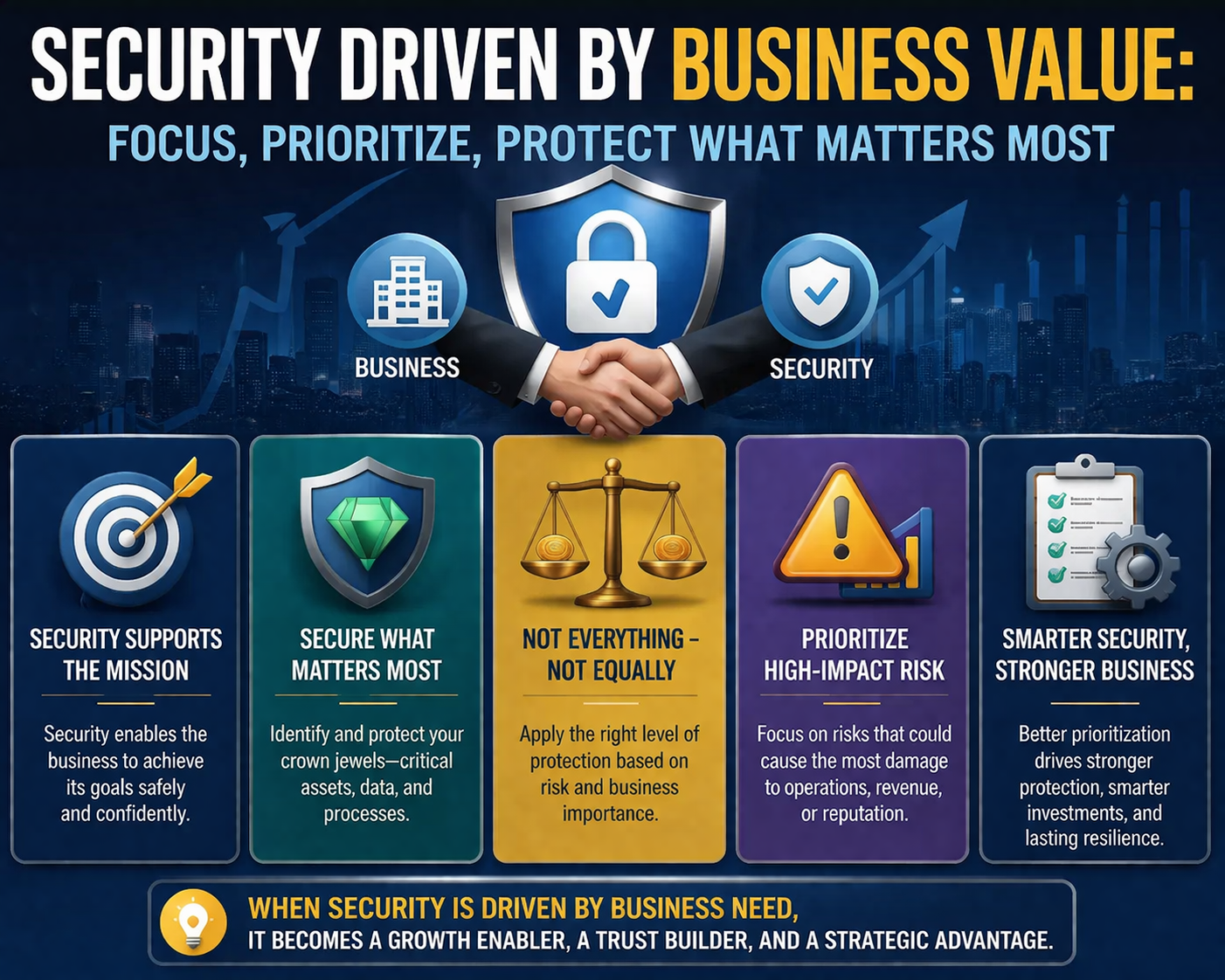
How “Security Must Be Driven by Business Need” Is Accomplished
This is achieved by tightly aligning security strategy with business objectives, revenue drivers, and operational priorities. Instead of applying controls uniformly, organizations perform risk-based assessments tied to critical business processes, assets, and data flows. Security leaders collaborate with executives to understand what truly impacts revenue, reputation, safety, and compliance. From there, controls, investments, and governance are prioritized based on business impact—not theoretical risk. Metrics like risk reduction per dollar, impact on uptime, and regulatory exposure help ensure security decisions are business-relevant and defensible.
Security Supports the Mission
Security should act as an enabler—not a blocker—of the organization’s mission. Whether the goal is growth, innovation, or customer trust, security programs must align with and accelerate these outcomes. When security understands the mission, it can design controls that protect without slowing down operations, ensuring the business can move fast while staying protected.
Secure What Matters Most
Not all assets carry equal importance. Organizations must identify their crown jewels—critical systems, sensitive data, key processes—and focus protection efforts there first. This ensures that limited resources are used effectively, protecting the areas that would cause the most damage if compromised.
Not Everything – Not Equally
Attempting to secure everything at the same level leads to wasted effort and burnout. A mature security program recognizes that some risks are acceptable and some assets require less stringent controls. Differentiation based on risk tolerance and business impact is essential for scalability and efficiency.
Prioritize High-Impact Risk
Security decisions should be driven by potential business impact, not just likelihood or technical severity. High-impact risks—those that could disrupt operations, cause financial loss, or damage reputation—must be addressed first. This approach ensures that the most dangerous threats are mitigated early, even if they are less frequent.
My Perspective (Practical & Strategic)
This post captures one of the most important shifts happening in cybersecurity today: moving from compliance-driven security to business-driven security.
In practice, many organizations still operate in a checklist mindset—focusing on frameworks like ISO 27001, NIST, or SOC 2 without fully translating them into business risk. That’s where most security programs fail to deliver real value.
A strong vCISO mindset (which aligns with your goals, (DISC InfoSec) should:
- Translate technical risks into business language (revenue loss, downtime, legal exposure)
- Tie every control to a measurable business outcome
- Push back on low-value security work that doesn’t reduce meaningful risk
- Build a risk-based roadmap instead of a control-based checklist
The real differentiator is prioritization. Companies don’t lose because they missed a low-risk control—they lose because they failed to protect what mattered most.
If you operationalize this correctly, security becomes:
- A revenue enabler (helps win deals)
- A trust engine (customers feel safe)
- A decision-making function (not just IT support)
That’s the level where security leadership becomes strategic—and where vCISOs deliver the most value.
InfoSec services | InfoSec books | Follow our blog | DISC llc is listed on The vCISO Directory | ISO 27k Chat bot | Comprehensive vCISO Services | ISMS Services | AIMS Services | Security Risk Assessment Services | Mergers and Acquisition Security
At DISC InfoSec, we help organizations navigate this landscape by aligning AI risk management, governance, security, and compliance into a single, practical roadmap. Whether you are experimenting with AI or deploying it at scale, we help you choose and operationalize the right frameworks to reduce risk and build trust. Learn more at DISC InfoSec.
- Security Is a People Problem: Culture, Behavior, and Decisions Drive Cyber Resilience
- Security Driven by Business Value: Focus, Prioritize, Protect What Matters Most
- Claude Mythos and the Future of Cybersecurity: Powerful—and Potentially Dangerous
- Hackers at Machine Speed: The AI Cybersecurity Reality
- AI Security = API Security: The Case for Real-Time Enforcement





