
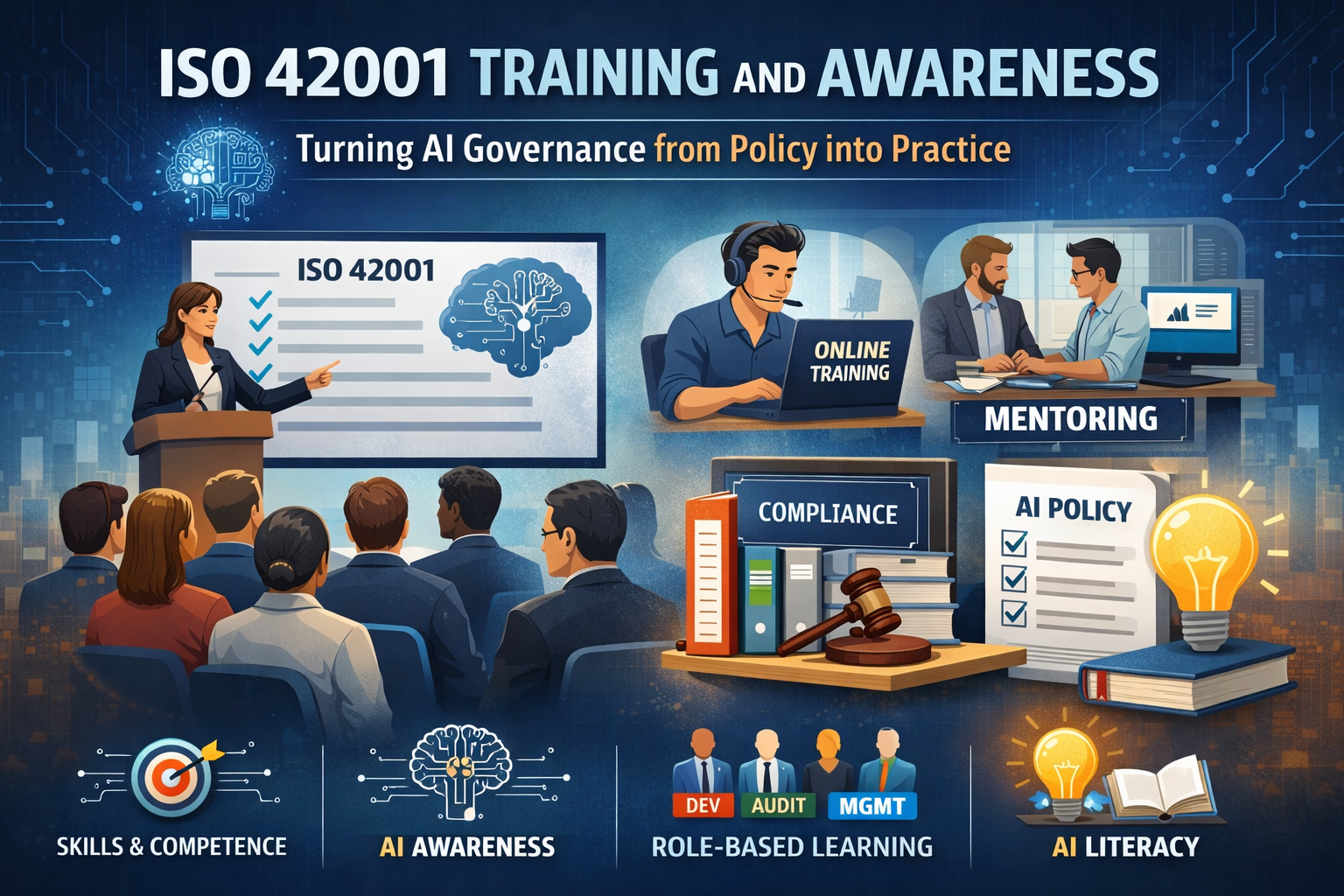
Turning AI Governance from Policy into Practice
Why ISO 42001 training and awareness matter
ISO/IEC 42001 places strong emphasis on ensuring that people involved in AI design, development, deployment, and oversight understand their responsibilities. This is not just a “checkbox” requirement; effective training and awareness directly influence how well AI risks are identified, managed, and governed in practice. With AI technologies evolving rapidly and regulations such as the EU AI Act coming into force, organizations need structured, role-appropriate education to prevent misuse, ethical failures, and compliance gaps.
Competence requirements (Clause 7.2)
Clause 7.2 focuses on competence and requires organizations to identify the skills and knowledge needed for specific AI-related roles. Companies must assess whether individuals already possess these competencies through education, training, or experience, and take action where gaps exist. This means competence must be intentional and evidence-based—organizations should be able to show why someone is qualified for a role such as AI governance lead, implementer, or internal auditor, and how missing capabilities are addressed.
Awareness requirements (Clause 7.3)
Clause 7.3 shifts the focus from deep expertise to general awareness. Employees must understand the organization’s AI policy, how their work contributes to AI governance, and the consequences of not following AI-related policies and procedures. Awareness is about shaping behavior at scale, ensuring that AI risks are not created unintentionally by uninformed decisions, shortcuts, or misuse of AI systems.
Training methods and delivery options
ISO 42001 allows flexibility in how competencies are built. Training can be delivered through formal courses, in-house sessions, mentorship, or structured self-study. Formal courses are well suited for specialized roles, while in-house training works best for groups with similar needs. Reading materials and mentorship typically complement other methods rather than replacing them. The key is aligning the training approach with the role, maturity level, and risk exposure of the audience.
Role-based and audience-specific training
Effective training starts with segmentation. Employees should be grouped based on function, seniority, or involvement in AI-related processes. Training topics, depth, and duration should then be tailored accordingly—for example, short, high-level sessions for senior leadership and more detailed, technical sessions for developers or AI operators. This ensures relevance and avoids overtraining or undertraining critical roles.
AI awareness and AI literacy
Beyond formal training, ISO 42001 emphasizes ongoing awareness, increasingly referred to as “AI literacy,” especially in the context of the EU AI Act. Awareness can be raised through videos, internal articles, presentations, and discussions. These methods help employees understand why AI governance matters, not just what the rules are. Continuous communication reinforces expectations and keeps AI risks visible as technologies and use cases evolve.
Modes of delivering training at scale
Organizations can choose between instructor-led classroom sessions, live online training, or pre-recorded courses delivered via learning management systems. Instructor-led formats allow interaction but are harder to scale, while pre-recorded training is easier to manage and track. The choice depends on organizational size, geographic spread, and the need for interaction versus efficiency.
My perspective
ISO 42001 gets something very important right: AI governance will fail if it lives only in policies and documents. Training and awareness are the mechanisms that translate governance into day-to-day decisions. In practice, I see many organizations default to generic AI awareness sessions that satisfy auditors but don’t change behavior. The real value comes from role-based training tied directly to AI risk scenarios the organization actually faces.
I also believe ISO 42001 training should not be treated as a standalone initiative. It works best when integrated with security awareness, privacy training, and risk management programs—especially for organizations already aligned with ISO 27001 or similar frameworks. As AI becomes embedded across business functions, AI literacy will increasingly resemble “digital hygiene”: something everyone must understand at a basic level, with deeper expertise reserved for those closest to the risk.

InfoSec services | InfoSec books | Follow our blog | DISC llc is listed on The vCISO Directory | ISO 27k Chat bot | Comprehensive vCISO Services | ISMS Services | AIMS Services | Security Risk Assessment Services | Mergers and Acquisition Security
At DISC InfoSec, we help organizations navigate this landscape by aligning AI risk management, governance, security, and compliance into a single, practical roadmap. Whether you are experimenting with AI or deploying it at scale, we help you choose and operationalize the right frameworks to reduce risk and build trust. Learn more at DISC InfoSec.
- When AI Hacks Faster Than Humans: The Coming Collapse of Traditional Cybersecurity Value
- SOC 2 Isn’t Enough: Moving Beyond Compliance Theater to Real Risk Management
- When AI Becomes the Attack Surface: Lessons from the McKinsey Lilli Incident
- Why Every Company Needs a CISO (or at Least vCISO-Level Leadership)
- How ISO 27001 Lead Auditors Should Evaluate AI Risks in an ISMS





February 13th, 2026 8:52 am
[…] ISO 42001 Training and Awareness: Turning AI Governance from Policy into Practice […]