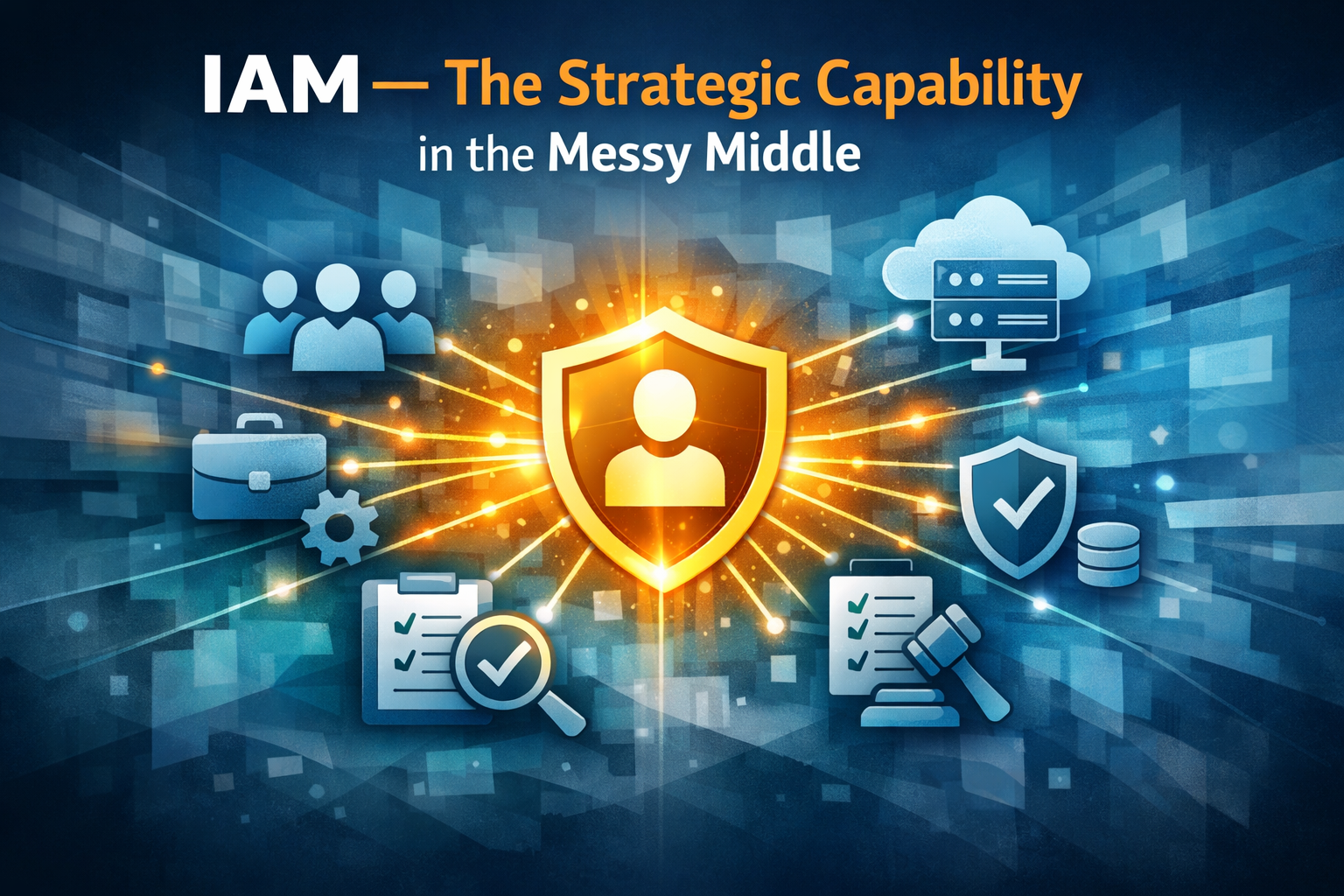
Identity and Access Management (IAM) is the discipline that ensures the right people have the right access to the right systems at the right time — and for the right reasons. It governs digital identities, entitlements, authentication, authorization, and ongoing access oversight across an organization.
1. The Common Perception of IAM
When people hear “IAM,” they often think of tools and platforms — multi-factor authentication, provisioning engines, connectors, approval dashboards, and certification workflows. The focus immediately goes to technology stacks and system integrations.
2. The Engineering Lens
For engineering teams, IAM is architecture and automation. It’s about API reliability, system integration, workflow efficiency, and reducing manual touchpoints. Success is measured in automation rates and seamless connectivity.
3. The GRC Lens
Governance, Risk, and Compliance (GRC) teams see IAM as documented controls, audit trails, certification evidence, and policy enforcement. Their concern is defensibility — can access decisions be justified during an audit?
4. The Cybersecurity Lens
Cybersecurity teams focus on privilege, toxic access combinations, password hygiene, and attack paths. Their priority is exposure reduction — minimizing the blast radius of compromised credentials.
5. All Are Valid — None Are Complete
Each perspective is legitimate, yet incomplete. IAM is not just technology, not just compliance, and not just risk management. Reducing IAM to a single lens is where organizational friction begins.
6. IAM Lives in the Messy Middle
Most real IAM work does not happen inside platforms or control matrices. It lives between people, processes, and systems. It’s where business reality meets technical constraint and regulatory expectation.
7. The Translation Layer
IAM requires translating cryptic entitlement names into business language that owners can confidently certify. It involves questioning legacy access no one remembers approving and explaining why a screenshot is not valid audit evidence.
8. The Ownership Problem
On paper, every system has an owner. In practice, ownership is often misunderstood. True ownership means defining appropriate access, understanding data sensitivity, and rejecting excessive permissions — not merely clicking “approve.”
9. Balancing Competing Priorities
IAM programs constantly balance automation versus oversight, standardization versus flexibility, and risk reduction versus operational speed. No platform alone fixes unclear accountability or poor data quality. No framework eliminates trade-offs.
10. IAM as a Business Enabler
When designed properly, IAM aligns access with real job functions, creates defensible but practical workflows, reduces audit findings, and accelerates onboarding. It shifts from being a control obstacle to a strategic capability embedded in how the organization operates.
My Perspective
After two decades in security and compliance environments, one thing becomes clear: IAM failure is rarely a technology failure — it is an ownership and alignment failure.
IAM is fundamentally about decision governance at scale. It operationalizes who can do what — and why — across thousands of daily business actions. If treated purely as an IT control, it becomes a bottleneck. If treated purely as compliance, it becomes checkbox theater. If treated purely as risk reduction, it slows the business.
The organizations that succeed treat IAM as a cross-functional business capability, with clearly defined ownership, measurable outcomes, and executive alignment. When that happens, IAM stops being a hurdle to bypass and becomes what it was meant to be: a structured, accountable way to enable secure and efficient business execution.
InfoSec services | InfoSec books | Follow our blog | DISC llc is listed on The vCISO Directory | ISO 27k Chat bot | Comprehensive vCISO Services | ISMS Services | AIMS Services | Security Risk Assessment Services | Mergers and Acquisition Security
At DISC InfoSec, we help organizations navigate this landscape by aligning AI risk management, governance, security, and compliance into a single, practical roadmap. Whether you are experimenting with AI or deploying it at scale, we help you choose and operationalize the right frameworks to reduce risk and build trust. Learn more at DISC InfoSec.
- AI Governance Enforcement: The Foundation for Scaling AI Governance Effectively
- Securing LLM-Powered Enterprises: From Invisible Threats to Operational Resilience
- Cyber Resilience Maturity Model: From Reactive Security to Operational Resilience
- From Risk to Resilience: A 5-Step Playbook for Securing AI in the Modern Threat Era
- Which AI Governance Framework Should You Adopt First? A Practical Guide for U.S., EU, and Global Organizations
In cybersecurity operations, documents often contain sensitive infrastructure details, internal assessments, or regulated data. Using generic PDF tools may expose organizations to unnecessary risks. PDF Agile ensures that document control remains in the hands of your team — not scattered across unsecured workflows. PDF Agile > https://tidd.ly/4reTXrS “PDF Agile: All-in-One PDF Editor, Converter and Viewer”
PDF Agile Built for Secure Document Handling
• 256-bit password encryption
• Granular permission control (copy, print, edit restrictions)
• Permanent redaction for sensitive data
• Digital signatures for compliance workflows
• Offline desktop mode for data privacy