
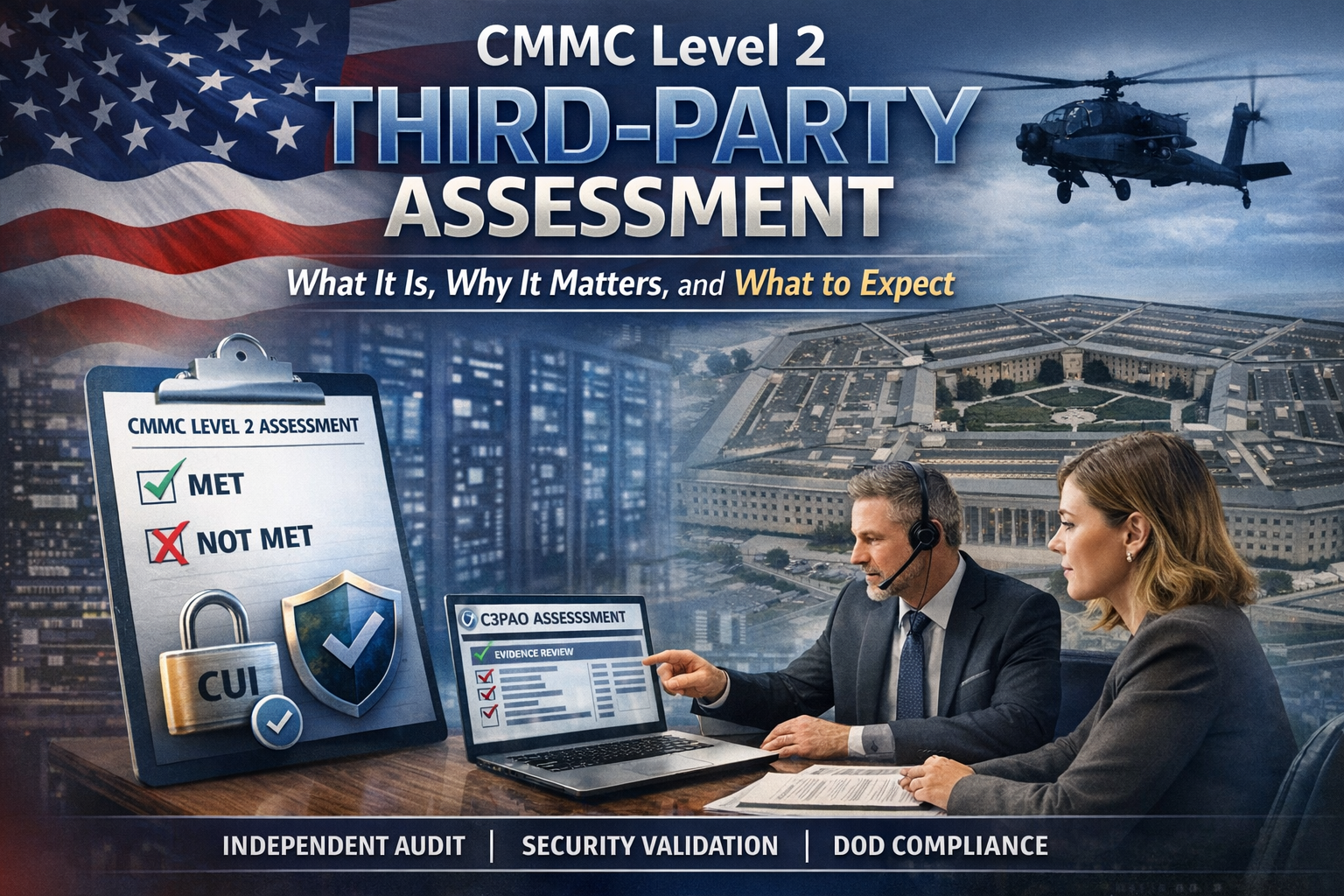
What Is a CMMC Level 2 Third-Party Assessment?
A CMMC Level 2 Third-Party Assessment is a formal, independent evaluation conducted by a certified assessor organization (C3PAO) to verify that a contractor complies with the 110 security requirements of NIST SP 800-171 under the Cybersecurity Maturity Model Certification framework. It determines whether an organization adequately protects Controlled Unclassified Information (CUI) when supporting the U.S. Department of Defense (DoD).
Why Does an Organization Need One?
Any Defense Industrial Base (DIB) contractor handling CUI under DoD contracts that require Level 2 certification must undergo a third-party assessment. Unlike Level 1 (self-assessment), Level 2 requires independent validation to bid on and maintain certain defense contracts. Without it, organizations risk losing eligibility for DoD work.
What happens in CMMC Level 2 assessment
– The Core Question
The most common concern among DIB executives preparing for CMMC is simple: what actually happens during a Level 2 third-party assessment?
– Demand for Transparency
Leaders want clarity around the process, including what qualifies as acceptable evidence, how assessors evaluate controls, and what the overall experience looks like from start to finish.
– The Resource from DISC InfoSec
To address this need, DISC InfoSec has developed a practical assessment process that helps organizations through the assessment exactly as a C3PAO would perform it.
– Structured, Real-World Walkthrough
The process breaks down the engagement phase by phase and control by control, using realistic mock evidence and assessor insights based on real-world scenarios.
– What the Assesssment Covers
It explains the full CMMC Assessment Process (CAP), clarifies what “MET” versus “NOT MET” looks like in practice, and provides a realistic walkthrough of a DIB contractor’s evaluation.
Color coded: Fully implemented, Partially implemented, Not implemented, Not Applicable + Assessment report
– The Overlooked Advantage
One often-missed benefit of a C3PAO assessment is the creation of a validated and independently verified body of evidence demonstrating that controls are implemented and operating effectively.
– Long-Term Value of Evidence
This validated evidence becomes the foundation for ongoing compliance, annual executive affirmation, continuous monitoring, and stronger accountability across the organization.
– Eliminating Uncertainty
CMMC should not feel confusing or opaque. Executives need a clear understanding of expectations in order to allocate budget, prioritize remediation efforts, and guide the organization confidently toward certification.
– Designed for Action
The purpose of this independent assessment process is to provide actionable clarity for organizations preparing for certification or advising others on their CMMC journey.
My Perspective on CMMC Level 2 Third-Party Assessments
From a governance and risk standpoint, a CMMC Level 2 third-party assessment is not just a compliance checkpoint — it is a strategic validation of operational cybersecurity maturity.
If approached correctly, it transforms security documentation into defensible, audit-ready evidence. More importantly, it forces executive leadership to move from policy statements to operational proof.
In my view, the organizations that benefit most are those that treat the assessment not as a hurdle to clear, but as a structured opportunity to institutionalize accountability, reduce decision risk, and build a defensible compliance posture that supports long-term DoD engagement.
CMMC Level 2 is less about passing an audit — and more about proving sustained control effectiveness under independent scrutiny.
Here’s a full breakdown of all the 97 security requirements in NIST SP 800‑171r3 (Revision 3) — organized by control family as defined in the official publication. It lists each requirement by its identifier and title (exact text descriptions are from NIST SP 800-171r3):(NIST Publications)
03.01 – Access Control (AC)
- 03.01.01 — Account Management
- 03.01.02 — Access Control Policies and Procedures
- 03.01.03 — Least Privilege
- 03.01.04 — Separation of Duties
- 03.01.05 — Session Lock
- 03.01.06 — Usage Restrictions
- 03.01.07 — Unsuccessful Login Attempts Handling
03.02 – Awareness and Training (AT)
- 03.02.01 — Security Awareness
- 03.02.02 — Role-Based Training
- 03.02.03 — CUI Handling Training
03.03 – Audit and Accountability (AU)
- 03.03.01 — Auditable Events
- 03.03.02 — Audit Storage Capacity
- 03.03.03 — Audit Review, Analysis, and Reporting
- 03.03.04 — Time Stamps
- 03.03.05 — Protection of Audit Information
- 03.03.06 — Audit Record Retention
03.04 – Configuration Management (CM)
- 03.04.01 — Baseline Configuration
- 03.04.02 — Configuration Change Control
- 03.04.03 — Least Functionality
- 03.04.04 — Configuration Settings
- 03.04.05 — Security Impact Analysis
- 03.04.06 — Software Usage Control
- 03.04.07 — System Component Inventory
- 03.04.08 — Information Location
- 03.04.09 — System and Component Configuration for High-Risk Areas
03.05 – Identification and Authentication (IA)
- 03.05.01 — Identification and Authentication Policies
- 03.05.02 — Device Identification and Authentication
- 03.05.03 — Authenticator Management
- 03.05.04 — Authenticator Feedback
- 03.05.05 — Cryptographic Multifactor Authentication
- 03.05.06 — Identifier Management
03.06 – Incident Response (IR)
- 03.06.01 — Incident Response Policies
- 03.06.02 — Incident Handling
- 03.06.03 — Incident Reporting
- 03.06.04 — Incident Response Assistance
03.07 – Maintenance (MA)
- 03.07.01 — Controlled Maintenance
- 03.07.02 — Maintenance Tools
03.08 – Media Protection (MP)
- 03.08.01 — Media Access and Use
- 03.08.02 — Media Storage
- 03.08.03 — Media Sanitization and Disposal
03.09 – Personnel Security (PS)
- 03.09.01 — Personnel Screening
- 03.09.02 — Personnel Termination and Transfer
03.10 – Physical Protection (PE)
- 03.10.01 — Physical Access Authorizations
- 03.10.02 — Physical Access Control
- 03.10.03 — Monitoring Physical Access
- 03.10.04 — Power Equipment and Cabling Protection
03.11 – Risk Assessment (RA)
- 03.11.01 — Risk Assessment Policy
- 03.11.02 — Periodic Risk Assessment
- 03.11.03 — Vulnerability Scanning
- 03.11.04 — Threat and Vulnerability Response
03.12 – Security Assessment and Monitoring (CA)
- 03.12.01 — Security Assessment Policies
- 03.12.02 — Continuous Monitoring
- 03.12.03 — Remediation Actions
- 03.12.04 — Penetration Testing
03.13 – System and Communications Protection (SC)
- 03.13.01 — Boundary Protection
- 03.13.02 — Network Segmentation
- 03.13.03 — Cryptographic Protection
- 03.13.04 — Secure Communications
- 03.13.05 — Publicly Accessible Systems
- 03.13.06 — Trusted Path/Channels
- 03.13.07 — Session Integrity
- 03.13.08 — Application Isolation
- 03.13.09 — Resource Protection
- 03.13.10 — Denial of Service Protection
- 03.13.11 — External System Services
03.14 – System and Information Integrity (SI)
- 03.14.01 — Flaw Remediation
- 03.14.02 — Malware Protection
- 03.14.03 — Monitoring System Security Alerts
- 03.14.04 — Information System Error Handling
- 03.14.05 — Security Alerts, Advisories, and Directives Implementation
03.15 – Planning (PL)
- 03.15.01 — Planning Policies and Procedures
- 03.15.02 — System Security Plan
- 03.15.03 — Rules of Behavior
03.16 – System and Services Acquisition (SA)
- 03.16.01 — Acquisition Policies and Procedures
- 03.16.02 — Unsupported System Components
- 03.16.03 — External System Services
- 03.16.04 — Secure Architecture Design
03.17 – Supply Chain Risk Management (SR)
- 03.17.01 — Supply Chain Risk Management Plan
- 03.17.02 — Supply Chain Acquisition Strategies
- 03.17.03 — Supply Chain Requirements and Processes
- 03.17.04 — Supplier Assessment and Monitoring
- 03.17.05 — Provenance and Component Transparency
- 03.17.06 — Supplier Incident Reporting
- 03.17.07 — Software Bill of Materials Support
- 03.17.08 — Third-Party Risk Remediation
- 03.17.09 — Critical Component Risk Management
(Note: the precise SR sub-controls can vary by implementation; NIST text includes multiple sub-items under some SR controls).(NIST Publications)
Total Requirements Count
- Total identified security requirements: 97
- Control families: 17 reflecting the expanded family set in R3 (including Planning, System & Services Acquisition, and Supply Chain Risk Management

InfoSec services | InfoSec books | Follow our blog | DISC llc is listed on The vCISO Directory | ISO 27k Chat bot | Comprehensive vCISO Services | ISMS Services | AIMS Services | Security Risk Assessment Services | Mergers and Acquisition Security
At DISC InfoSec, we help organizations navigate this landscape by aligning AI risk management, governance, security, and compliance into a single, practical roadmap. Whether you are experimenting with AI or deploying it at scale, we help you choose and operationalize the right frameworks to reduce risk and build trust. Learn more at DISC InfoSec.
- SOC 2 Isn’t Enough: Moving Beyond Compliance Theater to Real Risk Management
- When AI Becomes the Attack Surface: Lessons from the McKinsey Lilli Incident
- Why Every Company Needs a CISO (or at Least vCISO-Level Leadership)
- How ISO 27001 Lead Auditors Should Evaluate AI Risks in an ISMS
- Secure Your Web & API Applications Before Attackers Do: Reduce Vulnerabilities





